By Enda McLarnon — Experienced UK DIYer sharing practical fixes from my 1958 red brick home.
When you’re setting up a workshop or tackling a major home renovation involving sheet materials, you will eventually hit a classic woodworking crossroads: Should you buy a standard circular saw or invest in a dedicated track saw?
At a glance, they look similar. Both use a spinning carbide-tipped blade to cut timber, both can be guided along a straight line, and both can make short work of breaking down boards. However, they are designed for entirely different tasks.
If you are trying to decide which tool deserves space in your shed or garage, this guide breaks down how they differ, where each tool shines, and which one makes the most sense for a UK DIY beginner.
Table of Contents
What Is a Standard Circular Saw?

A standard circular saw is the versatile “Swiss Army knife” of portable power saws. It features a fixed motor housing mounted above an exposed blade and an adjustable base plate (shoe) that slides across the top of your workpiece.
- Primary Purpose: Fast, flexible cutting on construction sites and general DIY projects. It handles rough framing timber, crosscuts, bevel cuts, and rip cuts with ease.
- How It’s Guided: Freehand by eye, against a clamped straightedge, or using a basic clamp-on guide accessory.
- Pros: Highly portable, generally affordable, and exceptionally versatile.
- Cons: Requires setup effort to get dead-straight long cuts; bottom face can experience splintering without a fine blade; blade is exposed until it enters the material.
(For a deep dive into power sources and capacities, check out our overarching Circular Saw Buying Guide for UK DIYers).
What Is a Track Saw (Plunge Saw)?
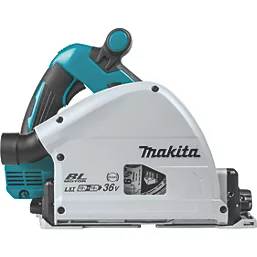
A track saw (often called a plunge saw) is a specialised variation of the circular saw designed specifically to lock onto an aluminium guide rail. Instead of resting its entire weight on the surface of the wood, the saw’s base features a precision groove that captures the rail, ensuring the blade travels in an unyielding straight line.
Crucially, track saws feature a plunge mechanism: the blade is fully enclosed inside the housing until you unlock it and plunge it straight down into the material.
- Primary Purpose: Flawless, splinter-free precision cuts in large sheet goods like plywood, MDF, and kitchen worktops.
- How It’s Guided: Permanently locked onto an interlocking aluminium track equipped with a rubber splinter guard.
- Pros: Absolute straight-line accuracy, zero tear-out on both sides of the cut, built-in plunge cutting (ideal for sink cut-outs), and superior dust extraction.
- Cons: More expensive, bulkier to store, and less suited for quick, dirty framing cuts or heavy joist trimming.
Key Differences at a Glance
| Feature | Standard Circular Saw | Track Saw (Plunge Saw) |
| Primary Job | Rough framing, timber cutting, general DIY | Precision sheet goods, cabinets, fitted furniture |
| Guiding Method | Freehand or clamped straightedge | Dedicated aluminium track / guide rail |
| Blade Action | Fixed depth relative to base plate | Plunge mechanism (starts retracted inside housing) |
| Cut Quality | Prone to splintering on top face without a fine blade | Splinter-free edges via the track’s rubber anti-tear strip |
| Mid-Panel Entry | Difficult / unsafe (requires kickback-prone plunge) | Safe, clean internal plunge cuts (e.g., sink apertures) |
| Price Point | Budget-friendly (£50 – £150) | Higher investment (£150 – £350+) |
When to Choose a Standard Circular Saw
For most DIY beginners, a standard circular saw is the logical first purchase. You should choose a circular saw if:
- You mostly cut timber and framing materials: If your projects involve building garden planters, cutting roofing battens, or trimming fence posts, a circular saw gives you fast, mobile power.
- You are on a sensible DIY budget: Standard circular saws cost significantly less than track saw systems, leaving room in your budget for extra batteries or quality blades.
- You only break down sheet goods occasionally: If you only need to chop a single sheet of plywood or MDF once or twice a year, a standard circular saw paired with a clamped straightedge or a shop-made guide gets the job done without buying specialized equipment.
(Learn how to set up straight cuts without a track in our guide on How to Cut Straight with a Circular Saw).
When to Choose a Track Saw
A track saw is a specialty tool for woodworkers and renovators who demand perfection on sheet materials. Consider investing in a track saw if:
- You build cabinets, fitted wardrobes, or fine furniture: When your project relies on exact 90-degree square panels where gaps are visible, a track saw eliminates wandering cut lines.
- You regularly process full 8×4 sheets alone: Breaking down heavy sheets of veneered plywood or kitchen worktops on the floor or a foam board is safer, faster, and infinitely more accurate with a track.
- Clean, splinter-free edges matter: The rubber anti-tear strip on a track acts as a zero-clearance barrier, preventing the laminate or wood veneer from chipping out along the cut line.
Can You Use a Standard Circular Saw Like a Track Saw?
If you like the idea of a track saw but already own a standard circular saw (or want to save money), you have options:
- Clamped Straightedge: Clamping a spirit level or straight timber across your board provides a reliable fence for your saw’s base plate to ride against.
- Universal Track Adapters: Third-party accessories (such as the Kreg Accu-Cut or universal guide rails) allow you to mount many standard circular saws onto a guided track system.
While these jigs take a bit longer to set up than a dedicated plunge track saw, they bridge the gap for occasional sheet cutting.
The Verdict: Which Should You Buy?
- Start with a circular saw if you are a beginner tackling general home maintenance, garden timber, and occasional DIY boards. It’s affordable, highly portable, and handles 80% of general household cutting tasks.
- Step up to a track saw if your workshop focus is cabinetry, custom shelving, or breaking down expensive veneered sheet materials where ragged edges ruin the finish.
Ready to compare models and features? Head back to our comprehensive Circular Saw Buying Guide for UK DIYers to explore power options, sizes, and top beginner recommendations.

About the Author: Enda McLarnon
I’m an experienced UK DIYer tackling renovation life inside a 1958 red brick home.
I built this blog to help beginners conquer home maintenance anxiety and save a fortune on expensive trade calls.