By Enda McLarnon — Experienced UK DIYer sharing practical fixes from my 1958 red brick home.
Buying a replacement circular saw blade in the UK should be simple, but that’s not always the case. With measurements given in millimetres, varying bore sizes, different tooth counts, and thin vs. standard kerfs, choosing the wrong blade can result in rough cuts, burnt wood, damaged tools, or even safety hazards.
When you’re replacing a blade on a circular saw, getting the right fit is crucial.
Below is a quick summary of standard UK circular saw blade sizes so you can grab the right specs fast.
Table of Contents
Quick Answer: Standard UK Circular Saw Blade Sizes
In the UK, saw blades are measured in millimeters by Outer Diameter × Bore (Arbor) Size.
- 160mm – 165mm (Bore: 20mm): Standard for cordless circular saws and plunge / track saws (Festool, Makita, DeWalt, Bosch).
- 184mm – 190mm (Bore: 30mm or 20mm): Standard for handheld corded circular saws and general site saws.
- 210mm – 216mm (Bore: 30mm): Compact table saws and benchtop mitre saws.
- 250mm – 260mm (Bore: 30mm): Full-sized jobsite table saws and sliding compound mitre saws.
- 305mm (Bore: 30mm): Large workshop table saws and heavy-duty 12″ mitre saws.
Rule of Thumb: Always check your saw’s guard label or instruction manual for the maximum outer diameter and exact bore size before purchasing. Never fit a blade with a larger diameter than your saw is rated for.
In my 50 years in the workshop, I’ve seen many beginners buy a blade that looks right, only to find it won’t fit the spindle or it’s too thick for their cordless saw to turn.This guide will show you exactly how to read a blade’s markings and find the perfect match for your specific saw.
If you are thinking of buying a circular saw but not sure about the size, then check out my guide what size circular saw do you need.
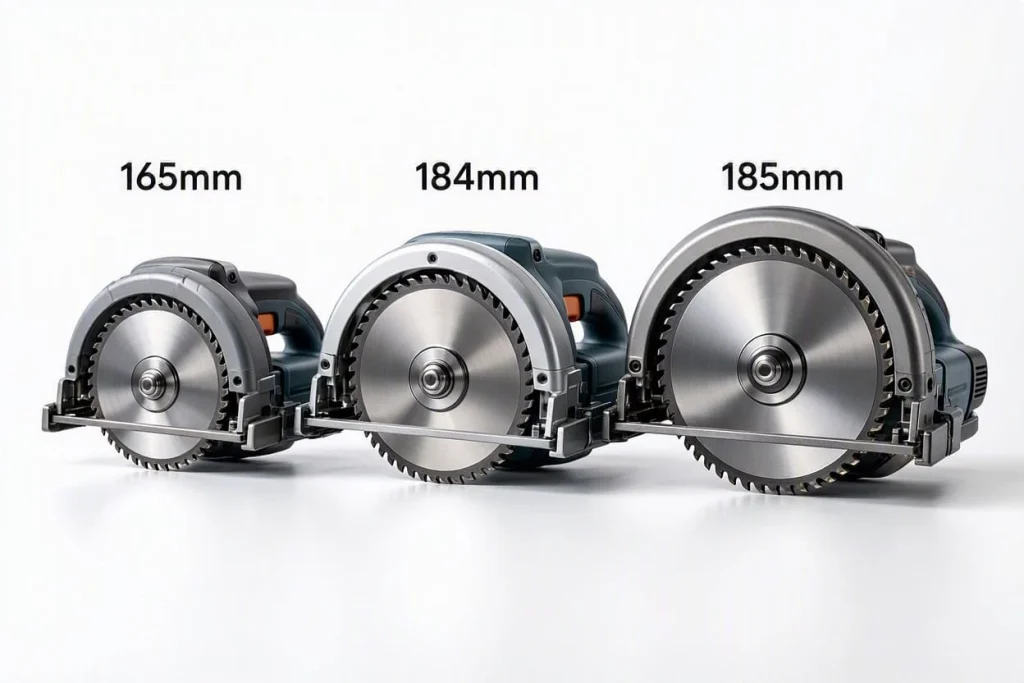
Comprehensive UK Size & Tool Compatibility Chart
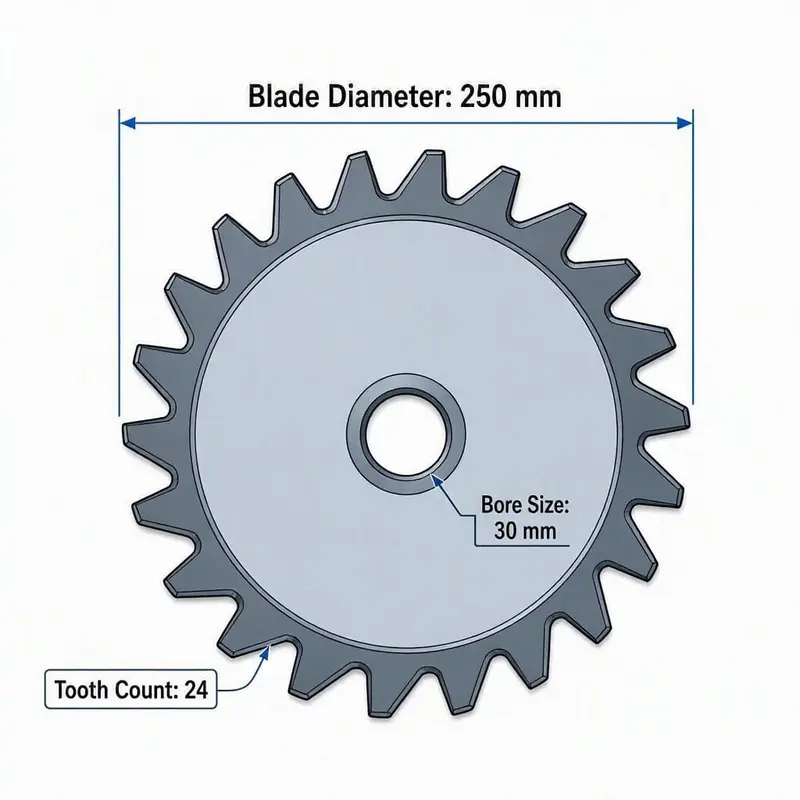
When buying a replacement blade in the UK, your saw requires three specific measurements:
- Outer Diameter (mm): The physical width of the blade.
- Bore Size / Arbor Hole (mm): The diameter of the centre hole that mounts to the saw shaft.
- Kerf (mm): The width of the teeth/cut (explained further down).
Below is the definitive size lookup chart for the most popular power tool brands sold in the UK (including DeWalt, Makita, Bosch, Festool, Evolution, and Milwaukee).
UK Circular Saw Blade Compatibility Matrix
| Saw Category | Outer Diameter (mm) | Standard UK Bore (mm) | Popular UK Examples | Primary Applications |
| Mini / Compact Trim Saws | 85mm – 120mm | 10mm or 15mm | Worx HandyCut, Bosch PKS 16, Erbauer Compact, Milwaukee M12 | Laminate flooring, thin ply, copper pipe, wall tiles, PVC |
| Sub-Compact Cordless Saws | 136mm – 150mm | 10mm or 20mm | Makita 12V Max, DeWalt Atomic 18V, Milwaukee M18 Trim | Light 1st & 2nd fix trimming, sheet goods, roof battens |
| Standard Cordless Circular Saws | 165mm | 20mm | Makita LXT/XGT, DeWalt XR 18V, Bosch Professional | Framing (2×4 C16/C24), plywood, general site carpentry |
| Plunge / Track Saws | 160mm – 165mm | 20mm | Festool TS55, Makita SP6000, DeWalt DWS520, Milwaukee M18 | Precision sheet material cutting, kitchen worktops, doors |
| Corded Handheld Circular Saws | 184mm – 190mm | 30mm (or 20mm) | DeWalt DWE575, Makita HS7601, Bosch GKS 190 | Deep joist cutting, heavy framing timber, thick sleepers |
| Compact Mitre & Table Saws | 210mm – 216mm | 30mm | DeWalt DWS774/DCS777, Evolution R210, Metabo | Architrave, skirting boards, studwork, bench DIY saws |
| Site Table Saws (10″) | 250mm – 254mm | 30mm | DeWalt DWE7492, Bosch GTS 10 XC, Makita MLT100 | Rip cuts through solid hardwood, continuous sheet sizing |
| Sliding Compound Mitre Saws (10″) | 254mm – 260mm | 30mm | Makita LS1019L, DeWalt D780, Bosch GCM 10 | Wide board cross-cutting, 2nd-fix trim, hardwood moldings |
| Heavy Workshop Machinery (12″) | 305mm | 30mm | DeWalt DHS780, Makita LS1219L, Festool Kapex KS120 | Heavy timber posts, structural beams, deep compound mitres |
You may also want to read my guide on the best circular saw blades for DIY.
How Blade Diameter Directly Controls Cutting Depth
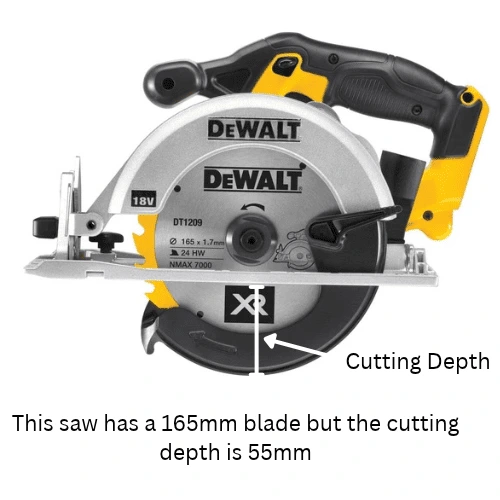
The outer diameter of your blade determines how deep your saw can physically cut into timber. Because the saw’s motor housing and mounting arbor flange take up space, your maximum cutting depth is slightly less than one-third of the blade’s outer diameter.
Here is what that looks like in practical UK timber sizes:
- 85mm – 120mm Mini Saws: ~16mm to 27mm cut depth. Perfect for cutting 18mm sheet materials, 12mm floorboards, or thin cladding.
- 165mm Blade: ~54mm to 57mm cut depth at 90°. This is the “sweet spot” for site joiners—it allows you to cleanly slice through standard UK C16/C24 2″ timber (47mm thick) in a single pass.
- 190mm Blade: ~62mm to 66mm cut depth at 90°. Gives you extra clearance when tilting the saw to a 45° bevel angle through 47mm timber.
- 216mm Mitre Saw Blade: ~65mm to 70mm vertical capacity. Easily handles standard 150mm (6″) skirting boards on edge.
- 250mm / 254mm Table Saw Blade: ~80mm to 85mm cut depth. Cuts through thick fence posts, sleepers, or double-stacked sheet material.
Rule of Thumb for Bevel Cuts: Tilting your saw blade to 45 degrees reduces your maximum cutting depth by roughly 30%. If you regularly bevel-cut 47mm joists, upgrade from a 165mm saw to a 190mm model so the blade can pass completely through the timber.
Note: If you need to cut a 2″x4″ (50.8mm x 101.6mm) with a circular saw, the recommended blade size is typically 7 1/4 inches (190mm) in diameter.
I have gone into cutting depth in a lot more detail in my article called how deep can a circular saw cut.
Critical Sizing & Safety Rules
⚠️ Warning: Never Over-size Your Blade
- Outer Diameter: You must never fit a blade larger than your saw’s rated maximum capacity. An oversized blade will rub against the internal blade guard or casting, posing a serious fire and impact hazard. Using a slightly smaller blade (e.g., a 160mm blade on a 165mm saw) is safe, but it reduces your maximum cutting depth.
- Bore Fit: The central bore must match your saw’s mounting spindle precisely. A loose bore causes extreme vibration, off-center rotation, and severe danger.
Enda’s Tip: In my experience, picking the right diameter and bore size ensures the blade will fit your saw. Always best to bring an old blade with you just to be sure. After that, it’s just the tooth count as explained above.
Understanding Kerf Thickness: Thin Kerf vs. Standard Kerf

When picking a circular saw blade in the UK, sizing isn’t just about the diameter and the bore, you also need to pay close attention to the kerf thickness.
What is Blade Kerf?
The kerf refers to the physical width of the cut created by the tungsten carbide teeth (TCT) as the blade passes through material. It determines how much wood is removed and turned into sawdust. In simpler terms it’s the width of the blade.
In the UK market, blades generally fall into two main kerf categories:
- Thin Kerf (~1.4mm to 1.8mm): Features narrower carbide teeth and a thinner steel body plate.
- Standard Kerf (~2.4mm to 3.2mm): Features traditional, thicker teeth on a heavy-duty steel plate for maximum rigidity.
Thin Kerf vs. Standard Kerf: Which Do You Need?
| Feature | Thin Kerf (1.4mm – 1.8mm) | Standard Kerf (2.4mm – 3.2mm) |
| Primary Power Source | Cordless Battery Saws (18V / 54V) | Corded Mains Saws (240V / 110V) & Bench Machinery |
| Motor Resistance | Very Low (Cuts faster with less strain) | Moderate to High |
| Battery Consumption | Up to 30% longer runtime per charge | Higher battery drain |
| Blade Flex / Deflection | Slight risk on deep cuts in heavy timber | Zero flex; rigid, true straight lines |
| Material Loss | Minimal waste (Ideal for expensive hardwoods) | Standard waste |
1. Why Choose Thin Kerf? (The Cordless Standard)
If you are running a cordless circular saw (such as a Makita LXT, DeWalt XR, or Milwaukee M18), thin kerf is almost mandatory.
Because the blade removes less material per second, the saw engine encounters significantly less resistance. This keeps the motor running cool, prevents thermal overload shutdowns on site, and gives you noticeably more cuts per battery charge.
2. Why Choose Standard Kerf? (The Workshop Standard)
For mains-powered (110V/240V) circular saws, jobsite table saws, and large sliding compound mitre saws, standard kerf is usually the better choice.
Because mains power supplies unlimited energy, battery life isn’t a concern. The thicker steel body of a standard kerf blade resists flexing and warping under heavy heat and pressure, delivering dead-straight, wobble-free cuts through dense oak, thick joists, or continuous sheet materials.
⚠️ Crucial Safety Note: Check Your Riving Knife!
Before changing your kerf width, you must check your saw’s riving knife (the vertical metal safety fin located directly behind the blade that prevents dangerous kickback).
For safe operation, your blade measurements must follow this golden rule:
(Blade Plate Thickness) < {Riving Knife Thickness} < {Kerf Width}
- If your kerf is too thin: The wood will pinches against the wider riving knife as it exits the blade, causing the material to bind, stall, or kick back toward the operator.
- If your kerf is too thick: The riving knife won’t prevent the cut timber from closing in behind the blade plate, increasing kickback risk.
💡 Pro Tip: Modern UK track saws and cordless handheld saws have thin riving knives built specifically for thin-kerf blades. Older site saws and cast-iron workshop table saws often have thicker riving knives designed exclusively for standard 2.8mm–3.2mm kerf blades. Always check the stamped millimeter thickness on your riving knife before buying!
Tooth Counts & Tooth Geometry: Choosing the Right Cut
Once you have identified the correct outer diameter, bore size, and kerf for your saw, the final specification to choose is the tooth configuration.
The number of teeth on a circular saw blade (indicated by T, such as 24T, 48T, or 80T) determines how fast the blade cuts and how smooth the final finish will be.
Part 1: Choosing the Right Tooth Count
As a general rule: fewer teeth mean faster, rougher cuts, while more teeth mean slower, cleaner cuts.
- 16T – 24T – Rip Cutting – Fast and rough
- 40T – 48T – General purpose cutting
- 60T – 80T+ – Fine Clean Cutting – for laminates and cross cutting
1. Low Tooth Count (16T – 24T): Ripping & Fast Framing
- Best For: Fast longitudinal cuts along the natural grain of solid timber (ripping), studwork framing, roof rafters, and rough site work.
- Why it Works: Blades with fewer teeth feature large gullets (the deep slots between teeth). These wide gullets clear large wood chips quickly, allowing the saw to feed through thick timber effortlessly without burning the wood or overheating the motor.
2. Medium Tooth Count (36T – 48T): General Purpose & Sheet Goods
- Best For: Cross-cutting timber (cutting across the grain), plywood, OSB, MDF, and general 2nd-fix carpentry.
- Why it Works: This is the ultimate “all-rounder” setup for site carpenters and DIYers. It offers a balanced compromise between cutting speed and a clean edge with minimal splintering.
3. High Tooth Count (60T – 80T+): Fine Finish & Delicate Materials
- Best For: Kitchen worktops, double-sided laminates, veneers, architrave, skirting boards, plastics, and non-ferrous metals (aluminium trims).
- Why it Works: The closely spaced teeth take tiny, precise bites out of the material. This produces a smooth, razor-clean cut with virtually zero breakout or tear-out on delicate surface coatings.
Part 2: Understanding Tooth Geometry (ATB vs. TCG vs. FTG)
The shape and angle of the tungsten carbide tips (TCT) affect how the blade shears through different materials. In the UK, you will encounter three primary tooth profiles:
| Tooth Profile | Acronym | Tooth Design / Action | Best Used For |
| Alternate Top Bevel | ATB | Teeth alternate between left-facing and right-facing angles to shear wood fibers cleanly like a knife. | General wood cutting, plywood, MDF, and cross-cutting. (Most common) |
| Triple Chip Grind | TCG | Alternates between a flat “raker” tooth and a higher trapezoidal tooth to balance cutting stress. | Laminates, composite worktops, acrylics, plastic, and non-ferrous metals. |
| Flat Top Grind | FTG | Square-topped teeth that chisel away material like a flat wood chisel. | Pure rip cutting along the grain on table saws. |
💡 Quick Selection Guide for Your Project
- Framing & Construction Timber (Structural): 165mm – 190mm Blade | 16T – 24T ATB
- Track Saw Sheet Goods (Plywood / MDF): 160mm – 165mm Blade | 40T – 48T ATB
- Mitre Saw Skirting & Architrave: 216mm – 305mm Blade | 48T – 60T ATB
- Laminate Kitchen Worktops: 160mm – 260mm Blade | 48T – 80T TCG
Bore Reduction Rings & Safety Guidelines
One of the most common issues UK tool users face when buying replacement blades is finding a blade with the perfect outer diameter and tooth count, but with a bore size that is larger than their saw’s arbor shaft.
For example, you might find a fantastic deal on a 165mm blade with a 30mm bore, but your cordless handheld saw has a 20mm arbor shaft.
Can you make it fit? Yes, but only if you use a precision bore reduction ring correctly and safely.
What is a Bore Reduction Ring?
A bore reduction ring (also known as a reducing washer, spacer ring, or bushing ring) is a precision-machined metal spacer designed to sit inside the center hole of a larger blade bore. It steps down the inner diameter so the blade sits perfectly centered on your saw’s smaller spindle shaft.
Popular UK Reduction Conversions:
- 30mm to 20mm: The most common conversion (adapting larger workshop/table saw blades to fit 20mm handheld or track saws).
- 30mm to 16mm (or 5/8″): Adapting standard UK blades to fit smaller vintage DIY saws or imported US tools.
- 20mm to 16mm: Common for compact cordless circular saws.
⚠️ Strict Safety Rules for Using Reduction Rings
Using an improper ring or fitting one incorrectly can lead to dangerous blade wobble, off-center rotation, severe vibration, or catastrophic blade failure while cutting. Always observe the following rules:
1. Precision Flange Clamping is Mandatory
A reduction ring does not hold the blade in place by friction alone. The ring’s only job is to center the blade on the shaft. The saw’s outer clamping flanges must overlap both the ring and the body plate of the circular saw blade securely.
2. Match the Ring Thickness to the Blade Plate
The reduction ring must never be thicker than the blade’s steel body plate. If the ring protrudes beyond the thickness of the blade plate, the saw’s arbor bolt will clamp down on the ring instead of the blade itself, leaving the blade loose and free to spin independently!
3. Never Stack Multiple Rings
Never use two thin rings together to make up a wider gap, or attempt to modify loose hardware store washers. Always use a single, purpose-built, high-precision ring from a reputable brand (such as Trend, Freud, or Saxton).
4. Check for Stepped Flanges
Some modern saws come with reversible internal arbor flanges that accommodate both 20mm and 30mm bores natively. Always check your saw’s original mounting flange components—you might already have a built-in step adapter!
🛠️ Summary Checklist Before Powering Up:
- Ensure the saw is unplugged or the battery is removed.
- Clean any sawdust or pitch build-up from the inner and outer arbor flanges.
- Press the reduction ring flush into the blade bore.
- Mount the blade onto the arbor shaft, ensuring the teeth face the correct direction of rotation (indicated by the arrow on the guard).
- Tighten the arbor bolt securely, and hand-spin the blade (with power disconnected) to verify there is zero wobble or contact with safety guards.
Summary & Quick Buying Checklist
Choosing the right circular saw blade in the UK comes down to four basic steps. Before you hit “buy” or head to the tool shop, run through this quick checklist:
📋 The 4-Step Blade Selection Checklist
- Check Outer Diameter (mm): Look at your saw’s guard label or manual. Buy the exact recommended diameter (e.g., 165mm, 190mm, 216mm, or 254mm). Never exceed the maximum size.
- Match the Bore Size (mm): Ensure the center hole matches your spindle shaft (commonly 20mm for handheld/track saws and 30mm for table/mitre saws). If using a reduction ring to step down a larger bore, ensure it is precision-machined and flush with the blade plate.
- Choose the Kerf Thickness:
- Thin Kerf (~1.4mm – 1.8mm): Essential for battery-powered cordless saws to preserve battery life and motor performance.
- Standard Kerf (~2.4mm – 3.2mm): Ideal for mains-powered (110V/240V) saws, heavy hardwoods, and table saws to eliminate blade flex.
- Select Tooth Count & Geometry:
- 16T – 24T (ATB): Fast ripping along timber grain.
- 36T – 48T (ATB): General purpose cross-cutting, sheet ply, and OSB.
- 60T – 80T (ATB / TCG): Fine finish, kitchen worktops, laminates, and non-ferrous metals.
Frequently Asked Questions (FAQ)
Q: Can I put a 165mm blade on a 190mm circular saw?
A: Technically yes, provided the bore size matches. However, it will reduce your maximum depth of cut, and the safety guard may not cover the blade properly at full retraction. It is always best practice to use the size specified by your tool manufacturer.
Q: What happens if I use a 20mm bore blade on a 5/8″ (15.88mm) US arbor?
A: The 20mm blade bore will be slightly too large for the 15.88mm arbor. The blade will fit off-center, causing severe vibration, wobble, and extreme danger. You would need a 20mm-to-15.88mm (5/8″) reduction ring to use it safely.
Q: Why is my saw burning the wood when I cut?
A: Burning usually happens for three reasons:
- You are using a high tooth count blade (e.g., 60T) for ripping long solid timber cuts instead of a fast 24T rip blade.
- The blade is dull or coated in resin build-up.
- You are pushing the saw too slowly, causing excessive friction.
Conclusion & Final Thoughts
Matching the right blade diameter, bore, kerf, and tooth count guarantees cleaner cuts, extends your power tool’s life, and keeps you safe on site or in the workshop. Keep this guide bookmarked for the next time you need to grab a replacement TCT blade!
Ready to see how all these factors fit together? Head back to our comprehensive Circular Saw Buying Guide for UK DIYers to compare power options, sizes, and top beginner recommendations.”
Blade size affects everything from cut depth to finish quality. Whether you’re trimming laminate or ripping timber, choosing the right blade ensures clean results and safe operation. Always check your saw’s specs before buying—and don’t forget to match the bore.

About the Author: Enda McLarnon
I’m an experienced UK DIYer tackling renovation life inside a 1958 red brick home.
I built this blog to help beginners conquer home maintenance anxiety and save a fortune on expensive trade calls.