
If you’re wondering what size circular saw do I need for your DIY projects, the good news is that choosing the right size is simpler than it first appears.
You’ll often see circular saws described by their blade size, such as 165mm, 184mm or 185mm, but what do those numbers actually mean?
The blade size affects how deeply the saw can cut, but bigger doesn’t automatically mean better. The right size depends on the materials you want to cut, the type of DIY projects you have planned and how easy you want the saw to be to handle.
For most DIY beginners, a compact circular saw with a 165mm blade can be more than enough for everyday jobs such as cutting timber, boards and sheet materials. Larger 184mm or 185mm saws can offer greater cutting capacity, which can be useful when working with thicker timber.
In this guide, we’ll explain circular saw sizes in straightforward terms. We’ll look at 165mm, 184mm and 185mm saws, how blade size affects cutting depth, what each size can realistically cut and which option is likely to suit different DIY projects.
By the end, you’ll have a much clearer idea of what size circular saw you need and what to look for before buying one.
Quick Answer
For most DIY beginners, a 165mm circular saw is a good all-round choice. It is compact, relatively easy to handle and provides enough cutting depth for many common DIY jobs. If you regularly need to cut thicker timber, a 184mm or 185mm circular saw can be a better choice because the larger blade generally provides greater maximum cutting depth.
The important thing is not simply to choose the biggest saw. Check the maximum cutting depth at 90° and 45° and make sure it is suitable for the materials you expect to cut.
In simple terms:
- 165mm — best for general DIY and easier handling
- 184–185mm — better when you need greater cutting capacity
- Bigger isn’t automatically better — choose the size that matches your projects
What Size Circular Saw Do I Need?
When a circular saw is described as a 165mm, 184mm or 185mm saw, the number normally refers to the diameter of the blade the saw is designed to use.
For example, a 165mm circular saw uses a blade that is approximately 165mm in diameter.
The blade diameter is important because it affects the maximum depth the saw can cut. In general, a larger blade can provide greater cutting depth, although the actual capacity also depends on the design of the saw and how far the blade can be adjusted.
Does a larger blade always mean a better saw?
No. A larger circular saw can cut deeper, but that doesn’t necessarily make it the best choice for DIY. A larger saw may also be heavier or less compact, while a smaller 165mm model can be easier to control and more convenient for general DIY work.
For example, if you’re mainly cutting timber for shelving, flooring, garden projects or making simple furniture, you may not need the extra cutting depth provided by a larger saw.
What does cutting depth mean?
Cutting depth is the maximum thickness of material the saw can cut through in a single pass. You’ll normally see this specification given at two different angles:
- 90° cutting depth — the maximum depth when making a normal straight cut.
- 45° cutting depth — the maximum depth when making a bevel or angled cut.
The cutting depth at 45° is usually less than at 90° because tilting the base of the saw changes the position of the blade in relation to the material.
This is why it’s important to look at the actual cutting-depth specifications rather than choosing a saw based only on its blade diameter.
Why blade size matters for DIY
For most beginners, the easiest way to think about circular saw size is:
Blade size → cutting capacity → suitable materials and projects
A 165mm saw can be an excellent all-round option for many DIY jobs, while a 184mm or 185mm model may be more useful when you regularly need to cut thicker material.
If you’re still unsure which features and specifications to look at, my circular saw buying guide that explains the main things to consider when choosing a saw.
The best size is therefore the one that gives you enough cutting capacity for your projects without choosing a larger and potentially heavier saw than you actually need.
165mm vs 184mm vs 185mm Circular Saws
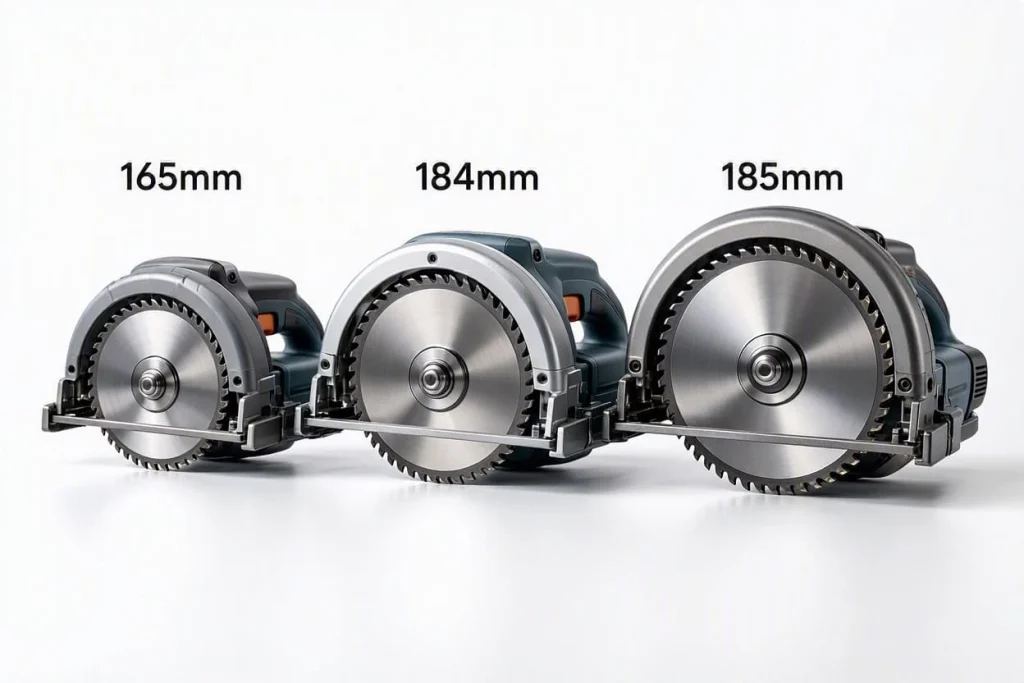
The three circular saw sizes you’re most likely to come across when shopping for DIY tools are 165mm, 184mm and 185mm.
The differences can seem confusing at first, but the basic idea is simple: the larger blades can generally provide greater cutting capacity, while smaller saws can be more compact and easier to handle.
165mm circular saws
A 165mm circular saw is a popular size for cordless DIY tools. Many 165mm models offer a maximum cutting depth of around 55–57mm at 90°, although the exact figure varies slightly between models.
For many DIY projects, this is plenty of capacity. A 165mm saw can be suitable for cutting:
- Timber for shelving
- Floorboards and boards
- Construction timber
- Sheet materials
- Wooden worktops, depending on thickness
- General DIY timber projects
The main advantage is that these saws can be relatively compact and easy to handle. For a beginner who doesn’t regularly cut very thick timber, a good 165mm saw can be an excellent all-round choice.
184mm circular saws
184mm circular saws are often found among larger cordless circular saws. Depending on the model, you may see cutting depths of around 60–65mm at 90°.
That extra capacity can be useful when working with thicker timber or when you want a little more flexibility from the saw.
A larger saw doesn’t necessarily mean it will produce better cuts, though. The blade quality, motor, cutting depth adjustment and your choice of blade all have an important role to play.
185mm circular saws
185mm is another common size, particularly among corded circular saws. For example, some 185mm models offer around 60–65mm of cutting depth at 90°, making them suitable for a wide range of DIY and construction work.
The difference between a 184mm and 185mm blade is extremely small in practical terms. You shouldn’t choose one over the other simply because of that 1mm difference.
Instead, compare the actual cutting depth, weight, motor, features and intended use of the complete saw.
Quick comparison
| Blade size | Typical cutting depth at 90°* | Best suited to |
|---|---|---|
| 165mm | Around 55–57mm | General DIY and easier handling |
| 184mm | Around 60–65mm | Larger DIY projects and thicker timber |
| 185mm | Around 60–65mm | General DIY and heavier cutting |
*These are typical ranges rather than fixed specifications. Always check the manufacturer’s stated cutting depth for the particular saw you’re considering.
Which size should you choose?
For most DIY beginners, 165mm is a sensible starting point if you mainly expect to cut standard timber, boards and sheet materials.
If you regularly work with thicker timber or simply want greater cutting capacity, an 184mm or 185mm saw may be more suitable.
The important thing is to choose based on your actual projects rather than assuming that the largest blade will automatically give you the best circular saw.
Circular Saw Blade Size and Cutting Depth
When choosing a circular saw, maximum cutting depth is one of the most important specifications to check.
The blade diameter gives you a useful indication of the saw’s size, but the actual cutting depth tells you what the saw can realistically cut through.
Cutting depth at 90°
The 90° cutting depth is the maximum thickness of material the saw can normally cut when the blade is positioned straight down. This is the figure you’ll probably use most often for everyday DIY.
For example, a circular saw with a maximum cutting depth of 57mm at 90° can theoretically cut through material up to around 57mm thick in a single pass.
However, it’s sensible not to choose a saw that is only just capable of cutting the material you need. Having some extra capacity gives you more flexibility for different projects.
Cutting depth at 45°
The 45° cutting depth is the maximum thickness the saw can cut when the blade is tilted for a bevel cut. Because the blade is angled, the cutting depth is normally lower than it is at 90°.
For example, a saw might have:
| Cutting angle | Example maximum depth |
|---|---|
| 90° | 57mm |
| 45° | 41mm |
These figures are only an example. Actual cutting depths vary between saws, so always check the manufacturer’s specifications before buying.
Why cutting depth matters
Imagine you regularly work with timber that is around 50mm thick.
- A saw with a 40mm maximum cutting depth at 90° would not be suitable for making that cut in one pass.
- A saw with a 55–60mm cutting capacity would give you considerably more flexibility.
This is why checking cutting depth is more useful than simply choosing a larger blade.
Does cutting depth need to match the material exactly?
Not necessarily. If your thickest regular material is 40mm, you don’t necessarily need a saw with exactly 40mm of cutting capacity. Having some additional capacity can be useful if you take on different projects in the future.
On the other hand, there’s little benefit in buying a much larger and heavier saw simply because it has a greater cutting depth that you are unlikely ever to use.
Remember that cutting depth can change
The maximum cutting depth is normally quoted at a particular blade angle, and changing the bevel angle reduces the available depth.
The type of blade can also affect the practical cutting performance, while the condition of the blade and the material being cut will affect how easily the saw works.
For beginners, the simplest approach is to check the manufacturer’s stated cutting depth at both 90° and 45°, then compare those figures with the materials you expect to cut.
That will give you a much better idea of whether a circular saw is suitable for your DIY projects than blade diameter alone.
What Can a 165mm Circular Saw Cut?
A 165mm circular saw is often a very practical choice for DIY because it offers a useful balance between cutting capacity, size and ease of handling.
The exact cutting depth varies between models, but many 165mm saws provide around 55–57mm of cutting depth at 90°. That is enough for a wide range of everyday DIY materials and projects.
Timber and construction wood
A 165mm saw can comfortably handle many common timber-cutting jobs, provided the material is within the saw’s maximum cutting capacity. This can include:
- Softwood boards
- Construction timber
- Timber for shelving
- Wooden battens
- Floorboards
- Some thicker wooden boards, depending on their thickness
Always check the actual thickness of the material against the saw’s specified cutting depth before starting a cut.
Sheet materials
A 165mm circular saw is also well suited to cutting sheet materials such as:
- Plywood
- OSB
- MDF
- Chipboard
- Other suitable wood-based panels
For large sheets, the saw’s relatively compact size can make it easier to move around the workpiece.
Using the correct blade is particularly important when cutting sheet materials. A suitable fine-tooth blade can produce a cleaner finish than a general-purpose construction blade.
What about thicker timber?
This is where the limitations of a 165mm saw become more noticeable. If you regularly need to cut timber that is close to or greater than the saw’s maximum cutting depth, a larger 184mm or 185mm circular saw may be a better choice.
You should never assume that a saw can cut through a particular thickness simply because the blade looks large enough. Always check the manufacturer’s stated cutting depth.
Is 165mm enough for most DIY?
For many DIY beginners, yes. If your projects mainly involve standard timber, boards and sheet materials, a good 165mm circular saw can provide plenty of capacity.
It can also be easier to handle than a larger saw, which is useful when you’re learning to make controlled, accurate cuts.
The important thing is to consider the materials you actually expect to work with. If you rarely cut thick timber, paying extra for a larger saw purely for its additional cutting depth may not provide much practical benefit.
When should you consider a larger saw?
A larger circular saw may be worth considering if you regularly:
- Cut thicker construction timber
- Work on larger building projects
- Need more than around 55–57mm of cutting depth
- Make frequent heavy-duty cuts
- Want additional cutting capacity for future projects
For general DIY, however, a 165mm saw shouldn’t be dismissed simply because larger sizes are available. For many homeowners and DIY beginners, it can be more than capable of handling the jobs they are likely to encounter.
What Can a 184mm or 185mm Circular Saw Cut?
If you regularly work with thicker timber, a 184mm or 185mm circular saw can give you more cutting capacity than a typical 165mm model. The exact specification varies between saws, but many models in this size range offer around 60–65mm of cutting depth at 90°.
That extra few millimetres can make a difference when you’re working with thicker materials.
Thicker timber
One of the main reasons to choose a larger circular saw is the ability to cut thicker timber in a single pass. Depending on the particular saw, a 184mm or 185mm model may be suitable for:
- Larger construction timber
- Thicker softwood boards
- Timber used for garden projects
- Heavier DIY building work
- Other materials within the saw’s maximum cutting capacity
As always, check the manufacturer’s stated cutting depth rather than relying on the blade diameter alone.
Sheet materials
Larger circular saws can also cut sheet materials such as plywood, OSB, MDF and chipboard. However, the extra cutting capacity isn’t necessarily an advantage when you’re cutting relatively thin sheets.
If most of your projects involve standard sheet materials, a 165mm saw may already provide everything you need.
When does the extra capacity become useful?
The additional cutting depth becomes particularly useful when the material you’re working with is too thick for a smaller saw to cut comfortably in one pass.
For example, if you regularly work with timber around 60mm thick, a saw capable of cutting around 60–65mm at 90° gives you more flexibility than a typical 165mm model with a cutting depth around the mid-50mm range.
This doesn’t mean that you should always choose the larger saw. It simply means that you should match the saw’s capacity to the work you expect to do.
Are larger saws harder to use?
Not necessarily, but larger circular saws can be heavier and may feel less compact than smaller models. For a beginner, this is worth considering.
If you only need the extra cutting depth occasionally, the additional size and weight may not be worth it. But if you regularly cut thicker timber, the greater capacity can make the larger saw a much more practical choice.
184mm vs 185mm — does it really matter?
For most DIYers, there is very little practical difference between a 184mm and 185mm blade.
The 1mm difference in blade diameter isn’t something you need to worry about when choosing between complete saws. Instead, compare the actual specifications of the models you’re considering, including:
- Maximum cutting depth
- Weight
- Motor performance
- Bevel adjustment
- Blade availability
- Corded or cordless operation
- Overall handling
The important question isn’t whether the blade is 184mm or 185mm. It’s whether the complete saw provides enough capacity for your projects and feels comfortable to use.
What Size Circular Saw Is Best for Beginners?
For most DIY beginners, a 165mm circular saw is a sensible all-round choice. It offers enough cutting capacity for many common DIY jobs while generally being compact and manageable enough for someone who is still getting used to using a circular saw.
However, that doesn’t mean every beginner should automatically buy a 165mm model. The right size depends on the type of projects you expect to tackle.
Why 165mm is a good starting point
A 165mm circular saw can be a good balance between cutting capacity and ease of handling. Many models provide around 55–57mm of cutting depth at 90°, which is enough for a wide range of timber and sheet-material projects.
For example, a beginner might use a 165mm saw for:
- Building shelves
- Cutting boards and panels
- Making garden projects
- Cutting floorboards
- Cutting construction timber
- DIY furniture projects
If most of your work falls into this category, there’s often little reason to choose a much larger saw.
When should a beginner choose 184mm or 185mm?
A larger saw can make sense if you already know that you’ll be working with thicker timber. If your projects regularly involve materials around 60mm or more, the additional cutting capacity offered by some 184mm and 185mm models could be useful.
It’s also worth considering a larger saw if you’re planning more substantial building or renovation projects where you’ll regularly make deeper cuts.
Don’t buy more saw than you need
It’s easy to assume that a larger blade and greater cutting capacity must mean a better circular saw. For beginners, this isn’t necessarily true.
A larger saw may be heavier, less compact and more tiring to use during a long project. If you rarely need its additional cutting capacity, you could be carrying extra weight without gaining much practical benefit.
Instead, think about the thickest material you’re realistically likely to cut and choose a saw that provides enough capacity for that work.
What if you’re not sure?
If you’re buying your first circular saw and don’t have any particularly demanding projects planned, 165mm is a safe starting point for many DIYers.
It gives you useful cutting capacity without going unnecessarily large. If you later discover that you regularly need to cut thicker timber, you can always consider a larger saw for those particular jobs.
The best beginner circular saw isn’t necessarily the biggest one. It’s the one that gives you enough cutting capacity while remaining comfortable and controllable to use.
If you’re looking for specific models rather than just choosing the right blade size, see my guide to the best circular saw for DIY in the UK.
Does a Bigger Circular Saw Mean More Power?
It’s easy to assume that a larger circular saw must also be more powerful, but blade size and motor power are not the same thing.
A larger blade can provide greater cutting depth, but the performance of the complete saw depends on several other factors, including the motor, battery or mains supply, blade and overall design.
Blade size and cutting capacity
The main advantage of a larger blade is usually greater cutting capacity. A 184mm or 185mm saw can often cut deeper than a 165mm model, making it more suitable for thicker timber.
However, that doesn’t automatically mean it will cut thin timber faster or produce a better finish. A good 165mm circular saw with a suitable blade can perform extremely well for general DIY.
Motor power matters too
With corded circular saws, you’ll often see power specified in watts (W). With cordless models, manufacturers commonly specify the battery voltage, such as 18V, although voltage alone doesn’t tell you how powerful the saw will be.
Two 18V cordless saws can have noticeably different performance depending on their motors, electronics, battery technology and design. This is why you shouldn’t compare circular saws using a single specification.
The blade makes a big difference
The blade fitted to the saw can have a major effect on cutting performance. A sharp blade designed for the material you’re cutting can make the saw feel much more capable than an unsuitable or worn blade.
For example, a blade designed for fast construction cuts may be very different from one designed to produce a cleaner finish in plywood or other sheet materials.
Bigger isn’t always better
For a beginner, choosing the largest circular saw available isn’t necessarily the best approach. A larger saw may provide more cutting capacity, but it can also be heavier and less convenient to handle.
If your projects don’t require the additional cutting depth, a smaller saw may actually be the more practical choice.
Think of it this way:
Blade size determines much of the cutting capacity, while the motor, blade and overall design determine how effectively the saw performs.
When comparing circular saws, look at the complete package rather than assuming that the biggest blade or highest power figure automatically makes one model better.
Which Circular Saw Size Is Best for Different DIY Jobs?
The best circular saw size depends largely on the type of DIY work you expect to do. Rather than choosing a blade size simply because it is bigger, think about the materials you are likely to cut and how much cutting capacity you actually need.
| DIY Job / Material | Typical Size | Imperial Size | Recommended Saw Size | Why |
|---|---|---|---|---|
| Shelving and small boards | 18–25mm | ¾–1″ | 165mm | Plenty of capacity and easy to handle |
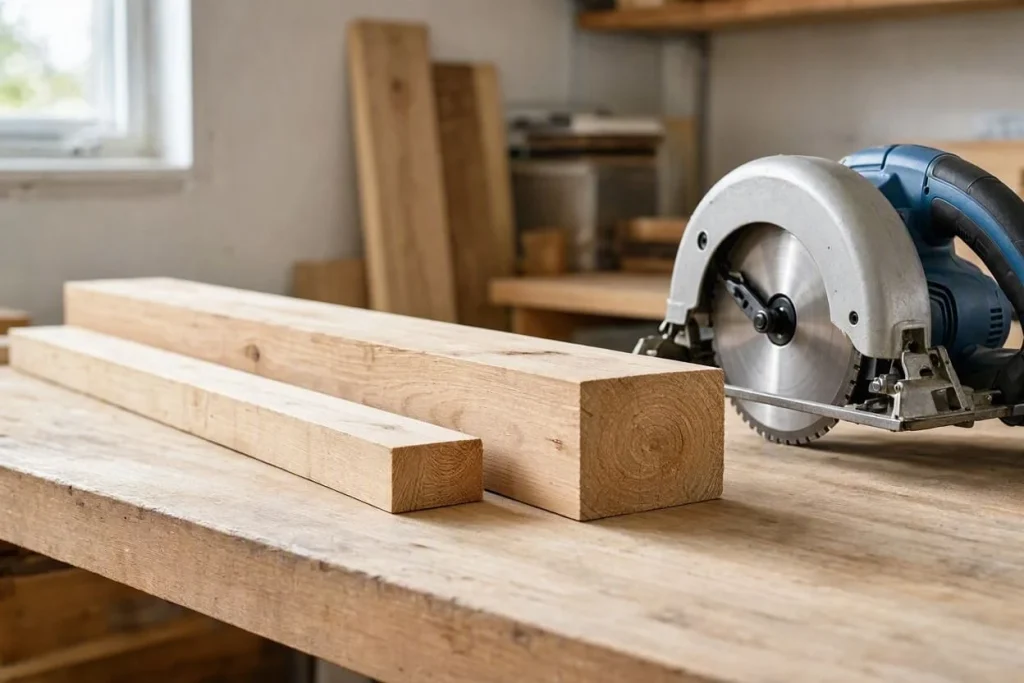
| 2″ × 1″ timber | 25 × 50mm | 1″ × 2″ | 165mm | Easily within the cutting capacity of most 165mm saws |
| 4″ × 2″ timber | 50 × 100mm | 2″ × 4″ | 165mm or 184–185mm | 165mm can cut it in one pass on suitable models, but check actual cutting depth |
| Plywood, OSB and MDF | 12–25mm | ½–1″ | 165mm | More than enough capacity for typical sheet materials |
| Floorboards | 18–22mm | Approx. ¾–⅞” | 165mm | Compact and easy to control |
| Decking boards | 25–32mm | Approx. 1–1¼” | 165mm | Good capacity for standard decking boards |
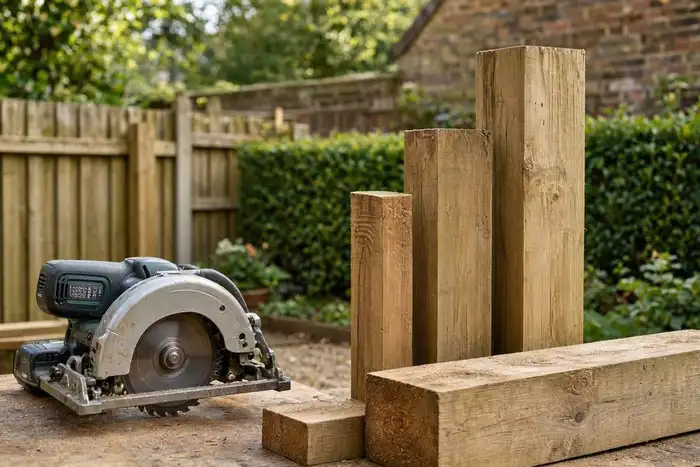
| Decking posts | 75–100mm+ | Approx. 3–4″+ | 165mm or 184–185mm | Depends on the actual post dimensions and required cutting depth |
| Fence posts | 75–100mm+ | Approx. 3–4″+ | 184–185mm | Larger saws can provide useful extra cutting capacity |
| Thicker construction timber | 50–100mm+ | 2–4″+ | 184–185mm | Greater cutting depth gives more flexibility |
| Large garden projects | 50–100mm+ | 2–4″+ | 184–185mm | Useful when regularly cutting larger timber |
| Heavy renovation/building work | 50–100mm+ | 2–4″+ | 184–185mm | Better suited to thicker materials |
| General household DIY | Mixed | Mixed | 165mm | A good all-round balance of size, capacity and handling |
Timber dimensions are typical examples rather than guaranteed sizes. Actual dimensions can vary between products, particularly for fence and decking posts. Always measure the material and check the circular saw’s maximum cutting depth before starting a cut.
165mm for general DIY
For many homeowners and DIY beginners, 165mm is the most versatile choice. It can handle a wide range of everyday jobs without being unnecessarily large or heavy.
If you’re building shelves, cutting boards, making simple furniture or working with sheet materials, a good 165mm circular saw is likely to provide enough capacity.
A 165mm saw can also handle common timber such as 2″ × 1″ (approximately 25 × 50mm) very easily. Some 165mm models can also cut 4″ × 2″ (approximately 50 × 100mm) timber, but you must check the individual saw’s maximum cutting depth because not every model will cut completely through 100mm timber in one pass.
184mm or 185mm for thicker materials
If your projects regularly involve thicker timber, stepping up to a 184mm or 185mm saw can be worthwhile.
The extra cutting depth gives you more flexibility when working with larger timber, decking posts, fence posts and construction materials.
For example, if you’re regularly working with timber around 4″ × 2″ (50 × 100mm) or larger, having a saw with greater cutting capacity can make the job easier.
However, a circular saw isn’t necessarily the best tool for cutting very large posts completely through in one pass. For particularly thick fence or decking posts, the safest approach may be to use a different cutting method or make the cut from more than one side, depending on the job and the manufacturer’s instructions.
What if you do a mixture of projects?
If you work on a mixture of projects, look at the thickest material you’re realistically likely to cut.
For example, if most of your DIY involves boards and sheet materials but you occasionally work with 2″ × 1″ or 4″ × 2″ timber, a 165mm saw may still be perfectly adequate.
If thicker timber, fence posts or decking posts are a regular part of your projects, the additional capacity of a 184mm or 185mm model may justify the extra size.
The goal isn’t to buy the biggest saw. It’s to choose a saw that gives you enough capacity for your normal work while remaining comfortable to use.
Corded vs Cordless: Does Size Matter?
When choosing between a corded and cordless circular saw, the blade size can affect the type of saw you end up with.
If you’re unsure whether corded or cordless is better for your DIY projects, my corded vs cordless circular saw guide compares the two options in more detail.
Cordless circular saws are particularly common in 165mm, while larger 184mm models are also available. Corded saws are commonly found in 185mm sizes.
But blade size isn’t determined by whether a saw is corded or cordless. The important thing is to look at the actual cutting capacity, weight and overall design of the saw.
165mm cordless circular saws
A 165mm cordless saw can be an excellent choice for general DIY.
Because there is no power cable to manage, these saws are convenient for jobs around the home, garden and workshop.
They are particularly useful when you’re cutting:
- 2″ × 1″ timber
- Shelving and boards
- Floorboards
- Plywood and OSB
- Decking boards
- General construction timber
For many DIY beginners, a 165mm cordless saw provides a good balance between cutting capacity, portability and ease of handling.
Larger cordless circular saws
Larger cordless models, such as 184mm saws, can provide greater cutting depth while still giving you the freedom of a battery-powered tool.
These can be useful if you regularly work with thicker timber or larger DIY projects.
The trade-off is that a larger saw may be heavier, and the additional battery capacity needed for longer or heavier cutting can also add weight.
185mm corded circular saws
185mm corded circular saws are another popular option for DIY and construction work.
A corded model can be particularly attractive if you expect to do a lot of cutting because you don’t need to stop to recharge a battery.
For workshop projects or jobs where you’re working close to a suitable power supply, a 185mm corded saw can provide plenty of cutting capacity.
The downside is having to manage the power cable, particularly when working outdoors or moving around a larger project.
Which combination is best?
For most beginners, the choice can be simplified:
- 165mm cordless — excellent for general DIY and portability
- 184mm cordless — useful when you regularly need greater cutting depth
- 185mm corded — good for heavier or longer cutting when mains power is available
There is no universally “best” combination.
Think about where you’ll use the saw, what materials you’ll cut and how often you’ll use it. A compact 165mm cordless saw can be a better choice for a homeowner who occasionally tackles DIY projects, while a larger corded or cordless model may make more sense for someone regularly working with thicker timber.
And remember that blade size, power source and cutting capacity are separate considerations. Don’t choose a saw based on blade size alone. Always check the manufacturer’s specifications for the actual maximum cutting depth at both 90° and 45°.
What Other Features Should You Look For?
Blade size is important, but it shouldn’t be the only thing you consider when choosing a circular saw.
Two saws with similarly sized blades can feel very different to use, and features such as cutting depth adjustment, bevel capacity and weight can make a big difference to a beginner.
Cutting depth adjustment
Check how the cutting depth is adjusted and, more importantly, how much cutting depth the saw actually provides.
A 165mm saw might offer around 55–57mm of cutting depth, while another model with the same blade size could have a slightly different specification.
Always check the manufacturer’s figures rather than assuming all 165mm saws are identical.

Bevel adjustment
If you plan to make angled cuts, check the saw’s maximum bevel angle.
Most DIY circular saws allow the base to tilt for bevel cuts, commonly to around 45°, although some models offer a greater range.
Remember that the maximum cutting depth is normally lower when cutting at 45°.
Weight and handling
For a beginner, how comfortable the saw feels can be just as important as its cutting capacity.
A heavier saw may provide greater cutting capacity, but it can also be more tiring to use, particularly when making lots of cuts.
If you’re mainly cutting boards, shelving and sheet materials, a lighter 165mm saw may be easier to control.
Blade quality and availability
Don’t overlook the blade.
The right blade can make a significant difference to the quality of the cut. Look for blades suitable for the material you’re cutting and check that replacement blades are readily available.
A good circular saw with the wrong blade can give disappointing results.
Battery system or mains power
If you choose a cordless saw, consider whether you already own batteries from the same tool system.
Buying a body-only saw can be much cheaper if you already have compatible batteries and a charger.
If you’re starting from scratch, remember to include the cost of the battery and charger when comparing cordless and corded options.
For corded models, consider the cable length and whether you have convenient access to a suitable power supply.
Safety features
Look for a saw with sensible safety features such as:
- A properly designed blade guard
- A comfortable trigger or switch
- A secure base plate
- Clear cutting-depth and bevel adjustments
- Good visibility of the cutting line
- A comfortable handle that gives you good control
Features are useful, but they should never replace safe working practices. Always follow the manufacturer’s instructions and use appropriate eye and hearing protection when required.
For more information on using work equipment safely, see the HSE guidance on using work equipment safely.
Don’t choose based on size alone
Ultimately, blade size is only one part of choosing the right circular saw.
For most DIY beginners, a well-designed 165mm saw with good cutting depth, comfortable handling and a suitable blade can be a better choice than simply buying the largest saw available.
If you need more cutting capacity for thicker timber, then moving up to a 184mm or 185mm model can make sense. The key is to match the complete saw to the work you actually expect to do.
Quick Circular Saw Size Comparison
This gives readers a quick way to compare the three common sizes before we move on to the recommendations.
| Feature | 165mm | 184mm | 185mm |
|---|---|---|---|
| Typical cutting depth at 90° | 55–57mm | 60–65mm | 60–65mm |
| Typical cutting depth at 45° | Around 40–45mm | Around 40–45mm | Around 40–45mm |
| Common power source | Cordless | Cordless | Corded |
| Portability | ⭐⭐⭐⭐⭐ | ⭐⭐⭐⭐ | ⭐⭐⭐ |
| Ease of handling | ⭐⭐⭐⭐⭐ | ⭐⭐⭐⭐ | ⭐⭐⭐⭐ |
| Thicker timber | ⭐⭐⭐ | ⭐⭐⭐⭐⭐ | ⭐⭐⭐⭐⭐ |
| Sheet materials | ⭐⭐⭐⭐⭐ | ⭐⭐⭐⭐⭐ | ⭐⭐⭐⭐⭐ |
| General DIY | ⭐⭐⭐⭐⭐ | ⭐⭐⭐⭐ | ⭐⭐⭐⭐ |
| Best for beginners | Yes | Sometimes | Sometimes |
Figures are typical ranges rather than fixed specifications. Always check the manufacturer’s specifications for the particular saw.
Which size comes out on top?
For the average DIY beginner, the 165mm circular saw remains the easiest size to recommend.
It offers enough cutting capacity for a wide range of common projects while generally being compact and easy to handle.
However, if you regularly work with thicker timber, 184mm or 185mm can be the better choice because the additional cutting depth gives you more flexibility.
The important thing is to choose based on your actual DIY projects, rather than assuming that the largest saw will automatically be the best.
My Recommendation for DIY Beginners
If you’re buying your first circular saw and mainly plan to tackle typical DIY projects around the home and garden, we would generally recommend a 165mm circular saw. It offers a very useful balance between cutting capacity, size, weight and ease of handling.
For many beginners, there is little benefit in buying a larger saw unless their projects specifically require the additional cutting depth.
Choose a 165mm circular saw if you mainly want to:
- Cut 2″ × 1″ timber
- Cut many types of sheet material
- Cut shelving and boards
- Cut floorboards
- Cut decking boards
- Build simple furniture
- Complete general DIY and garden projects
- Have a saw that’s relatively easy to handle
A good 165mm model can also cut 4″ × 2″ timber on some models, but you should always check the manufacturer’s maximum cutting depth before assuming it will cut completely through in one pass.
Consider a 184mm or 185mm saw if you:
- Regularly cut thicker construction timber
- Work with larger garden projects
- Frequently cut substantial fence or decking posts
- Want greater cutting capacity
- Carry out heavier renovation or building work
The extra capacity can be useful, but remember that a larger saw may also be heavier and less convenient for smaller jobs.
What would I choose?
For a typical UK DIY beginner, 165mm would be my starting point.
It’s large enough for most everyday DIY without being unnecessarily bulky. If you later find yourself regularly needing more than around 55–57mm of cutting depth, that’s when moving to a larger 184mm or 185mm saw starts to make more sense.
And if you’re still unsure whether you should choose corded or cordless, our guide Corded vs Cordless Circular Saws: Which Is Best for DIY? looks at the differences in power, portability, battery runtime and cost.
Frequently Asked Questions
What size circular saw is best for DIY beginners?
For most DIY beginners, a 165mm circular saw is a good all-round choice. It provides enough cutting capacity for many common DIY materials while generally being compact and easy to handle.
Is a 165mm circular saw big enough for 4″ × 2″ timber?
It depends on the particular saw. Some 165mm circular saws have enough cutting depth to cut through 4″ × 2″ timber (approximately 50 × 100mm), while others may not.
Always check the manufacturer’s stated maximum cutting depth at 90° before buying.
Is a 184mm circular saw better than a 165mm saw?
Not necessarily. A 184mm saw generally offers greater cutting depth, which is useful for thicker timber, but a 165mm saw can be easier to handle and is more than capable for many everyday DIY jobs.
The better choice depends on what you intend to cut.
Is there much difference between 184mm and 185mm circular saws?
In terms of blade diameter, the difference is only 1mm, so there is very little practical difference simply because of the blade size.
Instead, compare the individual saw’s cutting depth, weight, power, features and intended use.
Can a circular saw cut fence posts?
Yes, a circular saw can be used to cut some fence posts, but you need to check the dimensions of the post against the saw’s maximum cutting depth.
For thicker posts, you may need to cut from more than one side or use a more suitable cutting tool.
Can a circular saw cut decking posts?
Yes, depending on the size of the decking post and the cutting capacity of the saw.
A larger 184mm or 185mm circular saw can provide useful additional cutting capacity, but you should always measure the actual post and check the manufacturer’s specifications before starting the cut.
Is a bigger circular saw more powerful?
Not necessarily.
Blade size primarily affects cutting capacity. It doesn’t automatically tell you how powerful the motor is or how quickly the saw will cut.
When comparing saws, look at the complete specification rather than blade diameter alone.
Should I buy a 165mm, 184mm or 185mm circular saw?
For most DIY beginners, 165mm is the sensible starting point.
Choose a 184mm or 185mm model if you regularly expect to cut thicker timber or need the additional cutting capacity.
The best size is the one that comfortably handles the materials you actually expect to work with.
Final Verdict
For most UK DIY beginners, a 165mm circular saw is the best place to start.
It provides enough cutting capacity for a wide range of everyday jobs, including cutting sheet materials, shelving, floorboards, decking boards and common timber such as 2″ × 1″.
A good 165mm saw can also handle 4″ × 2″ timber on some models, although you should always check the individual saw’s maximum cutting depth before buying.
If you regularly work with thicker timber, larger garden projects, fence posts or decking posts, then a 184mm or 185mm circular saw may be the better option. The additional cutting capacity gives you more flexibility when working with larger materials.
The important thing is not to assume that bigger automatically means better.
Before choosing your saw, consider:
- Blade size and maximum cutting depth
- What materials you need to cut
- Whether you want corded or cordless
- Weight and ease of handling
- Bevel-cut capability
- Blade availability
- Battery compatibility, if choosing cordless
For the typical DIY beginner, we’d choose a 165mm model with good cutting capacity, comfortable handling and a quality blade rather than simply buying the largest saw available.