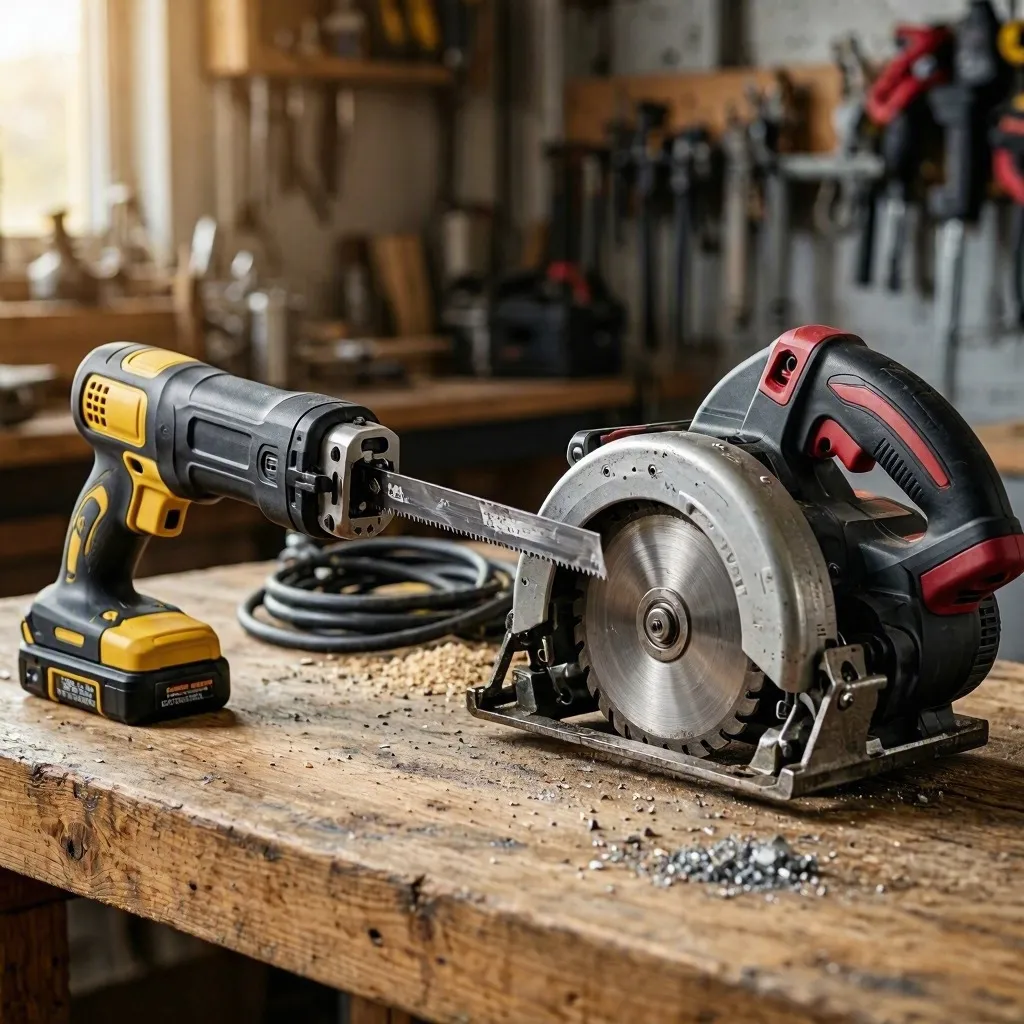
If you’re starting to build a collection of power tools, you may be wondering whether you need a reciprocating saw or a circular saw.
Both are powerful cutting tools, but they are designed for very different jobs.
A circular saw is primarily designed to make fast, reasonably accurate straight cuts through materials such as timber and sheet materials.
A reciprocating saw is more of a problem-solving and demolition tool. It’s particularly useful for dismantling structures, cutting pipe, timber containing nails and making cuts in awkward locations.
So which one should a DIY beginner buy?
The short answer is:
Choose a circular saw for accurate straight cuts in timber and sheet materials. Choose a reciprocating saw for demolition, dismantling and awkward cutting.
If you’re able to have both eventually, they make an excellent combination.
Table of Contents
Quick Answer: Reciprocating Saw or Circular Saw?
If your main DIY projects involve building, cutting timber and sheet materials, a circular saw is probably the better first choice.
If you’re mainly doing renovation, demolition, dismantling or pipework, a reciprocating saw is likely to be more useful. You can read more about what a reciprocating saw is used for.
| Job | Better Choice |
|---|---|
| Straight cuts in timber | Circular saw |
| Cutting plywood | Circular saw |
| Cutting MDF | Circular saw |
| Cutting decking | Circular saw |
| Cutting sheet material | Circular saw |
| Long straight cuts | Circular saw |
| Demolition | Reciprocating saw |
| Cutting timber with nails | Reciprocating saw |
| Cutting pipes | Reciprocating saw |
| Cutting awkward materials | Reciprocating saw |
| Removing old timber | Reciprocating saw |
| Cutting branches | Reciprocating saw |
| Precision woodworking | Circular saw |
| Rough cutting | Reciprocating saw |
What Is a Reciprocating Saw?
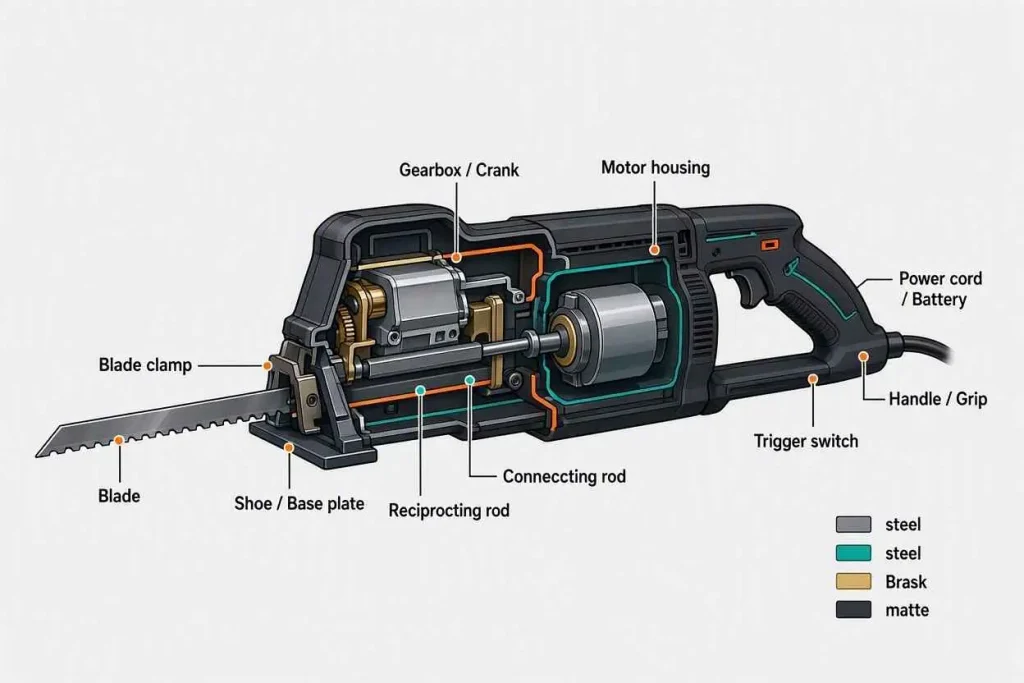
A reciprocating saw has a long, narrow blade that moves rapidly backwards and forwards. Unlike a circular saw, there is no large rotating blade. The blade sticks out from the front of the tool and is designed to cut through material as it moves backwards and forwards.
Reciprocating saws are available with blades designed for:
- Wood
- Metal
- Demolition
- Wood containing nails
- Plastic
- Pruning
This makes them extremely versatile. However, versatility doesn’t mean precision. A reciprocating saw is generally designed to cut quickly rather than cut beautifully.
What Is a Circular Saw?
A circular saw uses a round blade that rotates at high speed. The blade is usually mounted beneath a flat base plate, which rests against the material being cut.
Circular saws are particularly useful for:
- Timber
- Plywood
- MDF
- OSB
- Chipboard
- Flooring
- Decking
- Sheet materials
Different blades allow circular saws to cut different materials. However, they’re most commonly associated with woodworking and construction.
The Biggest Difference
The easiest way to understand the difference is to think about how the tools interact with the material.
A circular saw is designed to make a controlled cut along a defined path. A reciprocating saw is designed to get a blade into material and remove it quickly.
For example, imagine you’re building a garden shed. You need to cut a sheet of plywood into a straight line then always use a Circular saw.
Now imagine the shed is ten years old and you’re dismantling it, then use a reciprocating saw.
That’s the difference.
Reciprocating Saw vs Circular Saw Comparison
| Feature | Reciprocating Saw | Circular Saw |
|---|---|---|
| Main purpose | Demolition & rough cutting | Straight cutting |
| Wood | Excellent for rough work | Excellent |
| Sheet materials | Possible | Excellent |
| Metal | Excellent with suitable blade | Possible with suitable blade |
| Pipe | Excellent | Poor |
| Timber with nails | Excellent | Not recommended |
| Straight cuts | Poor–fair | Excellent |
| Long cuts | Difficult | Excellent |
| Precision | Low | Medium–high |
| Demolition | Excellent | Poor |
| Awkward access | Excellent | Limited |
| Curves | Possible | Poor |
| Portability | Excellent | Good |
| Garden pruning | Excellent with suitable blade | Not suitable |
Which Is Better for Cutting Wood?
Both tools can cut wood extremely well, but they approach the job differently. You can read in more detail about cutting wood with a recip saw.
Circular saw
A circular saw is the better option when you need:
- Straight cuts
- Long cuts
- Consistent depth
- Repeatable cuts
- Reasonably clean edges
It’s particularly useful for sheet materials.
Reciprocating saw
A reciprocating saw is better when:
- Accuracy isn’t important
- You’re dismantling something
- The timber contains nails
- You’re cutting in an awkward location
- You’re removing old timber
Simple rule
Building with wood? Circular saw.
Destroying or dismantling wood? Reciprocating saw.
Which Is Better for Straight Cuts?
The circular saw wins. This is one of the biggest reasons to buy one. A circular saw’s base plate provides a stable reference against the workpiece.
You can also use:
- A straight edge
- Guide rail
- Fence
- Clamp
- Measuring guide
to improve accuracy.
A reciprocating saw doesn’t provide the same level of control.
Its blade can flex, particularly during deeper cuts.
Which Is Better for Long Cuts?
Again, the circular saw. Imagine you need to cut a 2.4-metre sheet of plywood. A circular saw is designed for exactly this sort of job.
A reciprocating saw would make the task much more difficult. The narrow blade can wander and maintaining a straight line over a long distance is challenging.
Which Is Better for Demolition?
The reciprocating saw is the clear winner. This is where the tool really shines.
With an appropriate demolition blade, you can cut through:
- Timber
- Nails
- Screws
- Old framing
- Pipe
- Plastic
- Metal
That makes the reciprocating saw extremely useful when removing old structures. Find out more information here about choosing a reciprocating saw.
Can You Cut Timber With Nails?
Yes, and this is one of the reciprocating saw’s biggest advantages. Specialist demolition blades are available for cutting wood containing nails.
This makes them useful for dismantling:
- Pallets
- Stud walls
- Fences
- Timber frames
- Old sheds
- Flooring
You should not assume that an ordinary wood-cutting circular saw blade can safely perform the same task.
Hitting nails or screws with a circular saw blade can be extremely dangerous and can damage the blade or tool.
Which Is Better for Cutting Pipes?
The reciprocating saw wins. A narrow reciprocating blade can reach into areas where a circular saw simply can’t.
It’s particularly useful for:
- Copper pipe
- Plastic pipe
- Steel pipe
- Renovation work
- Plumbing demolition
A circular saw isn’t designed for this type of work.
Important safety point
Before cutting any installed pipe, identify what it is and make sure any relevant supply has been isolated.
Never assume a pipe is empty or safe to cut.
Be particularly careful around:
- Gas
- Electricity
- Pressurised water
- Heating systems
If you don’t know what’s behind or inside the material, don’t cut it until you do.
Which Is Better for Plywood?
The circular saw.
It’s one of the best tools for making long straight cuts in plywood. A suitable fine-tooth blade can also give you a cleaner finish. A reciprocating saw can cut plywood, but it would never be my first choice.
The blade can wander and the finished edge may be rough.
Which Is Better for MDF?
Again, generally the circular saw.
A suitable blade will allow you to make straight cuts through MDF efficiently.
If you’re making:
- Shelves
- Cabinets
- Furniture
- Panels
a circular saw is much more suitable.
Which Is Better for Decking?
A circular saw is usually the better choice. It can make quick, straight crosscuts through decking boards.
A reciprocating saw could certainly cut them, but you’d sacrifice accuracy and speed.
The reciprocating saw becomes more useful when you’re removing old decking rather than installing new decking.
Which Is Better for Building Furniture?
The circular saw.
For furniture and woodworking, accuracy matters.
You need cuts that are:
- Straight
- Consistent
- Repeatable
- Clean
A reciprocating saw isn’t really designed for this.
If your DIY interests are mainly furniture and woodworking, you may actually want to consider a jigsaw and circular saw before buying a reciprocating saw.
Which Is Better for Demolishing Furniture?
The reciprocating saw.
Old furniture can contain:
- Nails
- Screws
- Staples
- Hardwood
- Mixed materials
A reciprocating saw with a suitable demolition blade can be extremely useful for dismantling it.
Which Is Better for Curved Cuts?
Neither tool is ideal.
A jigsaw would normally be the better choice. A circular saw is designed primarily for straight cuts.
A reciprocating saw can make curved or irregular cuts, but accuracy is difficult.
This is an important point for beginners:
You don’t have to choose between only two saws.
Different saws have different strengths.
Circular Saw vs Reciprocating Saw vs Jigsaw
If you’re building a DIY tool collection, it’s useful to understand all three.
| Job | Reciprocating Saw | Circular Saw | Jigsaw |
|---|---|---|---|
| Straight timber cuts | ★★★ | ★★★★★ | ★★★★ |
| Long straight cuts | ★★ | ★★★★★ | ★★★ |
| Curves | ★★ | ★ | ★★★★★ |
| Worktops | ★★ | ★★★ | ★★★★★ |
| Sheet material | ★★ | ★★★★★ | ★★★★ |
| Demolition | ★★★★★ | ★★ | ★ |
| Timber with nails | ★★★★★ | ★ | ★ |
| Pipe cutting | ★★★★★ | ★ | ★ |
| Precision | ★★ | ★★★★ | ★★★★ |
| Awkward access | ★★★★★ | ★★ | ★★★ |
| Garden pruning | ★★★★★ | ★ | ★ |
Note: These ratings are general guidance rather than laboratory performance measurements. The actual result depends on the tool, blade, material and user.
Which Is Easier for a Beginner?
For basic straight cutting, I’d generally say the circular saw is easier to get good results from once you’ve learned the basics.
However, it needs to be treated with considerable respect. A circular saw has a large, rapidly rotating blade and can cause serious injury if used incorrectly.
A reciprocating saw has a different set of risks. Its blade is exposed at the front and the tool can move suddenly if the blade catches.
Neither should be treated as a casual tool. You can see me recommendations for the best reciprocating saws for beginners.
Which Is Safer?
There’s no simple answer. Both tools can be dangerous when used incorrectly.
A circular saw’s rotating blade can cause severe injuries and kickback is an important hazard to understand.
A reciprocating saw can also catch or bind, causing the tool to move unexpectedly.
With either tool:
- Read the manufacturer’s instructions.
- Wear suitable eye protection.
- Secure your workpiece.
- Keep both hands away from the blade.
- Check the material before cutting.
- Look for hidden electrical cables and pipes.
- Use the correct blade.
- Don’t force the tool.
- Allow the blade to stop before putting it down.
- Disconnect the battery or power before changing blades.
What Is Kickback?
Kickback is particularly important when using a circular saw. It can occur when the blade binds or becomes pinched in the material. The saw can then move suddenly back towards the operator.
This is one reason why correct technique, blade selection and workpiece support are so important.
A reciprocating saw can also react suddenly if its blade catches or binds, but its cutting action and design are different.
If you’re new to power tools, take the time to understand the safety instructions for the specific saw you’re using.
Which Has Better Cutting Accuracy?
The circular saw.
A circular saw can produce very accurate straight cuts when used correctly.
Accuracy can be improved further with:
- A guide rail
- Straight edge
- Fence
- Clamps
- Careful measuring
A reciprocating saw is much more dependent on the operator. It’s difficult to produce consistently accurate cuts with one.
Which Is Better for Awkward Cuts?
The reciprocating saw.
This is another area where it has a huge advantage. The blade can reach into places where the body of a circular saw can’t.
For example, you may be able to cut a piece of timber in place rather than dismantling the surrounding structure first. This makes reciprocating saws extremely useful during renovation.
Can a Circular Saw Cut Metal?
Some can, with the correct blade and appropriate setup. However, this isn’t the area where a typical DIY circular saw shines.
A reciprocating saw is generally more versatile for cutting metal pipe and demolition-related metal work.
For certain metal-cutting jobs, a dedicated metal-cutting saw or angle grinder may be more appropriate.
Always follow the manufacturer’s instructions regarding what materials the saw is designed to cut.
Can a Reciprocating Saw Replace a Circular Saw?
No.
You can use a reciprocating saw to make rough cuts in timber, but it isn’t a practical replacement for a circular saw when accuracy and long straight cuts matter.
For example, cutting a sheet of plywood into multiple straight sections would be far easier with a circular saw.
Can a Circular Saw Replace a Reciprocating Saw?
No.
A circular saw isn’t a practical substitute for a reciprocating saw when you’re:
- Cutting pipe
- Cutting timber with nails
- Dismantling structures
- Cutting in confined spaces
- Removing old fixtures
- Making plunge-style demolition cuts
Trying to use the wrong tool can make a straightforward job much harder.
Which Should You Buy First?
This depends on your DIY plans.
Choose a circular saw if you want to:
- Build shelves
- Cut plywood
- Cut MDF
- Build furniture
- Cut decking
- Build a shed
- Cut timber
- Make long straight cuts
Choose a reciprocating saw if you want to:
- Renovate
- Demolish
- Dismantle
- Remove old timber
- Cut pipe
- Cut nails
- Remove flooring
- Cut awkward materials
- Prune branches
What If You’re Building a General DIY Tool Collection?
If you’re starting from scratch, I wouldn’t necessarily make a reciprocating saw your first saw.
For many beginners, I’d consider the following order:
1. Jigsaw
A versatile option for smaller woodworking projects and curved cuts.
2. Circular saw
A major step up for straight cuts and sheet materials.
3. Reciprocating saw
Add one when you’re taking on renovation, demolition or more demanding DIY.
Of course, this isn’t a strict rule.
If your first project is dismantling an old shed, the reciprocating saw might be the first saw you actually need.
Cordless or Corded?
All three types of saw are available in cordless and corded versions.
For a modern DIY setup, cordless can be particularly convenient.
If you already own an 18V battery platform, check whether the manufacturer makes the saw you want.
Popular UK cordless ecosystems include:
- Makita 18V LXT
- DeWalt 18V XR
- Bosch Professional 18V
- Ryobi ONE+
- Milwaukee M18
The important thing is to avoid buying several incompatible battery systems unless you have a good reason to do so.
Battery Considerations
Cordless saws can make DIY much easier, but remember that the advertised voltage isn’t the whole story.
You’ll also want to consider:
- Battery capacity
- Weight
- Runtime
- Charging time
- Existing batteries
- Battery cost
- Availability
For example, if you already own a compatible 18V battery and charger, a bare tool may be considerably better value.
If you’re starting from scratch, compare the price of the complete kit.
Which Is More Versatile?
This depends on how you define versatility.
Reciprocating saw
More versatile in terms of materials and awkward situations.
It can cut:
- Wood
- Metal
- Plastic
- Pipe
- Nails
- Branches
with suitable blades.
Circular saw
More versatile for construction and woodworking.
It can handle:
- Timber
- Plywood
- MDF
- OSB
- Flooring
- Decking
and other suitable sheet materials.
For a general DIY beginner, both eventually have a place.
Which Is Better Value?
Again, it depends on what you’ll use it for.
- A £100 reciprocating saw that sits in your garage unused isn’t good value.
- A £100 circular saw that gets used every weekend could be excellent value.
Before buying either tool, ask:
What jobs will I use this for over the next year?
That’s a much better question than:
Which saw is the most powerful?
Common Buying Mistakes
- Buying the most powerful saw. – More power isn’t necessarily better for your needs.
- Ignoring the battery system – If you’re already invested in a cordless platform, take advantage of it.
- Choosing the wrong blade. – The blade can have a huge effect on performance.
- Expecting a reciprocating saw to make precision cuts. – That’s not what it’s designed for.
- Expecting a circular saw to handle demolition. – Again, use the right tool for the job.
- Forgetting about safety. – Both tools are powerful enough to cause serious injuries.
Reciprocating Saw vs Circular Saw: Which Is Best for You?
Here’s the simplest decision tree.
Do you mainly want to cut timber accurately?
Circular saw.
Do you mainly want to cut plywood or MDF?
Circular saw.
Do you want to build furniture?
Circular saw, potentially combined with a jigsaw.
Are you demolishing an old shed?
Reciprocating saw.
Do you need to cut old timber containing nails?
Reciprocating saw.
Do you need to cut pipes?
Reciprocating saw.
Do you need to make long straight cuts?
Circular saw.
Do you need to cut awkward materials already installed?
Reciprocating saw.
Do you want both capabilities?
Buy both eventually.
My Verdict for UK DIY Beginners
If I had to choose one saw for a beginner who mainly wants to build things, I’d choose a circular saw.
Its ability to make fast, straight cuts through timber and sheet materials makes it incredibly useful for construction and woodworking.
But if your DIY plans involve renovation and demolition, I’d choose the reciprocating saw. It can get into awkward spaces, cut through old timber and nails, tackle pipework and dismantle structures quickly.
The two tools aren’t really competitors. They’re more like two different specialists.
Circular saw
Build it.
Reciprocating saw
Take it apart.
And if you’re developing a serious DIY tool collection, eventually having both gives you the best of both worlds.
Frequently Asked Questions
Is a reciprocating saw the same as a circular saw?
No. A reciprocating saw uses a straight blade that moves backwards and forwards, while a circular saw uses a round blade that rotates.
Which is better for wood?
For accurate straight cuts and woodworking, a circular saw is generally better. A reciprocating saw is excellent for rough cutting and demolition.
Can a reciprocating saw cut plywood?
Yes, but a circular saw or jigsaw would generally be a better choice if you want an accurate or clean cut.
Can a circular saw cut pipes?
It isn’t normally the right tool for pipe cutting. A reciprocating saw is generally much more suitable.
Which is better for demolition?
A reciprocating saw.
Which is better for building a shed?
A circular saw is generally more useful for cutting the timber and sheet materials. A reciprocating saw can become useful if you’re dismantling an existing shed.
Which is better for beginners?
It depends on the work. A circular saw is useful for woodworking and construction, while a reciprocating saw is particularly useful for renovation and demolition.
Can I use a reciprocating saw for straight cuts?
Yes, but getting a perfectly straight cut is much harder than with a circular saw.
Can a circular saw cut curves?
Not easily. A jigsaw is generally the better tool for curved cuts.
Do I need a reciprocating saw if I already own a circular saw?
Not necessarily. If you mainly do woodworking, you may have little need for one. If you start doing renovation or demolition, a reciprocating saw can become very useful.
Final Thoughts
The reciprocating saw and circular saw are designed for very different types of DIY work.
A circular saw is the better choice when you need to make straight, controlled cuts, particularly through timber and sheet materials.
A reciprocating saw is the better choice when the job is messy, awkward or destructive.
If you’re building something, reach for the circular saw.
If you’re taking something apart, the reciprocating saw is often the better tool.
For a beginner building a tool collection, don’t feel that you have to buy everything immediately. Start with the saw that matches the work you’re actually planning to do.
Looking for a New Circular Saw or Upgrading Your Setup?
For our full breakdown of top-rated corded and cordless tools, check out my complete guide for the Circular Saw Buying Guide UK for Beginners. On the other hand if you want to know more about reciprocating saws then check out my Reciprocating Saw Buying Guide UK.