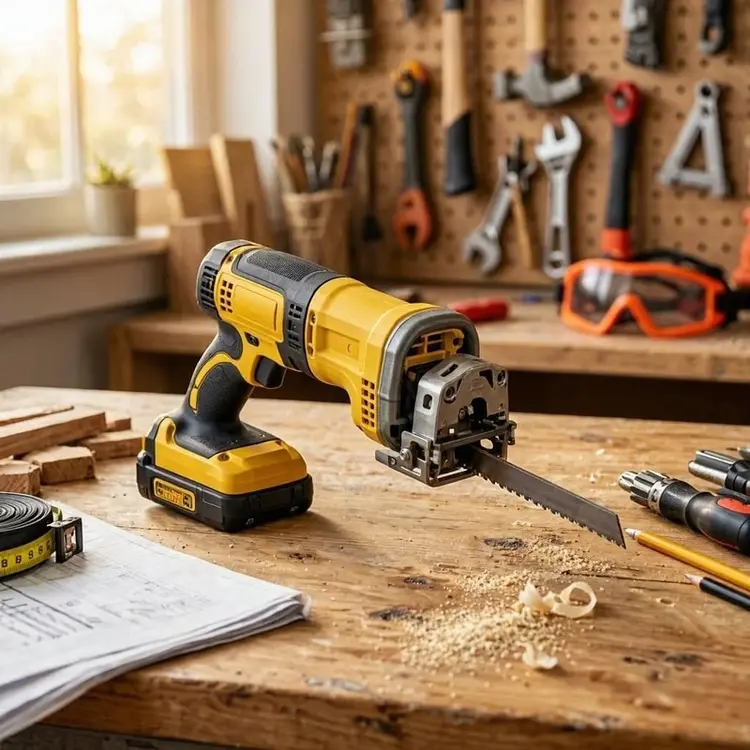
A reciprocating saw can be one of the most useful power tools for DIY. It’s particularly good at jobs where other saws can struggle, including demolition, cutting timber with nails, cutting pipes and reaching awkward areas.
But if you’re buying your first reciprocating saw, choosing the right one can be confusing.
There are cordless and corded models, different battery voltages, compact and full-size saws, brushed and brushless motors, and a huge range of prices. So which one should you buy?
For most DIY beginners, you don’t necessarily need the most powerful or expensive reciprocating saw available.
The best choice is the one that gives you enough power for your projects while remaining comfortable, easy to control and affordable.
In this guide, I’ll explain what to look for and the types of reciprocating saw I’d consider for different DIY situations.
Quick Answer: What’s the Best Reciprocating Saw for DIY?
For most UK DIYers, I’d look at an 18V cordless reciprocating saw. An 18V model gives you a good balance of portability, cutting performance and battery availability.
If you already own batteries from a power-tool manufacturer, I’d strongly consider staying within that battery system.
Some current options worth considering include:
- Makita DJR186Z 18V LXT Reciprocating Saw – Powerful Makita reciprocating saw with high review ratings, suitable for DIY projects.
- DeWalt DCS369N 18V XR Compact Reciprocating Saw – DeWalt’s compact 18V saw offers reliable performance, popular among DIYers.
- Bosch GSA 18V-LI Professional Cordless Saw – Bosch cordless saw with professional features, ideal for versatile cutting tasks.
- Ryobi 18V Cordless Saw – Ryobi’s budget-friendly 18V saw with strong reviews, great for DIY use.
Best all-round DIY option
Makita DJR186Z
A strong choice for general DIY if you’re already invested in Makita’s 18V LXT battery system. Current UK listings show it at around £88–£100 as a bare tool, although prices vary.
Best compact option
DeWalt DCS369N
A compact 18V XR model that’s particularly interesting if you’ll be working in confined spaces or want something easier to manoeuvre.
Best Bosch option
Bosch GSA 18V-LI
A good option for DIYers already using the Bosch Professional 18V system.
Best for budget-conscious DIYers
Ryobi 18V ONE+
Ryobi’s ONE+ system is worth considering if you’re starting to build a collection of DIY tools and want one battery platform for multiple tools.
What Is a Reciprocating Saw Used For?
Before buying one, it’s worth understanding what this type of saw actually does. A reciprocating saw is designed primarily for fast, rough and sometimes awkward cutting.
It’s particularly useful for:
- Demolition
- Cutting timber
- Cutting wood containing nails
- Cutting metal pipe
- Cutting plastic pipe
- Cutting plasterboard
- Cutting branches
- Removing old fittings
- Cutting bolts
- Renovation work
It’s not normally the best choice when you need a perfectly straight, clean cut. For that, you’d generally choose a circular saw, mitre saw or jigsaw depending on the job.
Think of a reciprocating saw as your problem-solving saw.
Do DIY Beginners Need a Reciprocating Saw?
Not necessarily. If you’re only doing simple woodworking projects, you might get more use from a:
- Jigsaw
- Circular saw
- Mitre saw
- Handsaw
But if you’re planning renovation or demolition work, a reciprocating saw becomes much more useful.
It’s particularly valuable when you need to cut something that’s:
- Already installed
- Difficult to reach
- Made from mixed materials
- Containing nails or screws
- In an awkward position
That’s where the reciprocating saw earns its place.
Corded vs Cordless Reciprocating Saws
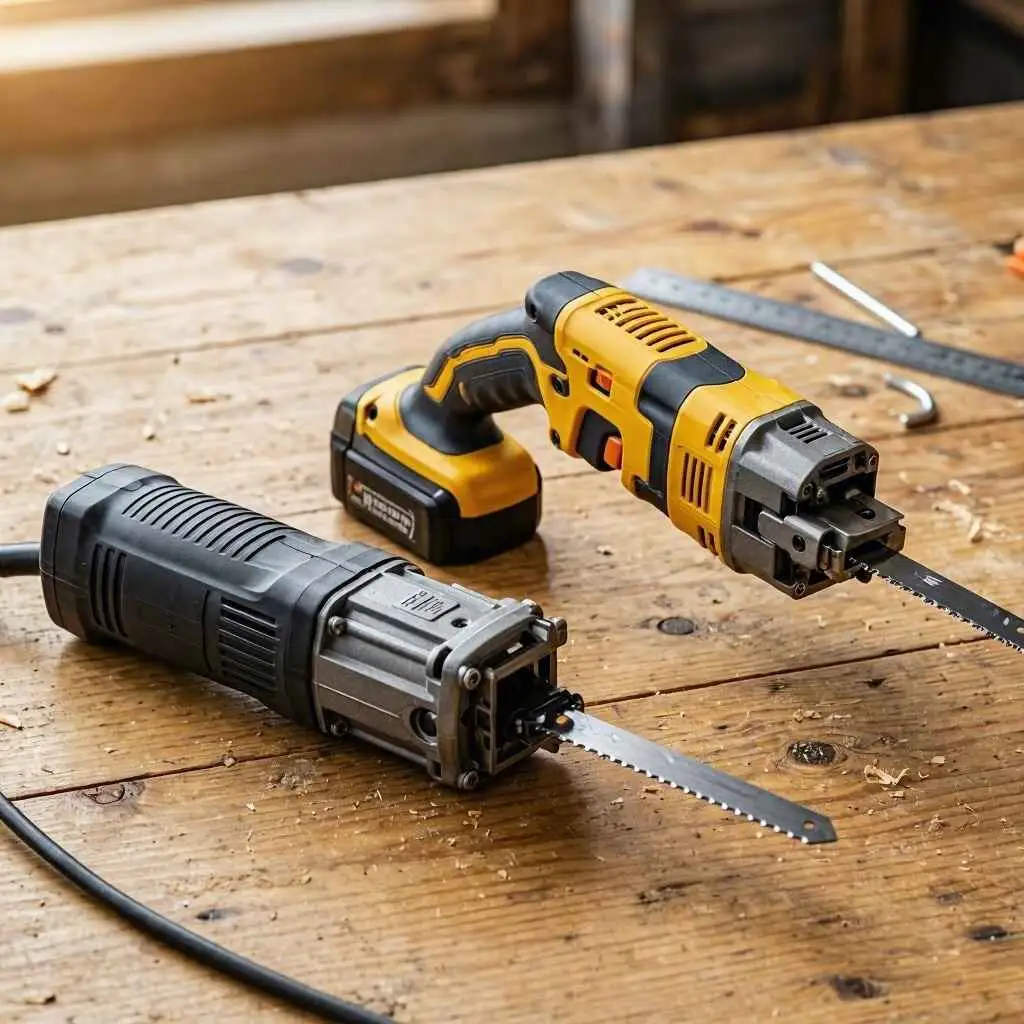
One of the first decisions you’ll need to make is whether to buy a corded or cordless saw.
Cordless reciprocating saw
Cordless models are probably the most convenient option for most DIY users.
Advantages
- No power cable
- Easy to move around
- Useful outdoors
- Convenient for renovation
- Easier to use in awkward locations
- Can be used where mains electricity isn’t convenient
Disadvantages
- Battery and charger may cost extra
- Battery eventually needs charging
- Can be more expensive
- Performance depends on the battery and tool
For most modern DIY applications, I’d lean towards cordless.
Corded Reciprocating Saws
Corded models still have advantages. You plug the saw into the mains and can continue working without worrying about battery capacity.
That can make sense if you’re doing:
- Long demolition sessions
- Workshop work
- Repeated cutting
- Work close to a mains socket
A corded model can also be cheaper to buy initially. For a DIY beginner who only occasionally uses a reciprocating saw, however, the convenience of cordless can outweigh the disadvantages.
What Voltage Reciprocating Saw Should You Buy?
You’ll commonly see cordless reciprocating saws marketed around different voltage systems.
For a UK DIYer, 18V is a particularly useful middle ground.
It’s powerful enough for a wide range of DIY work without necessarily requiring the bulk of some higher-powered systems.
You may also encounter:
- 12V
- 18V
- 20V MAX
- Higher-voltage professional systems
12V
Best suited to lighter work and compact tools.
18V
Excellent all-round option for DIY.
20V MAX
Often refers to the manufacturer’s nominal battery platform rather than meaning a fundamentally different class of tool from 18V systems.
Higher voltage
Can be useful for heavy-duty applications but is often unnecessary for occasional DIY.
Why 18V Is a Good Choice for DIY
If you’re building a collection of cordless tools, 18V can make a lot of sense.
You can potentially use the same battery system for:
- Drill
- Impact driver
- Jigsaw
- Circular saw
- Angle grinder
- Reciprocating saw
- Garden tools
That means you don’t necessarily need to buy a battery and charger with every tool.
For example, Makita’s DJR186Z is sold as a bare tool and uses the company’s 18V LXT battery platform. Current UK listings show the bare tool available at around £88–£100 depending on retailer.
Should You Buy a Bare Tool or a Kit?
This is particularly important for beginners. You’ll often see two versions of the same cordless tool:
Bare tool / body only
or
Kit including battery and charger
Bare tool
A bare tool doesn’t normally include the battery and charger.
This can be excellent value if you already own compatible batteries.
Complete kit
A kit normally includes the saw, battery and charger. This can make more sense if you’re buying your first tool in that battery system.
My advice for beginners
If you don’t own any cordless tools yet, compare the total cost of the kit.
Don’t look at a £90 bare tool and think it’s cheaper than a £160 kit until you’ve checked the price of the battery and charger.
Best Reciprocating Saw for General DIY
For general DIY, I’d prioritise:
- Good battery system
- Reasonable weight
- Variable speed
- Tool-free blade change
- Good ergonomics
- Adequate cutting capacity
- Good availability of blades
- Reasonable price
The Makita DJR186Z is an interesting all-round option.
Makita DJR186Z 18V LXT Reciprocating Saw
It’s widely available in the UK and is part of Makita’s large 18V LXT ecosystem.
A current UK comparison also identifies the DJR186Z as a strong versatile option for DIY and trade use.
Best Compact Reciprocating Saw for DIY
If you’re working in tight spaces, a compact saw can be a better choice than a full-size model.
The DeWalt DCS369N is an example.
DeWalt DCS369N 18V XR Compact Reciprocating Saw
A compact reciprocating saw can be useful for:
- Plumbing
- Cutting pipe
- Under-sink work
- Renovation
- Tight spaces
- Garden work
- Light demolition
The trade-off is that compact models may sacrifice some of the cutting capacity and aggressive performance of larger reciprocating saws.
Best Reciprocating Saw for Beginners
A beginner doesn’t necessarily need a professional-grade demolition saw.
In fact, buying an extremely powerful saw can sometimes make the tool more difficult to control.
I’d look for:
- Variable speed
- Comfortable grip
- Manageable weight
- Tool-free blade change
- Good shoe adjustment
- Reliable battery system
- Easy-to-find replacement blades
A current UK comparison rated the corded Bosch PSA 700 E as its beginner pick, while recommending the Makita DJR186Z for versatility.
However, for a new cordless-tool buyer, I’d generally favour starting with a good 18V cordless platform rather than choosing purely on the saw’s price.
Best Budget Reciprocating Saw for DIY
If you’re only going to use a reciprocating saw occasionally, there’s no reason to spend several hundred pounds.
There are budget options available, including corded models.
The important thing is to distinguish between:
Cheap because it’s good value
and
Cheap because it’s poorly suited to the job.
For occasional DIY:
- Corded can offer excellent value.
- A budget cordless model can make sense if you already own its battery.
- A premium brushless model isn’t essential.
Is Brushless Worth It?
You’ll often see the term brushless motor when comparing modern cordless power tools.
A brushless motor can offer advantages including:
- Efficiency
- Longer motor life
- Less maintenance
- Good performance
- Better battery utilisation
But don’t assume that every brushless tool is automatically better for your particular DIY needs. For occasional use, a good brushed saw can still do the job. For frequent use, a brushless model becomes more attractive.
Read more details about brushed vs brushless motors.
How Powerful Should a DIY Reciprocating Saw Be?
This is one area where beginners can easily get distracted by numbers.
More power isn’t always better.
Think about what you’re actually going to cut.
Light DIY
Examples:
- Small branches
- Plastic pipe
- Thin timber
- Occasional repairs
You don’t need a huge professional saw.
General DIY
Examples:
- Timber
- Pallets
- Pipe
- Renovation
- Demolition
An 18V model is a sensible choice.
Heavy renovation
Examples:
- Thick timber
- Heavy demolition
- Large metal sections
- Frequent use
A more powerful brushless saw may be worthwhile.
Stroke Length Explained
The blade doesn’t simply move a tiny distance backwards and forwards.
The distance it travels is called the stroke length.
A longer stroke can help remove more material with each cycle.
However, don’t assume:
Longer stroke = automatically better saw.
Overall performance depends on:
- Motor
- Stroke length
- Stroke rate
- Blade
- Battery
- Gearbox
- Tool design
A saw with a long stroke but poor blade selection can still perform badly.
Variable Speed Is Worth Having
I’d strongly recommend choosing a saw with a variable-speed trigger if your budget allows.
It gives you greater control.
You can use a slower speed when:
- Starting a cut
- Cutting delicate material
- Cutting plastic
- Positioning the blade
And increase the speed when:
- Cutting suitable timber
- Demolishing materials
- Making longer cuts
For a beginner, variable speed is one of those features that can make the tool easier to learn.
Tool-Free Blade Change
Another feature I’d look for is a tool-free blade clamp.
It allows you to change blades without reaching for another tool.
This is particularly useful because reciprocating saws are designed to work with different blade types.
You might use:
Wood blade → metal blade → demolition blade → pruning blade
during different jobs.
A tool-free clamp makes that much easier.
Adjustable Shoe
The shoe is the part of the saw that rests against the material. An adjustable shoe can help you control the saw and make better use of the blade.
It can also allow you to position the blade appropriately for different materials and cuts. It’s not the first feature I’d prioritise, but it’s a useful one.
LED Work Light
An LED work light isn’t essential, but it can be useful.
Reciprocating saws are often used in:
- Cupboards
- Under floors
- Roof spaces
- Behind fixtures
- Dark corners
- Renovation areas
A small LED can help illuminate the cutting area.
How Important Is Weight?
Very important.
A reciprocating saw can be tiring because you’re often using it:
- At arm’s length
- Above your head
- In awkward positions
- Against vertical surfaces
A lighter saw isn’t necessarily better in every situation, but if you’re a beginner, don’t underestimate the difference a few hundred grams can make.
The compact DeWalt DCS369N, for example, is designed around a smaller form factor, while full-size saws such as the Makita DJR186Z are aimed more at general-purpose cutting and heavier work.
Battery Size: What Ah Do You Need?
Battery capacity is measured in amp-hours (Ah).
You’ll commonly encounter batteries such as:
- 2.0Ah
- 3.0Ah
- 4.0Ah
- 5.0Ah
- 6.0Ah
- 8.0Ah
As a general rule:
Higher Ah = more battery capacity
But also:
Higher Ah = usually more weight
For a reciprocating saw, a 4Ah or 5Ah battery can be a useful compromise between runtime and weight for many DIY applications.
For occasional light work, a smaller battery may be perfectly adequate. For heavy demolition, a larger battery can make more sense, when it comes to battery run times.
How Long Will the Battery Last?
This is difficult to answer with a single number. Battery runtime depends heavily on what you’re cutting.
Cutting a few pieces of softwood requires much less energy than continuously cutting thick steel. This is why manufacturers don’t generally give a simple “hours of cutting” figure that applies to every job.
What Blades Should You Buy?
Don’t forget the blades. A reciprocating saw without suitable blades isn’t much use.
For a beginner, I’d start with:
- Wood blade – For ordinary timber.
- Wood-and-nail blade – For pallets and demolition.
- Metal blade – For steel and other suitable metals.
- Pruning blade – If you intend to use the saw in the garden.
You don’t need to buy every type immediately. Buy the blades that match the jobs you’re actually going to do.
How Much Should You Spend?
There’s no perfect budget. I’d roughly divide the UK market like this:
| Budget | What to Expect |
|---|---|
| Under £70 | Basic/occasional DIY |
| £70–£120 | Good DIY options |
| £120–£200 | Higher-quality cordless models |
| £200+ | Premium/professional territory |
These are broad categories rather than fixed price bands. Battery and charger costs can also make a major difference to the final price.
A bare tool at £100 isn’t necessarily cheaper than a £150 kit if you have to spend another £80 on a battery and charger.
Is It Worth Buying a Professional Reciprocating Saw?
For most beginners, probably not. If you’re going to use your saw:
- Twice a year
- For occasional pruning
- For a small renovation
- For a few demolition jobs
you probably don’t need a £300+ professional tool.
However, if you’re renovating a house or regularly doing serious DIY, a better-quality saw can be a sensible investment.
What I Would Look for in a DIY Reciprocating Saw
If I were helping a beginner choose one, my checklist would be:
Essential
- Cordless 18V platform
- Variable speed
- Tool-free blade change
- Comfortable grip
- Suitable battery availability
Very useful
- Brushless motor
- Adjustable shoe
- LED work light
- Good vibration control
- Compact design
Nice to have
- Advanced electronic controls
- Premium anti-vibration systems
- Higher-capacity professional batteries
Don’t pay for features you aren’t going to use.
Reciprocating Saw Comparison for DIY
| Type | Best For | My Verdict |
|---|---|---|
| Corded | Occasional workshop/long jobs | Good value |
| 12V cordless | Light DIY/tight spaces | Useful but limited |
| 18V cordless | General DIY | Best choice for most |
| Compact 18V | Tight spaces | Excellent for specific jobs |
| Brushless 18V | Regular DIY | Excellent |
| Professional high-power | Heavy renovation | Overkill for most beginners |
What About Ryobi?
Ryobi deserves consideration if you’re building a DIY tool collection from scratch.
The ONE+ system covers a very large range of cordless tools, meaning the same battery platform can potentially be used across your workshop and garden tools.
Ryobi 18V Cordless Saw
There’s also the brushless RRS18BL-0, which is aimed at users wanting more performance.
Ryobi 18V Brushless Reciprocating Saw RRS18BL-0
For someone starting a collection of tools rather than buying one isolated saw, the battery ecosystem is an important part of the decision.
What About Bosch?
Bosch has two relevant cordless ecosystems worth distinguishing.
Bosch Home & Garden
The green Bosch range is aimed primarily at DIY and home users.
Bosch Professional
The blue Bosch Professional range is aimed more towards professional and demanding users.
The Bosch GSA 18V-LI is an example of a Professional cordless reciprocating saw.
Bosch GSA 18V-LI Professional Cordless Saw ·
Bosch also offers compact models such as the GSA 18V-LI C.
Bosch GSA 18V-LI C 18V Reciprocating Saw ·
If you already own Bosch batteries, check which Bosch system they belong to before buying.
What About Makita?
Makita is particularly attractive for DIYers who want access to a large 18V battery ecosystem.
The Makita DJR186Z is a straightforward example.
Makita DJR186Z 18V LXT Reciprocating Saw ·
Its popularity also means replacement blades, batteries and accessories are easy to find in the UK.
For someone already using Makita 18V LXT tools, it would be high on my shortlist.
What About DeWalt?
DeWalt’s XR range is another strong option.
The DCS369N is particularly interesting if compact size is important.
DeWalt DCS369N 18V XR Compact Reciprocating Saw
For heavier DIY and renovation work, you may want to consider one of DeWalt’s larger reciprocating saws rather than the compact model.
Do You Need an 18V Reciprocating Saw?
For most DIY beginners, no—but I’d still recommend one if you’re buying cordless.
18V gives you a particularly good balance between:
- Power
- Battery availability
- Tool choice
- Weight
- Runtime
- Price
It’s also an excellent platform if you’re planning to buy more cordless tools.
Common Buying Mistakes
Buying the cheapest saw
Cheap isn’t necessarily bad, but don’t make price your only consideration.
Buying a bare tool without owning the battery
Always calculate the total cost.
Ignoring weight
You may regret buying a heavy saw when working overhead.
Buying too much power
You don’t necessarily need a professional demolition saw.
Forgetting about blades
Budget for good-quality blades. Find out more about reciprocating saw blades.
Choosing the wrong battery system
If you already own cordless tools, staying within your existing ecosystem can save money.
Buying based purely on voltage
18V doesn’t automatically mean one tool is better than another.
Motor, blade, stroke length, gearing and overall design matter too.
Safety for DIY Beginners
A reciprocating saw is a powerful cutting tool and should be treated accordingly.
Before using it:
- Read the manufacturer’s instructions.
- Wear appropriate eye protection.
- Wear suitable PPE.
- Secure the material.
- Check for hidden cables and pipes.
- Keep your hands away from the blade.
- Make sure the blade is correctly fitted.
- Keep the saw under control.
- Allow the blade to stop before putting the saw down.
- Remove the battery before changing the blade.
Be particularly careful when cutting into walls, floors, ceilings or other installed materials.
You need to know what’s behind the material before cutting.
Best Reciprocating Saw for DIY: My Verdict
For the majority of UK DIY beginners, I’d recommend looking at a cordless 18V reciprocating saw.
You don’t need the most powerful professional model.
Instead, concentrate on buying a saw that’s:
- Comfortable
- Reliable
- Easy to control
- Powerful enough for your projects
- Part of a useful battery ecosystem
- Compatible with readily available blades
My main choices
Best all-round DIY: Makita DJR186Z
Best compact option: DeWalt DCS369N
Best Bosch Professional option: Bosch GSA 18V-LI
Best battery ecosystem for DIY: Ryobi ONE+
Best for heavier professional-style work: Look at the higher-end DeWalt, Bosch Professional or Milwaukee models.
Current UK comparison testing also places models from DeWalt, Makita, Bosch and Ryobi among the leading options, although the best choice depends heavily on the user’s intended application and existing battery platform. You may also check out my reciprocating saw buying guide.
Frequently Asked Questions
What is the best reciprocating saw for DIY beginners?
For most beginners, I’d look for an 18V cordless model with variable speed, tool-free blade changing and a comfortable weight. The Makita DJR186Z is a strong general-purpose option.
Is a cordless reciprocating saw better than a corded one?
For most DIYers, cordless is more convenient because you can use it almost anywhere. Corded models can still be excellent value if you’re working near a power socket for long periods.
Is 18V enough for a reciprocating saw?
Yes. An 18V reciprocating saw is capable of handling a wide range of DIY jobs, including timber, demolition and suitable metal-cutting applications.
What size battery should I use?
A 4Ah or 5Ah battery is a useful compromise for many DIY applications. Smaller batteries reduce weight, while larger batteries provide more capacity.
Do reciprocating saws come with blades?
Some do and some don’t. Always check the contents before buying.
Can I use any reciprocating saw blade?
You should use blades that are compatible with your saw and appropriate for the material you’re cutting.
Is a reciprocating saw difficult to use?
The basic operation is relatively straightforward, but it’s still a powerful cutting tool. Beginners should start with simple jobs and learn how the saw behaves before tackling difficult cuts.
Can I use a reciprocating saw for woodworking?
Yes, but it’s mainly a rough-cutting and demolition tool rather than a precision woodworking saw.
Is a reciprocating saw the same as a sabre saw?
In the UK, the terms are often used interchangeably. “Reciprocating saw”, “recip saw” and “sabre saw” can all refer to this type of tool.
Final Thoughts
A reciprocating saw isn’t an essential tool for every DIY beginner.
But if you’re planning renovation, demolition, plumbing, garden work or general repairs, it can quickly become one of the most useful tools in your collection.
For most UK DIYers, I’d start by looking at an 18V cordless model.
Then choose the brand based partly on the battery system.
If you already own Makita, DeWalt, Bosch or Ryobi cordless tools, buying a reciprocating saw from the same system can make much more financial sense than starting another battery platform.
And don’t forget the blades.
A good reciprocating saw with the wrong blade won’t perform well.
A reasonably priced saw with the right blade for the job can be surprisingly capable.
What to Read Next?
If you’re deciding whether a reciprocating saw is right for you, these UKToolGuide guides are useful next steps: