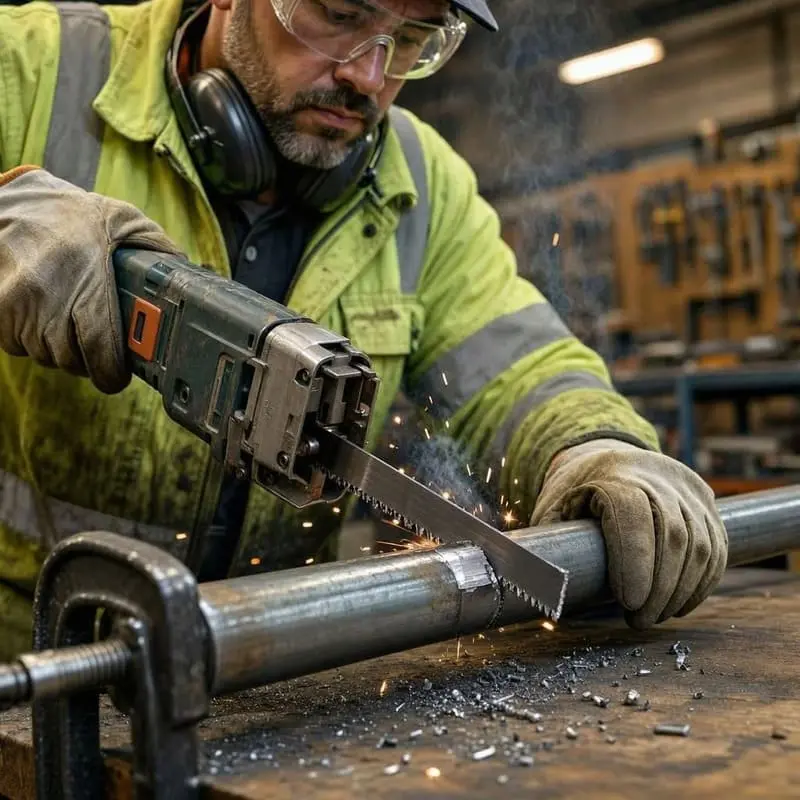
Yes, you can cut metal with a reciprocating saw. With the correct metal-cutting blade, a reciprocating saw can cut materials such as steel, stainless steel, aluminium, metal pipe and some sheet metal.
This makes it a useful tool for DIY renovation, plumbing, demolition and general repair work. However, you can’t simply fit any reciprocating saw blade and start cutting metal. The blade needs to be suitable for the type and thickness of metal you’re cutting.
For a DIY beginner, the most important things to understand are:
- Which blade to use
- What TPI means
- How thick the metal is
- How to support the material
- How to cut safely
- When a reciprocating saw is the right tool for the job
In this guide, we’ll explain everything you need to know about cutting metal with a reciprocating saw.
What Types of Metal Can a Reciprocating Saw Cut?
A reciprocating saw can cut a surprisingly wide range of metals when fitted with the correct blade.
Depending on the blade and saw, applications can include:
- Mild steel
- Stainless steel
- Aluminium
- Copper
- Steel pipe
- Metal tubing
- Metal profiles
- Sheet metal
- Metal studs
- Bolts and fixings
- Nails
The important point is that different metals and thicknesses require different blades. Don’t assume that because a blade is labelled “metal” it will be suitable for every type of metal.
Always check the blade manufacturer’s specifications.
Can You Cut Steel With a Reciprocating Saw?
Yes.
A suitable metal-cutting reciprocating saw blade can cut steel.
This can be useful for jobs such as:
- Cutting steel pipe
- Removing metal brackets
- Cutting metal framing
- Cutting bolts
- Demolition work
- Cutting steel sections
Steel can be demanding on a blade, so choosing an appropriate blade is particularly important. For thicker steel, check the blade’s maximum recommended material thickness before starting.
Can You Cut Stainless Steel?
Yes, but stainless steel can be more demanding to cut than ordinary mild steel. Use a blade specifically rated for stainless steel where appropriate.
Stainless steel can generate considerable heat during cutting, so avoid forcing the saw and follow the blade manufacturer’s recommendations.
If you’re cutting a substantial amount of stainless steel, a specialist blade designed specifically for the application is likely to give better results than a general-purpose blade.
Can You Cut Aluminium?
Yes. Aluminium can be cut with a suitable metal-cutting blade. However, aluminium behaves differently from steel, so make sure the blade is suitable for non-ferrous metals.
If you’re cutting thin aluminium sheet, a finer-tooth blade may be appropriate. For thicker material, follow the blade manufacturer’s guidance regarding TPI and maximum cutting thickness.
Can You Cut Copper Pipe?
Yes. A reciprocating saw can be useful for cutting copper pipe when fitted with a suitable metal-cutting blade.
This can be particularly handy during renovation or plumbing work because the saw can make quick cuts in awkward locations.
However, never cut a pipe until you know what it contains.
Make sure:
- The water supply is isolated where appropriate.
- The pipe is not carrying a dangerous substance.
- You know what’s behind or around the pipe.
- You aren’t going to damage another service.
If you’re unsure about a pipe, stop and get professional advice.
Can You Cut Metal Pipe?
Yes. Metal pipe is one of the applications where a reciprocating saw can be particularly useful. It can be easier to position a reciprocating saw around a pipe than some larger saws.
You may encounter metal pipe during:
- Plumbing work
- Heating work
- Renovation
- Demolition
- General repairs
Choose a blade designed for the type of metal and its thickness.
Can You Cut Sheet Metal?
Yes. A reciprocating saw can cut suitable sheet metal, provided the blade is designed for the material. For thin sheet metal, a finer blade is often appropriate.
Bosch, for example, lists a 24 TPI reciprocating blade specifically for thin metal applications. Thin sheet metal can be more difficult to control than thicker material because it can flex and vibrate during cutting.
Make sure the sheet is properly supported before cutting.
What Is the Best Reciprocating Saw Blade for Metal?
There isn’t one blade that is best for every type of metal.
Instead, look for a blade specifically designed for:
- Metal cutting
- The type of metal you’re cutting
- The thickness of the material
- The application
Metal blades usually have finer teeth than coarse wood-cutting blades. Many are made using bi-metal construction, which combines different materials to provide a balance of cutting performance and durability.
The important thing is to check the manufacturer’s specifications.
What TPI Should You Use for Metal?
TPI means teeth per inch.
Metal-cutting blades generally use more teeth per inch than coarse wood blades.
As a broad starting point:
| Metal Application | Approximate TPI Range |
|---|---|
| Thin sheet metal | 18–24+ TPI |
| Thin metal sections | 14–18 TPI |
| General metal cutting | 10–18 TPI |
| Thicker metal | Lower TPI metal blade may be appropriate |
These figures are only a starting point. The correct TPI depends on the material, thickness and blade design.
For example, Bosch offers a 24 TPI reciprocating blade for thin metal. For a fuller explanation, see our What TPI Reciprocating Saw Blade Do I Need? guide.
Why Does Metal Need More Teeth?
This is one of the things beginners often find confusing. You might expect a more powerful cut to require larger teeth.
But when cutting thin metal, having more teeth engaged with the material helps prevent the blade from catching aggressively. Fine teeth can provide a smoother cutting action on suitable thin materials.
However, using an excessively fine blade on very thick metal can make cutting unnecessarily slow. That’s why material thickness matters.
Can You Cut Metal With a Wood Blade?
You shouldn’t. A standard wood-cutting blade is designed around the characteristics of wood. Metal requires a blade specifically designed for metal cutting.
Using the wrong blade can result in:
- Poor cutting performance
- Damaged teeth
- Excessive heat
- Premature blade wear
- Increased risk of losing control
If you’re cutting metal, fit a suitable metal-cutting blade.
Can You Cut Nails With a Reciprocating Saw?
Yes. Cutting nails is one of the useful applications of a reciprocating saw. For example, during demolition you may need to cut through timber containing nails.
A bi-metal demolition blade designed for wood containing nails can be a good choice.
Don’t simply use an ordinary wood blade. Specialist blades are available specifically for this application.
Can You Cut Bolts With a Reciprocating Saw?
Yes. A reciprocating saw with an appropriate metal-cutting blade can be useful for cutting bolts.
This can be particularly helpful during repair or demolition work when a seized or inaccessible bolt needs to be removed.
Choose a blade suitable for the diameter and material of the bolt. For small bolts, a fine-tooth metal blade may be appropriate.
How to Cut Metal With a Reciprocating Saw
If you’re new to cutting metal, take your time.
Step 1: Choose the correct blade
Select a metal-cutting blade appropriate for the material and thickness.
Check the manufacturer’s specifications.
Step 2: Secure the metal
Make sure the workpiece cannot move unexpectedly.
This is particularly important with sheet metal because it can flex and vibrate.
Step 3: Mark the cut
Clearly mark where you want to cut.
A marker or suitable metal-marking tool can be useful.
Step 4: Fit the blade
Make sure the blade is properly installed and secured.
Follow the instructions for your saw.
Step 5: Position the shoe
Where appropriate, place the saw’s shoe against the workpiece.
This can improve stability and control.
Step 6: Start carefully
Don’t immediately force the blade into the metal at maximum pressure.
Start the cut in a controlled manner.
Step 7: Let the blade work
Allow the blade to do the cutting.
Excessive pressure can make the tool harder to control and can shorten blade life.
Step 8: Complete the cut
Maintain control until the blade has passed completely through the material.
Be aware that the metal may move or fall as the cut is completed.
Why Is My Reciprocating Saw Cutting Metal Slowly?
If your saw is taking a long time to cut metal, don’t immediately assume that the saw isn’t powerful enough.
Check the blade first.
Possible causes include:
- Wrong blade
- Blunt blade
- Incorrect TPI
- Material is thicker than the blade is designed for
- Excessive pressure
- Insufficient battery charge
- Poor support of the workpiece
- Blade overheating
A suitable new blade can make a major difference.
Should You Use Oil When Cutting Metal?
Some metal-cutting applications can benefit from lubrication, particularly when cutting certain metals or thicker material.
However, don’t automatically apply lubricant to every metal-cutting job. Check the blade manufacturer’s recommendations and the saw manufacturer’s instructions.
If lubrication is appropriate, use a product suitable for the material and application.
Why Does My Blade Get Hot When Cutting Metal?
Heat is generated by friction during cutting.
Metal cutting can produce considerable heat, particularly when:
- The blade is blunt
- You’re applying too much pressure
- The blade is unsuitable
- The material is thick
- You’re cutting continuously for long periods
If the blade becomes excessively hot, stop and allow it to cool. Don’t continue forcing a blade that is overheating.
How to Make a Reciprocating Saw Cut Metal Better
If you’re struggling with metal cutting, try these steps.
Use the correct blade
This is the most important factor.
Match TPI to material thickness
Don’t simply choose the finest blade available.
Secure the workpiece
Movement makes cutting harder.
Don’t force the saw
Allow the teeth to do the cutting.
Replace worn blades
A blunt blade can make even a powerful saw seem ineffective.
Keep the cut controlled
Avoid twisting the blade while it’s cutting.
Check battery charge
Cordless saws can lose performance as the battery becomes depleted, depending on the tool and battery system.
Reciprocating Saw vs Angle Grinder for Cutting Metal
A reciprocating saw isn’t the only tool you can use for cutting metal. An angle grinder can also be useful for certain metal-cutting applications.
Reciprocating saw advantages
- Less bulky for some awkward cuts
- Useful for demolition
- Can cut pipes and sections
- Good access in some locations
- No abrasive cutting disc required
Angle grinder advantages
- Fast cutting of some metal
- Useful for cutting and grinding
- Can produce relatively precise cuts with practice
- Suitable for many workshop applications
The better tool depends on the material, location and type of work. For awkward demolition and cutting pipes, a reciprocating saw can be particularly convenient.
Reciprocating Saw vs Hacksaw
A hacksaw can still be an excellent choice for small metal-cutting jobs. It’s inexpensive, doesn’t require electricity or batteries and gives you good control.
However, a reciprocating saw can save considerable time when making repeated cuts or working on heavier materials.
For occasional DIY work:
Small job → hacksaw may be perfectly adequate.
Multiple cuts or difficult access → reciprocating saw may be more convenient.
Safety When Cutting Metal
Metal cutting requires particular care. Always follow the manufacturer’s instructions for your saw and blade.
Before starting:
- Wear suitable eye protection.
- Wear appropriate PPE for the job.
- Secure the workpiece.
- Check the blade is correctly fitted.
- Keep your hands away from the cutting area.
- Make sure the work area is clear.
- Be aware of sharp metal edges.
- Allow hot material to cool before handling it.
- Disconnect the battery or power supply before changing the blade.
Metal edges can be extremely sharp. Don’t assume that because the saw has stopped moving, the cut piece is safe to pick up immediately.
Be Careful With Sparks
Unlike an angle grinder, a reciprocating saw doesn’t normally produce the same shower of sparks associated with abrasive metal cutting.
However, sparks can still potentially be produced when cutting certain metals, fixings or contaminated materials.
Always consider the surroundings before cutting. Never cut near flammable materials unless the work is specifically assessed as safe and appropriate.
What About Hidden Pipes and Cables?
This is particularly important during renovation.
If you’re cutting metal, wood or other materials inside walls, floors or ceilings, you need to know what is behind the material.
You could encounter:
- Electrical cables
- Water pipes
- Gas pipes
- Heating pipes
- Structural components
Never assume that an area is safe simply because you can’t see anything. If you don’t know what’s behind the material, investigate before cutting.
Metal-Cutting Blade Cheat Sheet
| Material | Blade to Look For | General TPI Direction |
| Thin sheet steel | Fine metal blade | Higher TPI |
| Steel pipe | Metal-cutting blade | Depends on thickness |
| Stainless steel | Stainless/metal blade | Follow manufacturer |
| Aluminium | Non-ferrous metal blade | Follow manufacturer |
| Copper pipe | Metal-cutting blade | Fine/appropriate metal blade |
| Metal studs | Metal blade | Fine-to-medium |
| Bolts | Metal-cutting blade | Fine-to-medium |
| Nails in timber | Bi-metal demolition blade | Application-specific |
The TPI guidance is deliberately general because blade manufacturers specify different material thickness ranges for their products.
Frequently Asked Questions
Can a cordless reciprocating saw cut metal?
Yes. A cordless reciprocating saw can cut metal when fitted with a suitable metal-cutting blade and provided the saw is rated for the application.
Can a reciprocating saw cut steel pipe?
Yes. A suitable metal-cutting blade can cut steel pipe. Make sure the pipe is secure and that you know what it contains before cutting.
Can a reciprocating saw cut stainless steel?
Yes, with an appropriate blade designed for stainless steel or the specific application.
Can a reciprocating saw cut aluminium?
Yes. Use a suitable blade designed for aluminium or non-ferrous metals.
What is the best TPI for cutting metal?
There isn’t one universal TPI. Finer blades are commonly used for thin metal, while thicker materials may require a different tooth configuration. Always check the manufacturer’s recommendations.
Can I use a wood blade to cut metal?
No. Use a blade specifically designed for metal.
Can a reciprocating saw cut through bolts?
Yes. A suitable metal-cutting blade can be useful for cutting bolts during repair and demolition work.
Can a reciprocating saw cut nails?
Yes. A suitable demolition or bi-metal blade designed for wood containing nails is ideal for this type of work.
Final Thoughts
A reciprocating saw can be a very useful tool for cutting metal, particularly when you’re working on renovation, plumbing, demolition or repair projects.
The most important thing to remember is that metal cutting requires the correct blade.
Don’t simply fit whatever blade happens to be in the tool.
Choose a blade designed for the type and thickness of metal you’re cutting, pay attention to TPI and make sure the workpiece is properly supported.
For a DIY beginner, the safest approach is to start with simple cuts in securely supported material and become familiar with how the saw behaves.
Once you understand blade selection and TPI, you’ll find that a reciprocating saw can handle a surprisingly wide range of metal-cutting jobs.