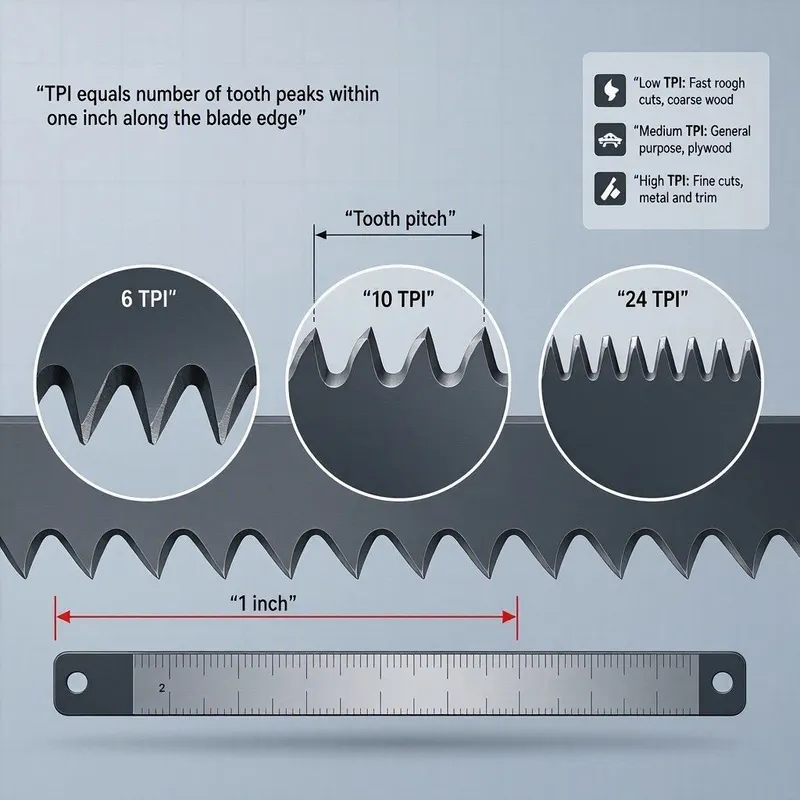
If you’ve been looking for reciprocating saw blades, you’ve probably noticed numbers such as 5 TPI, 8 TPI, 14 TPI or 24 TPI. But what do these numbers actually mean? In my reciprocating saw blade TPI guide you will find that TPI stands for teeth per inch, and it is one of the most useful things to understand when choosing a reciprocating saw blade.
The basic rule is fairly simple:
Lower TPI generally means larger, more widely spaced teeth for faster, rougher cutting. Higher TPI generally means smaller, more closely spaced teeth for finer cutting.
However, choosing the right TPI isn’t quite as simple as picking the biggest or smallest number. The material you’re cutting, its thickness and the type of cut you want all matter.
This guide explains TPI in simple terms and shows you how to choose the right reciprocating saw blade for common DIY jobs. TPI will likely be different depending on the reciprocating saw blade types.
What Does TPI Mean?
TPI means: Teeth Per Inch
It describes approximately how many teeth are present along one inch of the blade’s cutting edge.
For example:
- 5 TPI = relatively large, widely spaced teeth
- 10 TPI = smaller and more closely spaced teeth
- 20 TPI = much finer teeth
The easiest way to remember it is:
Low TPI = coarse teeth
High TPI = fine teeth
The correct TPI depends on what you’re cutting.
Why Does TPI Matter?
The number of teeth on a blade affects how the blade cuts.
A coarse blade with fewer teeth can remove material quickly. This makes it useful for thick wood and demolition work.
A fine-tooth blade removes less material with each stroke but provides more teeth in contact with the workpiece. This makes finer blades useful for thinner materials and many metal-cutting applications.
Manufacturers offer different TPI configurations for different materials and thicknesses, which is why you will see such a wide range of reciprocating saw blades available.
Low TPI vs High TPI
Here’s the simplest way to understand the difference.
| Feature | Low TPI | High TPI |
|---|---|---|
| Tooth size | Larger | Smaller |
| Tooth spacing | Wider | Closer |
| Cutting speed | Generally faster | Generally slower |
| Cut | Rougher | Finer |
| Common use | Thick wood | Thin materials/metal |
| Material removal | More per stroke | Less per stroke |
| Typical application | Demolition | Metal cutting |
These are general guidelines rather than absolute rules. Always check the blade manufacturer’s recommended application.
What TPI Should I Use for Wood?
Wood is one of the most common materials you’ll cut with a reciprocating saw.
For many wood-cutting jobs, a relatively low TPI wood blade is a good starting point.
Around 3–5 TPI
Very coarse blades can be useful for:
- Thick timber
- Fast rough cutting
- Demolition
- Large pieces of softwood
The large teeth remove material quickly. The downside is that the resulting cut can be quite rough.
Around 5–8 TPI
This can be a useful range for general wood cutting.
It’s suitable for jobs such as:
- Timber
- Softwood
- General construction wood
- Pallets
- Demolition
Around 8–12 TPI
A higher TPI can be useful when you want more control or a relatively cleaner cut in suitable wood.
However, the ideal choice also depends on the thickness and type of timber.
What TPI Should I Use for Wood With Nails?
If you’re cutting old timber containing nails, don’t simply choose a wood blade based on TPI. Instead, look for a demolition or bi-metal blade specifically designed for wood containing nails. The blade needs to cope with both the wood and the metal.
For example, specialist demolition blades are available with tooth configurations designed specifically for wood with embedded nails.
A blade around the 5–8 TPI range may be suitable for some demolition applications, but always follow the manufacturer’s specification.
What TPI Should I Use for Metal?
Metal generally requires a finer blade than thick wood. The exact TPI depends heavily on the type and thickness of the metal.
As a general guide:
Thin metal
Use a finer blade with a higher TPI.
Thick metal
A somewhat coarser metal-cutting blade may be more appropriate. This is because you need enough teeth engaged with the material during the cut. For example, Bosch offers a 24 TPI reciprocating blade for thin metal applications.
Don’t assume that the highest possible TPI is always best. The material thickness matters just as much as the material itself.
What TPI Should I Use for Thin Metal?
Thin metal normally benefits from a finer tooth configuration. A blade in the region of 18–24 TPI may be suitable for some thin-metal applications.
However, the manufacturer’s recommended material thickness is more important than simply choosing a number.
For example, a blade might be specifically designed for cutting thin sheet metal, while another blade with the same TPI could have different characteristics. Always check the manufacturer’s specifications.
What TPI Should I Use for Thick Metal?
Thicker metal can require a somewhat coarser blade. However, this doesn’t mean you should use a wood blade.
Use a blade specifically designed for metal and select the TPI based on the material thickness and manufacturer’s recommendations.
If you’re cutting substantial steel sections or pipe, check the blade specifications carefully before starting.
What TPI Should I Use for PVC and Plastic?
Plastic is different from metal and wood because there are many different types and thicknesses. A suitable plastic or multi-material blade is usually the best starting point.
A medium TPI blade may work well for many plastic-cutting applications, but again, the blade manufacturer’s specifications should be your guide. Avoid choosing a blade based on TPI alone.
What TPI Should I Use for Demolition?
For demolition, speed and durability are often more important than producing a clean edge. A coarse blade is commonly used for heavy wood-cutting and demolition work.
Around 5–8 TPI can be a useful general starting point for some demolition applications. However, demolition blades are designed in different ways, so look for blades specifically labelled for:
- Demolition
- Wood with nails
- Heavy-duty cutting
- Mixed materials
What TPI Is Best for Cutting Branches?
If you’re using a reciprocating saw for garden work, a suitable pruning blade is usually a better choice than simply selecting a blade based on TPI.
Pruning blades are designed around the characteristics of cutting green or dry wood and branches. Blade length and tooth design can be just as important as TPI.
Does Higher TPI Mean a Better Blade?
No. This is a common beginner’s mistake.
A 24 TPI blade isn’t automatically better than a 5 TPI blade.
They’re designed for different jobs.
Think of it like using a kitchen knife.
You wouldn’t say a bread knife is better than a carving knife simply because it has a different edge.
The same idea applies to reciprocating saw blades.
The best blade is the one suited to the material and job.
Does Lower TPI Cut Faster?
Generally, yes. A lower-TPI blade has larger teeth with wider gaps between them. This allows it to remove more material with each stroke.
That’s why coarse blades are often useful for fast cutting through thick wood. However, cutting speed also depends on:
- Saw power
- Blade quality
- Material
- Material thickness
- Cutting technique
- Battery condition
- Blade condition
So TPI isn’t the only factor determining cutting speed.
Does Higher TPI Give a Cleaner Cut?
Generally, a higher TPI blade can provide a finer cut in suitable materials. But don’t expect a reciprocating saw to produce the same finish as a jigsaw, circular saw or handsaw designed for accurate woodworking.
Reciprocating saws are primarily valued for their versatility, access and speed rather than precision. If appearance matters, choose the appropriate blade and let the saw do the work without excessive pressure.
How Thick Should the Material Be for Each TPI?
There isn’t one universal TPI chart that applies to every blade. Different manufacturers design blades differently, and tooth geometry, blade thickness and material all affect performance.
However, you can use this as a rough starting point:
| TPI | General Type | Typical Use |
| 3–5 TPI | Very coarse | Thick wood, fast cutting |
| 5–8 TPI | Coarse | Wood, demolition |
| 8–12 TPI | Medium | General wood, plastic, mixed materials |
| 12–18 TPI | Fine | Thin materials, some metal |
| 18–24+ TPI | Very fine | Thin metal and specialist applications |
Important: These aren’t fixed rules. Always check the blade manufacturer’s recommended material and thickness range.
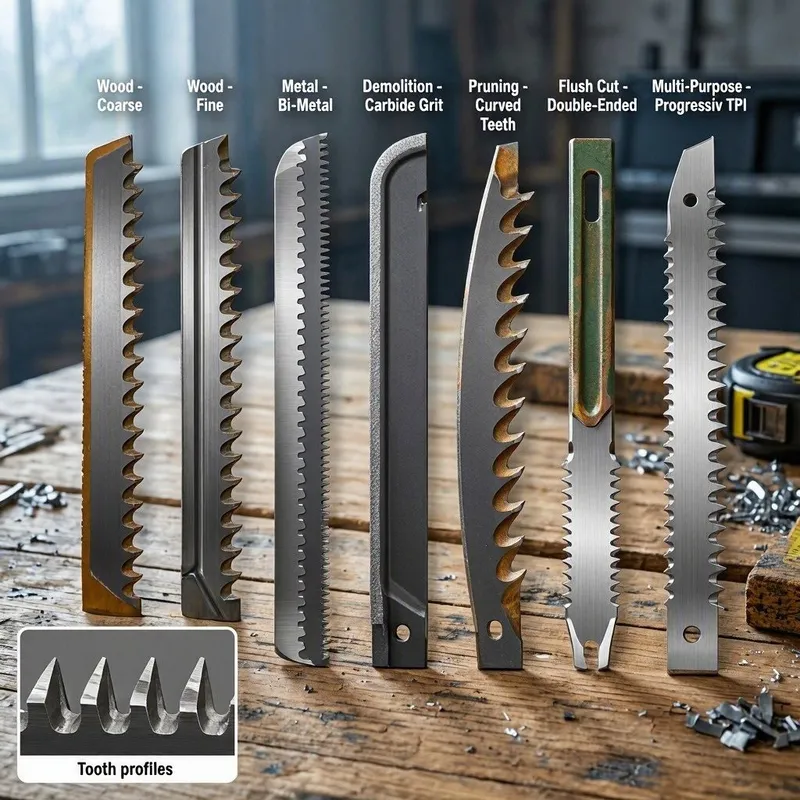
What Happens If You Use the Wrong TPI?
Using the wrong blade can cause several problems.
TPI Too Low
If the teeth are too coarse for a thin material, you may experience:
- A rough cut
- Increased vibration
- Poor control
- Difficulty starting the cut
- Damage to thin material
TPI Too High
If the teeth are too fine for thick wood, you may experience:
- Slow cutting
- Excessive heat
- Increased blade wear
- More frequent clogging
- Frustratingly slow progress
This is why choosing the correct TPI is about finding the right balance.
What Is Tooth Loading?
Tooth loading occurs when material becomes trapped between the teeth of the blade.
This can reduce cutting performance and make the blade less effective.
It can be particularly noticeable when using an inappropriate blade for the material.
Using the correct tooth spacing helps the blade clear material more effectively.
This is another reason why a coarse wood blade is useful for thick timber while a fine metal blade is better suited to many thin-metal applications.
Do More Teeth Always Mean a Slower Cut?
Not necessarily, but all else being equal, a fine-tooth blade generally removes less material per stroke than a coarse blade.
However, the actual cutting speed depends on many factors.
For example, a high-quality fine metal blade may cut thin sheet metal extremely effectively even though it has considerably more teeth than a coarse wood blade.
The important thing is to match the blade to the material.
Does Blade Length Affect TPI?
Blade length and TPI are separate specifications, but both can affect how suitable a blade is for a particular job.
For example, you might need:
- A long blade for thick material
- A shorter blade for better control
- A coarse blade for fast wood cutting
- A fine blade for thin metal
Don’t choose a blade based on TPI alone.
What TPI Should a Beginner Buy?
If you’re buying your first reciprocating saw blade set, don’t worry about covering every possible TPI.
A small selection is usually more useful.
For general DIY, you could start with:
General wood blade
A coarse blade around the 5–8 TPI range can be useful for general wood and demolition-type work.
Metal blade
A finer blade suitable for the thickness of metal you expect to cut.
Multi-material blade
A medium-to-fine blade designed for mixed materials can be useful for renovation jobs.
Demolition blade
A robust blade designed for wood containing nails and other demanding applications.
This gives you a useful starting collection without buying dozens of blades.
Quick TPI Guide for Beginners
If you want the simple version:
Cutting thick wood?
→ Start with a coarse, low-TPI wood blade.
Cutting general timber?
→ Look at a general-purpose wood blade around the medium-low TPI range.
Cutting wood containing nails?
→ Use a demolition/bi-metal blade designed for nails.
Cutting thin metal?
→ Look for a fine-tooth metal blade.
Cutting thick metal?
→ Choose a metal blade specifically rated for the material thickness.
Cutting plastic?
→ Use a suitable plastic or multi-material blade.
Cutting branches?
→ Use a pruning blade designed for the job.
Reciprocating Saw TPI Cheat Sheet
| Job | Starting Point |
| Thick softwood | 3–5 TPI |
| General timber | 5–8 TPI |
| Demolition | 5–8 TPI |
| Wood with nails | Specialist demolition/bi-metal blade |
| Plastic | Medium TPI/multi-material blade |
| Thin metal | 18–24+ TPI |
| General metal | Fine metal-cutting blade |
| Branches | Specialist pruning blade |
Remember that these are general starting points, not universal specifications.
The manufacturer’s recommendations should always take priority.
Frequently Asked Questions
What does TPI stand for?
TPI stands for teeth per inch. It describes the number of teeth along one inch of a saw blade’s cutting edge.
Is 5 TPI or 10 TPI better?
Neither is automatically better. A 5 TPI blade is generally better suited to fast, coarse cutting, while a 10 TPI blade may be more appropriate for different materials or applications.
Is higher TPI better for metal?
Higher TPI blades are commonly used for metal, particularly thinner metal, but the correct TPI depends on the type and thickness of the material.
Is lower TPI better for wood?
Generally, coarse, lower-TPI blades are useful for fast cutting of thicker wood. The exact choice depends on the wood and the type of cut.
What TPI should I use for cutting pallets?
A coarse wood or demolition blade is generally a good starting point. If the pallet contains nails, choose a blade specifically designed to cut wood containing nails.
What TPI should I use for cutting nails?
Don’t choose a blade based on TPI alone. Use a demolition or bi-metal blade specifically designed for cutting wood containing nails and follow the manufacturer’s recommendations.
Can I use one TPI for everything?
You can buy multi-material blades that are designed to handle several materials, but there isn’t one TPI that is ideal for every cutting job.
A small selection of blades will normally give you better results.
Final Thoughts
TPI can look complicated when you first start shopping for reciprocating saw blades, but the basic principle is quite simple.
Lower TPI generally means larger teeth and faster, rougher cutting.
Higher TPI generally means smaller teeth and finer cutting.
For most DIY beginners, you don’t need to become an expert in blade specifications.
Start by identifying the material you’re cutting, choose a blade specifically designed for it, and then use TPI as another way of selecting the appropriate blade.
And remember:
Don’t choose a blade because it has the highest TPI. Choose it because it’s designed for the job.
Once you understand TPI, choosing reciprocating saw blades becomes much easier.
New Saw or Upgrading Your Existing Setup
If you want to upgrade your existing reciprocating saw or want to know the latest models, then check out my Reciprocating Saw Buying Guide UK.