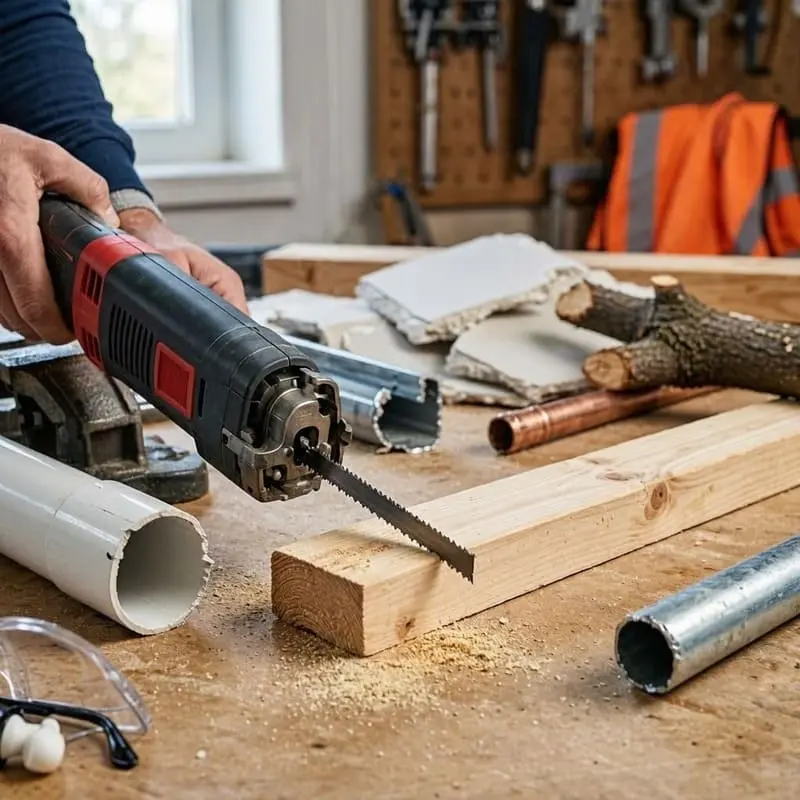
A reciprocating saw is a power tool with a blade that moves rapidly backwards and forwards to cut through materials. Unlike a circular saw, which uses a spinning blade, or a jigsaw, which is designed for more controlled cutting, a reciprocating saw uses a straight blade with a push-and-pull cutting action.
This makes it particularly useful for jobs where speed and access are more important than producing a perfectly neat finish.
For DIY beginners, the easiest way to think about a reciprocating saw is as a powerful demolition and rough-cutting saw.
It can cut materials including wood, plastic and metal when the correct blade is fitted. Different blades are designed for different materials and applications.
What Is a Reciprocating Saw Used For?
There are many jobs around the home where a reciprocating saw can save considerable time and effort.
1. Cutting Wood
A reciprocating saw can cut timber, wooden boards and other wood-based materials.
It is particularly useful when the cut doesn’t need to be perfectly neat.
For example, you could use one for:
- Cutting timber during a renovation
- Cutting old wooden framing
- Cutting through floorboards
- Cutting pallets
- Cutting timber containing nails
- Making rough cuts before removing old materials
For clean, accurate woodworking, however, another saw may be a better choice.
2. Demolition Work
This is where a reciprocating saw really comes into its own.
The long, narrow blade can reach into awkward areas and cut through materials that would be difficult to remove using a conventional saw.
With an appropriate demolition blade, you can cut through wood containing nails and other mixed materials. Some professional blade ranges specifically include blades designed for wood with embedded nails and demolition applications.
Typical DIY demolition jobs include:
- Removing old timber
- Cutting through wooden frames
- Removing old studwork
- Cutting nails and screws
- Taking apart pallets
- Cutting sections of old flooring
3. Cutting Plastic and PVC Pipe
A reciprocating saw can also be useful for cutting plastic pipes and profiles.
This can make it handy for certain plumbing and renovation jobs.
However, always make sure you know what is behind the material before cutting.
If you’re cutting inside a wall, floor or ceiling, you need to consider the possibility of hidden electrical cables, water pipes and other services.
4. Cutting Metal
With the correct metal-cutting blade, a reciprocating saw can cut a range of metal materials.
Depending on the blade and its specifications, applications can include:
- Metal pipe
- Steel sections
- Aluminium
- Sheet metal
- Metal profiles
Metal blades generally have finer teeth than blades intended for wood. For example, Bosch lists a 24 TPI reciprocating blade for thin metal applications, while lower-TPI blades are commonly used for wood and mixed-material applications.
5. Cutting Branches
A reciprocating saw can also be useful for some garden jobs.
With a suitable pruning or wood-cutting blade, it can make short work of branches that would otherwise require considerable effort with a hand saw.
It can be especially useful for:
- Cutting dead branches
- Removing smaller branches
- Cutting up garden waste
- Cutting timber and firewood
Always make sure the branch is secure and that you have a safe position before cutting.
6. Cutting Wood With Nails
One of the advantages of a reciprocating saw is its ability to deal with demolition materials.
A suitable bi-metal or demolition blade can be designed for cutting wood containing nails.
This makes the tool useful when dismantling old structures because you don’t necessarily have to remove every nail before making a cut.
Is a Reciprocating Saw Good for DIY?
Yes, but it depends on the type of DIY you’re doing.
A reciprocating saw is particularly useful if your projects involve:
- Renovation
- Demolition
- Cutting old timber
- Plumbing
- Cutting pipes
- Garden work
- General rough cutting
It is less suitable when you need extremely straight, precise or decorative cuts.
For those jobs, a circular saw, jigsaw or mitre saw may be a better choice.
Is a Reciprocating Saw Easy for Beginners to Use?
The basic operation is relatively straightforward, but that doesn’t mean it should be treated like a normal hand saw.
The blade moves extremely quickly and the saw can produce significant vibration.
A beginner should start with simple cuts in securely supported material and learn how the saw reacts before attempting more difficult jobs.
Always follow the instructions supplied with your particular saw and wear appropriate PPE.
What Blade Should You Use?
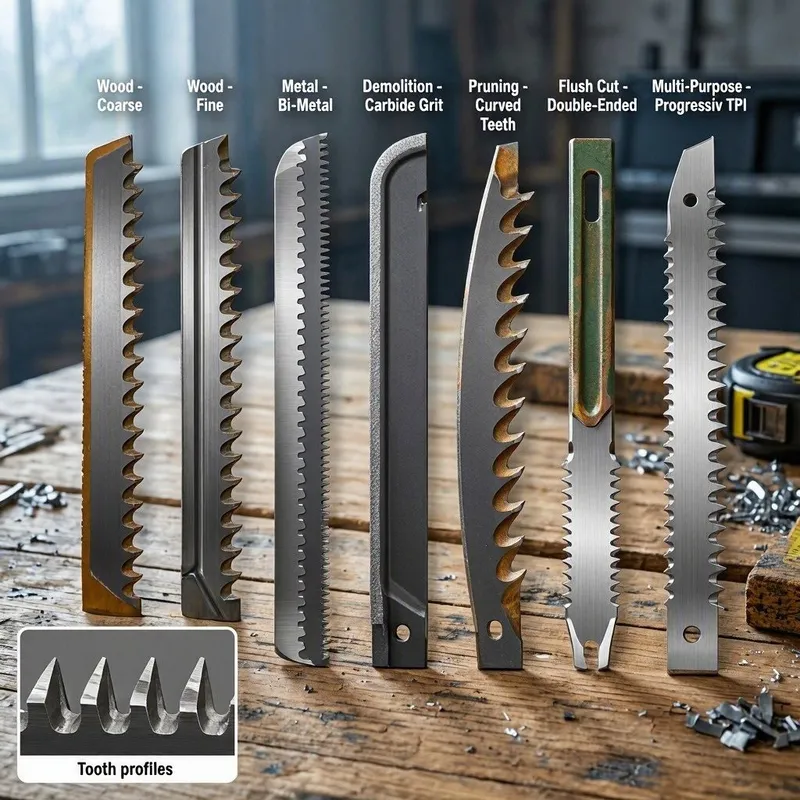
The blade is just as important as the saw itself. There isn’t one blade that is ideal for every job. As a general starting point:
| Job | Typical blade choice |
|---|---|
| Softwood | Coarser wood blade |
| General wood cutting | Wood-cutting blade |
| Wood with nails | Bi-metal demolition blade |
| Metal | Metal-cutting blade |
| Plastic/PVC | Suitable wood/plastic or multi-material blade |
| Branches | Pruning/wood blade |
TPI means teeth per inch. Generally, lower TPI blades make faster, rougher cuts, while higher TPI blades are more suitable for finer cutting and many metal applications.
Reciprocating Saw vs Other Saws
You may be wondering why you would buy a reciprocating saw when you already have other saws.
The answer is that each type of saw has a different job.
Reciprocating saw: Best for demolition, awkward access and rough cutting.
Jigsaw: Better for controlled curved and detailed cuts.
Circular saw: Better for long, straight cuts.
Mitre saw: Better for accurate crosscuts and mitre cuts.
Hand saw: Cheap, simple and useful for occasional cutting without batteries or electricity.
A reciprocating saw doesn’t replace all of these tools. Instead, it fills a particular gap.
Final Thoughts
A reciprocating saw is one of the most useful power tools for renovation and demolition work.
Its biggest advantages are its versatility, cutting speed and ability to reach awkward areas.
For a DIY beginner, it can be particularly useful for dismantling old timber, cutting pipes, tackling garden jobs and making rough cuts.
The most important thing to remember is that the blade determines what the saw can cut. Choosing the correct blade for the material will make the job easier, safer and more effective.
Once you’ve decided that a reciprocating saw is right for your DIY projects, the next question is usually: what exactly can you cut with a reciprocating saw?