By Enda McLarnon — Experienced UK DIYer sharing practical fixes from my 1958 red brick home.
Disclosure: As an Amazon Associate, I earn from qualifying purchases made through links on this page. If you buy a tool through my links, it costs you nothing extra, but the small commission helps me keep this site running.
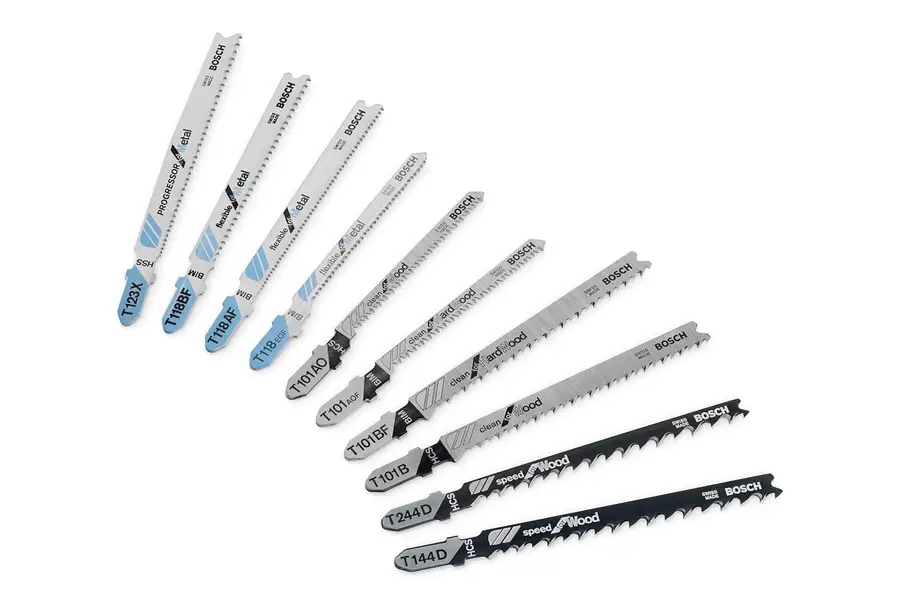
If you walk into a UK trade counter like Screwfix or Toolstation to buy a pack of jigsaw blades, you will quickly find yourself staring at an absolute alphabet soup of numbers and letters. Stamped onto the shank of almost every blade, whether it is made by DeWalt, Makita, or Bosch, is a cryptic code like T101B, T144D, or T244D.
If you just grab a random pack because the picture on the front shows a piece of wood, you are playing Russian roulette with your project. Use the wrong blade, and you will instantly splinter your expensive laminate flooring, dull your teeth on thin metal, or warp the blade until your cut is completely crooked.
The good news is that these markings aren’t random. They form a universal coding system originally designed by Bosch that is now used by virtually every major tool manufacturer.
As a heavy-duty DIYer who keeps a wide selection of DeWalt and Makita bits in my garage kit box, learning to decode these stamps completely changed how I work. Here is the dead-simple breakdown of what jigsaw blade numbers actually mean, and how to choose the right one for your next DIY task.
The Anatomy of a Jigsaw Blade Code
A standard universal jigsaw blade code is broken down into four distinct parts. Let’s take the most common wood-cutting blade in the UK—the T144D—as our example:
    T   ─►   1   ─►   44   ─►   D
   ▲        ▲        ▲         ▲
 Shank    Length   Material   Tooth
 Type      Code      Code     Size
1. The First Letter: Shank Type
The very first letter tells you if the blade will physically fit inside your jigsaw’s chuck mechanism.
- T (T-Shank): This is the modern, universal standard. It features a distinct single-tang design with two “wings” near the top. Virtually all modern cordless and corded jigsaws (including DeWalt, Makita, Bosch, and Parkside) use T-shanks because they snap cleanly into tool-free quick-release collets.
- U (U-Shank): This is an older American standard with a crescent-shaped cutout at the very top. Unless you are running an old, legacy jigsaw that requires an Allen key to tighten the blade down, you can completely ignore these.
2. The First Number: Blade Length
The number immediately following the ‘T’ tells you the overall length of the metal cutting shaft:
- 1: Standard/Short Length (approx. 75mm – 100mm) — Perfect for standard 18mm ply, MDF, and typical timber.
- 2: Medium Length (approx. 100mm – 115mm) — Great for deeper cuts.
- 3: Long Length (approx. 115mm – 150mm) — Built for heavy-duty structural posts.
- 7: Extra Long (150mm+) — Used for cutting insulated sandwich panels or massive timber sleepers.
3. The Middle Numbers: Material Type & Purpose
The next two digits specify what material the blade flutes were engineered to cut, alongside their geometric application:
- 01, 11, or 19: Engineered for clean, fine, splinter-free cuts in softwoods and laminates.
- 44: Engineered for fast, aggressive, coarse ripping cuts in raw timber.
- 18 or 27: Engineered for slicing through metals, aluminium, and non-ferrous piping.
4. The Final Letter: Tooth Geometry & Size
The letter at the very end of the code indicates the size of the cutting teeth and how close together they are (known as TPI, or Teeth Per Inch). This letter runs in alphabetical order from A (Finest) to D (Coarsest):
- A: Ultra-Fine Teeth (High TPI) — Best for sheet metal or clean plexiglass.
- B: Fine/Medium Teeth — The sweet spot for clean wood cuts and joinery.
- C: Coarse Teeth — Fast cuts in medium timber panels.
- D: Very Coarse/Large Teeth (Low TPI) — Designed to chew through thick timber at lightning speed.
- F: Bi-Metal Hardened — Built for cutting nail-embedded wood or heavy structural plastics.
The 3 Most Common Jigsaw Blades Every UK DIYer Needs
You do not need to memorise the entire dictionary of codes to build a great kit. If you stock your garage tool chest with just these three universal T-shank blades, you can successfully tackle 95% of household property renovations and garden tasks:
1. The T144D: The “Speed Demon” (Coarse Wood)
If you are building garden decking frames, assembling a timber stud wall, or cutting fence panels down to size, reach for the T144D.
- What it does: It features massive, ground-set teeth that act like tiny chisels, throwing sawdust out of the cut at blinding speed.
- The Trade-off: The cut is incredibly rough and will splinter the top edge of your material. Never use this on visible cabinetry or laminate!
- My Pick: DeWalt DT2163 T144D Packs — Hardened carbon steel that holds its edge beautifully against treated structural timber. Check Amazon UK for Price.
2. The T101B: The “Clean Finisher” (Fine Wood & Worktops)
When you are cutting down a visible cabinet carcass, trimming architectural skirting boards, or scribing timber panels, drop a T101B into your chuck.
- What it does: The teeth are small, pointed, and taper-ground. It cuts slower than a T144D but leaves an absolute mirror-smooth edge with zero splintering.
- My Pick: Bosch Expert T101B Clean for Wood — The gold standard for precision finishing work on the bench. Check Amazon UK for Price.
3. The T244D: The “Curve Master” (Intricate Scroll Cuts)
If you need to make an intricate radius cut—such as cutting out a laminate floor panel around a curved radiator pipe or profiling a decorative garden arch—you need a T244D.
- What it does: It has coarse teeth like the T144D for speed, but the physical width of the metal blade is cut in half. This narrow spine allows you to steer the saw around incredibly tight curves without the back edge wedging against the wood.
- My Pick: Bosch T 244 D Speed for Wood— Excellent flexibility that resists snapping when twisting through sharp corners. Check Amazon UK for Price.
Quick Summary Reference Table
| Code Stamp | Primary Material | Cut Style | Best Real-World DIY Application |
|---|---|---|---|
| T144D | Softwood & Construction Timber | Coarse / Ultra-Fast | Ripping decking joists, cutting fence posts, rough framing work. |
| T101B | Softwood, MDF, Plywood | Fine / Clean | Trim work, skirting boards, visible cabinet modifications. |
| T244D | Softwood & Plywood Panels | Curve / Scroll | Cutting around radiator pipes, intricate decorative arches, radius corners. |
| T118A | Sheet Metal, Steel & Aluminium | Ultra-Fine / Slow | Cutting copper plumbing pipes, trimming metal corner beads, sheet steel. |
Related Articles:
- Tired of ruined, uneven cuts? Learn the simple trick to stop underside blade flexing: [Why Is My Jigsaw Cut Straight on Top But Slanted Underneath?].
- Having blade tracking failures? Fix it safely using our manual guide: [Why Does My Jigsaw Blade Keep Jumping Off the Roller Wheel?].
- Upgrading your garage tool setup? Read my objective, hands-on review to find the perfect tool for your kit: [5 Best Jigsaws for DIY UK].

About the Author: Enda McLarnon
I’m an experienced UK DIYer tackling renovation life inside a 1958 red brick home.
I built this blog to help beginners conquer home maintenance anxiety and save a fortune on expensive trade calls.