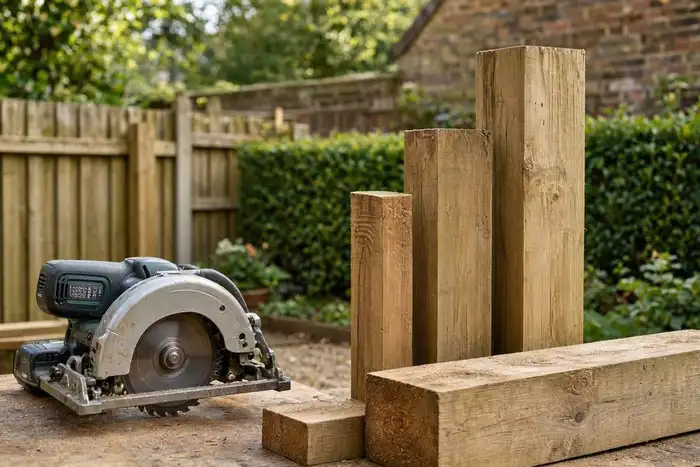
Can You Cut Fence Posts With a Circular Saw?
Yes, you can cut fence posts with a circular saw, provided the post is within the saw’s cutting capacity and the blade is suitable for the timber. A circular saw can be useful for cutting timber fence posts to length, trimming posts during a fencing project or making accurate straight cuts before installation.
However, fence posts can be considerably thicker than ordinary decking boards or smaller pieces of DIY timber. This means you need to check the actual size of the post and the cutting depth of your circular saw before starting.
For example, a typical 165mm circular saw may have a cutting depth of around 55–57mm at 90°. That is enough for smaller timber posts, but it will not cut completely through many larger fence posts in a single pass.
What Types of Fence Posts Can You Cut?
A circular saw may be suitable for cutting:
- Treated softwood fence posts
- Square timber fence posts
- Wooden gate posts
- Timber landscaping posts
- Smaller hardwood posts, with a suitable blade
For larger posts, you may need to consider a saw with greater cutting capacity or another suitable cutting method.
What About Concrete or Metal Fence Posts?
This guide is mainly about wooden and timber fence posts. Concrete, metal and other specialist posts require different tools and cutting methods, so you should not assume that a standard wood-cutting circular saw blade is suitable.
Is a Circular Saw a Good Choice?
For smaller timber posts and situations where you need a reasonably accurate straight cut, a circular saw can be an excellent choice.
The key is to match the saw, blade and cutting depth to the size and type of fence post rather than simply choosing the largest blade available.
In the sections below, we’ll look at common UK fence post sizes, suitable blades and how to work out whether your circular saw can cut through a particular post.
What You Need Before Cutting Fence Posts
Before cutting a fence post with a circular saw, it’s worth getting everything ready first. Fence posts can be heavy and awkward to handle, so a stable setup is particularly important.
Basic Equipment
For a typical timber fence post cutting job, you may need:
- Circular saw with enough cutting capacity for the post
- Suitable wood-cutting blade
- Tape measure
- Pencil or marking tool
- Combination square or carpenter’s square
- Suitable supports to keep the post stable
- Clamps, where appropriate
- Safety glasses or suitable eye protection
- Hearing protection when appropriate
You may also need a straightedge or guide if you want to make a particularly accurate cut.
Check the Fence Post First
Before cutting, check the post carefully.
Look for:
- Screws or nails
- Metal fixings
- Damaged or split sections
- Embedded hardware
- Areas that may contain unexpected obstructions
Never assume a piece of reclaimed or previously installed timber is free from metal.
Check the Saw and Blade
Make sure the circular saw is suitable for the size and type of post you’re cutting. Check the manufacturer’s stated maximum cutting depth, particularly if you’re working with a larger fence post.
The blade should also be suitable for the timber and compatible with your circular saw. Check the blade diameter, bore size and maximum RPM before fitting it.
Think About How the Post Will Be Supported
A fence post can be awkward to hold securely because of its length and weight. Place it on a stable surface and provide suitable support so it cannot move unexpectedly while you’re cutting.
If the post is particularly long or heavy, getting another person to help handle it can make the job easier.
Beginner Tip
Don’t start cutting until you’ve checked the post size, cutting depth, blade suitability and support.
A few minutes spent preparing the work area can make cutting a fence post much easier and help you achieve a cleaner, more controlled cut.
You may also want to read HSE guidance on using work equipment safely.
Common Fence Post Sizes in the UK
Fence posts come in a range of sizes depending on the type of fence, its height and how much support is required. For DIY projects, you’ll commonly come across square timber posts, although round posts and larger gate or structural posts are also available.
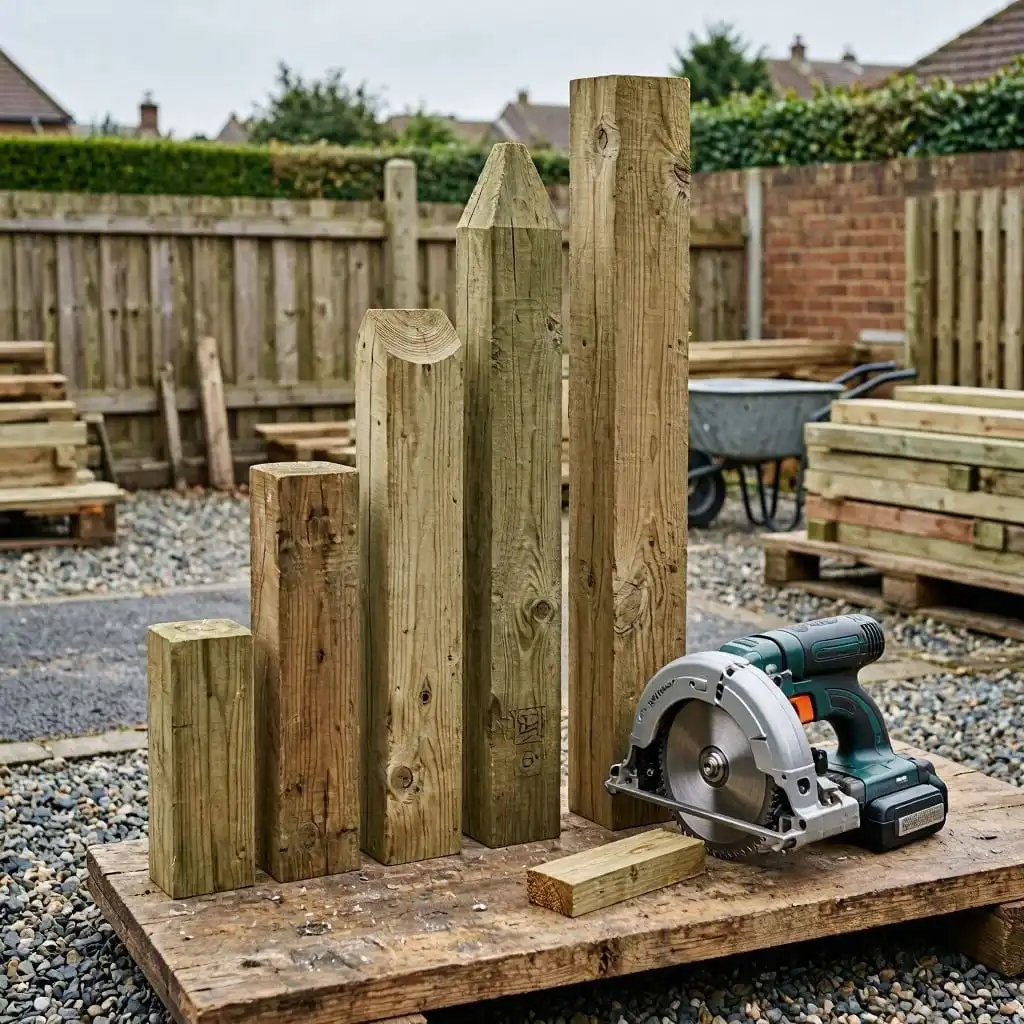
Typical Timber Fence Post Sizes
| Fence Post Size | Approx. Metric Size | Common DIY Use |
|---|---|---|
| 3 × 3 | 75 × 75mm | Smaller fences and lightweight projects |
| 4 × 4 | 100 × 100mm | General domestic fencing |
| 5 × 5 | 125 × 125mm | Heavier fencing and larger projects |
| 6 × 6 | 150 × 150mm | Large fences, gates and heavier-duty applications |
| 7 × 7 | 175 × 175mm | Larger structural or specialist applications |
These are typical nominal sizes rather than fixed UK standards. The actual finished dimensions can vary between suppliers and products. Always measure the fence post you’re actually working with before choosing a saw.
What Does This Mean for a Circular Saw?
The size of the post is important because it determines whether your circular saw can cut completely through it in one pass. For example, a typical 165mm circular saw may have a cutting depth of around 55–57mm at 90°.
That means:
- A 75 × 75mm post will normally be too thick to cut completely through in one pass.
- A 100 × 100mm post will also be too thick for a typical 165mm saw to cut through in one pass.
- Larger 125mm and 150mm posts require even greater cutting capacity or another cutting method.
However, the direction you cut the post from also matters. A post’s cross-section is much thicker than the saw’s cutting depth when cutting directly through its full width.
Treated Timber Fence Posts
Many UK fence posts are made from pressure-treated softwood to help protect them from outdoor conditions. Treated timber can be cut with a suitable wood-cutting circular saw blade, but always follow the manufacturer’s recommendations for the particular timber and treatment.
Gate Posts Are Often Larger
Gate posts can be significantly larger than ordinary fence posts because they may need to support the weight and movement of a gate. If you’re cutting a large gate post, check the dimensions carefully before deciding whether a circular saw is the right tool.
Measure the Actual Post
Don’t rely solely on the size printed on the packaging or listed by the supplier. Timber can be sold using nominal dimensions, while the actual finished size may be smaller.
Measure the post before cutting and compare that measurement with your circular saw’s actual cutting capacity.
What Circular Saw Blade Is Best for Fence Posts?
For most wooden fence posts, you should use a wood-cutting circular saw blade that is suitable for the type of timber you’re cutting. Because fence posts are often made from treated softwood, a general-purpose timber blade can be a good choice for typical DIY work.
What Tooth Count Should You Use?
The best tooth count depends on the type of cut you want to make.
| Blade Tooth Count | Typical Use |
|---|---|
| 18–24 teeth | Faster, rougher cuts in construction timber |
| 30–40 teeth | Good general-purpose choice for DIY |
| 40–60 teeth | Cleaner cuts where appearance matters |
For cutting ordinary treated timber fence posts, a 24–40 tooth blade is generally a sensible starting point. If the cut will be visible and you want a cleaner finish, a higher-tooth-count blade may be worth considering..
Check the Blade Is Suitable for Your Saw
Before fitting a blade, check:
- Blade diameter matches your circular saw
- Bore size is compatible
- Maximum RPM is suitable for the saw
- Blade is designed for cutting wood
- Blade is suitable for the type of timber you’re cutting
The blade manufacturer’s instructions should always take priority.
What About Treated Timber?
Treated fence posts are commonly used outdoors and can be harder or more abrasive to cut than untreated timber. Use a suitable, sharp blade and avoid forcing the saw through the material.
If you’re regularly cutting treated timber, choosing a quality carbide-tipped blade designed for construction timber can be a practical option.
What About Hardwood Fence Posts?
Hardwood posts can be denser than typical softwood fence posts. If you’re cutting hardwood, check that the blade is specifically suitable for the material. A blade designed for hardwood or general-purpose timber may be more appropriate than a basic construction blade.
What About Reclaimed Fence Posts?
Take extra care when cutting reclaimed timber. Old fence posts may contain nails, screws, staples or other metal objects that aren’t immediately visible.
Inspect the timber carefully before cutting and remove any accessible metal fixings. If you’re unsure whether the timber contains hidden metal, don’t simply assume it is safe to cut with a standard wood blade.
For More Information on Circular Saw Blades
If you’re unsure which blade tooth count or blade type is best for different DIY materials, see my guide to Best Circular Saw Blades for DIY UK.
The right blade can make a significant difference to cutting speed, finish and how easily your circular saw handles the material.
How to Mark a Fence Post for Cutting
Accurate marking is important when cutting a fence post, particularly if you need the finished post to be a specific length. A clear cut line also makes it easier to position the circular saw correctly.
Measure the Required Length
Use a tape measure to determine the length you need. Measure from the same reference point each time and mark the required length clearly with a pencil. If you’re preparing several posts for the same job, don’t automatically assume every post is identical. Check each one before cutting.
Use a Square for a Straight Cut
For a square timber fence post, a combination square or carpenter’s square is useful for marking a straight line around the post. Mark one face first, then transfer the line around the remaining faces.
This gives you a clear reference all the way around the post.
Use the Saw’s Cut-Line Indicator
Circular saws commonly have an arrow, notch, groove or other marking on the base plate to indicate the blade’s cutting path.
Before cutting, make sure you understand where your particular saw’s blade will travel in relation to this marking. Some models also have separate indicators for 90° and 45° cuts.
What About a Laser Guide?
Some circular saws have a laser guide that projects a line onto the material. A laser can make it easier to follow a straight cut, but it isn’t essential. A correctly marked line and the saw’s built-in cut-line indicator can be perfectly adequate for many DIY jobs.
If your saw has a laser, check the manufacturer’s instructions and make sure you understand how it is aligned with the blade.
Mark the Waste Side
Remember that the blade removes a small amount of timber as it cuts. This is called the kerf. If the finished length is important, mark the section that will be removed with an X.
This makes it clear which side of the line is the waste and helps prevent accidentally cutting on the wrong side of your mark.
Double-Check Before Cutting
Before starting the saw, check:
- The measurement is correct.
- The cut line is straight.
- The waste side is clearly marked.
- The saw’s cut-line indicator is understood.
- The post is properly supported.
- The blade has a clear cutting path.
Taking a few seconds to check the setup can prevent an incorrectly cut fence post.
How to Support a Fence Post Before Cutting
Fence posts can be heavy, long and awkward to handle, so proper support is important before using a circular saw. The post should remain stable while you make the cut, without anything interfering with the saw or blade.
Place the Post on a Stable Surface
Whenever possible, place the fence post on a stable work surface or suitable supports. The post should not rock, roll or move unexpectedly when you start cutting. For a long post, use suitable supports along its length rather than allowing it to hang unsupported.
Keep the Blade Path Clear
Make sure there is enough clearance underneath the cut for the circular saw blade. The blade should not contact the work surface, supports or anything else beneath the post. Think about where the blade will travel before starting the cut.
Use Clamps Where Appropriate
Clamps can help prevent the post from moving during cutting.
If you use clamps, position them so they:
- Hold the post securely
- Don’t interfere with the circular saw
- Don’t obstruct the cut line
- Don’t come into contact with the blade
Never position a clamp where the saw could accidentally strike it.
Consider the Offcut
Think about what will happen to the section of post being cut away. The offcut should be able to separate without pinching the blade or causing the post to move unexpectedly. This is particularly important when cutting long or heavy timber.
Get Help With Heavy Posts
Large fence posts can be surprisingly heavy. If a post is too long or awkward to position safely on your own, get another person to help support and handle it. Don’t try to control a heavy or unstable piece of timber while simultaneously operating a circular saw.
What If the Post Is Already Installed?
Cutting an installed fence post is a different situation. Before cutting, make sure you know what is around and behind the post. Check for fixings, brackets, cables, pipes or other obstructions that could be hidden from view.
If you’re unsure what is behind or inside the area you’re cutting, stop and investigate rather than making the cut.
Beginner Tip
A good setup should leave you with both hands available to control the saw as intended by the manufacturer, while the fence post remains securely supported.
If the timber is moving, unstable or awkward to control, stop and improve the setup before cutting.
How to Set the Cutting Depth
Before cutting a fence post, check that your circular saw has enough cutting depth for the size of timber you’re working with.
The required cutting depth depends on the thickness of the post and the direction you’re cutting it.
Typical Circular Saw Cutting Depths
As a general guide, typical cutting capacities at 90° are:
| Circular Saw Size | Typical Cutting Depth at 90° |
|---|---|
| 165mm | Around 55–57mm |
| 184mm | Around 60–65mm |
| 185mm | Around 60–65mm |
These are typical ranges rather than guaranteed specifications. Always check the manufacturer’s specifications for your particular circular saw.
For reference, a 165mm saw with around 55–57mm of cutting depth will not normally cut completely through a 75mm or 100mm square fence post in one pass.
Set the Depth Correctly
If your circular saw has an adjustable cutting depth, set it according to the manufacturer’s instructions and the job you’re carrying out.
Don’t assume that maximum cutting depth is always the best setting. The correct setup depends on the material, the type of cut and what is underneath the timber.
What If the Post Is Too Thick?
If the fence post is thicker than your circular saw’s cutting capacity, don’t force the saw through the timber.
Depending on the size and type of post, you may need to:
- Use a larger circular saw with greater cutting capacity
- Use another suitable saw
- Change the cutting approach if appropriate and safe
The important point is to make sure the chosen tool is suitable for the actual dimensions of the post.
Check the Direction of the Cut
A square post may be cut from different directions, so consider the actual distance the blade needs to travel through the timber.
For example, a 100 × 100mm post is 100mm across when making a straight cut through one full dimension. A typical 165mm circular saw cannot cut that distance in a single pass.
This is why measuring the actual post and comparing it with the saw’s cutting capacity is essential.
Cutting an Installed Fence Post
If the post is already installed, take particular care with cutting depth. You need to consider what is underneath or behind the section being cut, including other timber, fixings, cables or pipes.
Never set the saw depth without considering what the blade could contact beyond the timber.
Useful Guide
For a more detailed explanation of circular saw cutting capacities, see my guide to How Deep Can a Circular Saw Cut? UK DIY Guide.
Key Takeaway
Before cutting a fence post, check the actual post thickness, the saw’s cutting depth and what lies beyond the cut. If the post is thicker than the saw can safely handle, choose a more suitable cutting method rather than forcing the circular saw through it.
How to Cut a Fence Post Straight
A circular saw can make a clean, straight cut across a timber fence post, but accurate results depend on good preparation and keeping the saw under control.
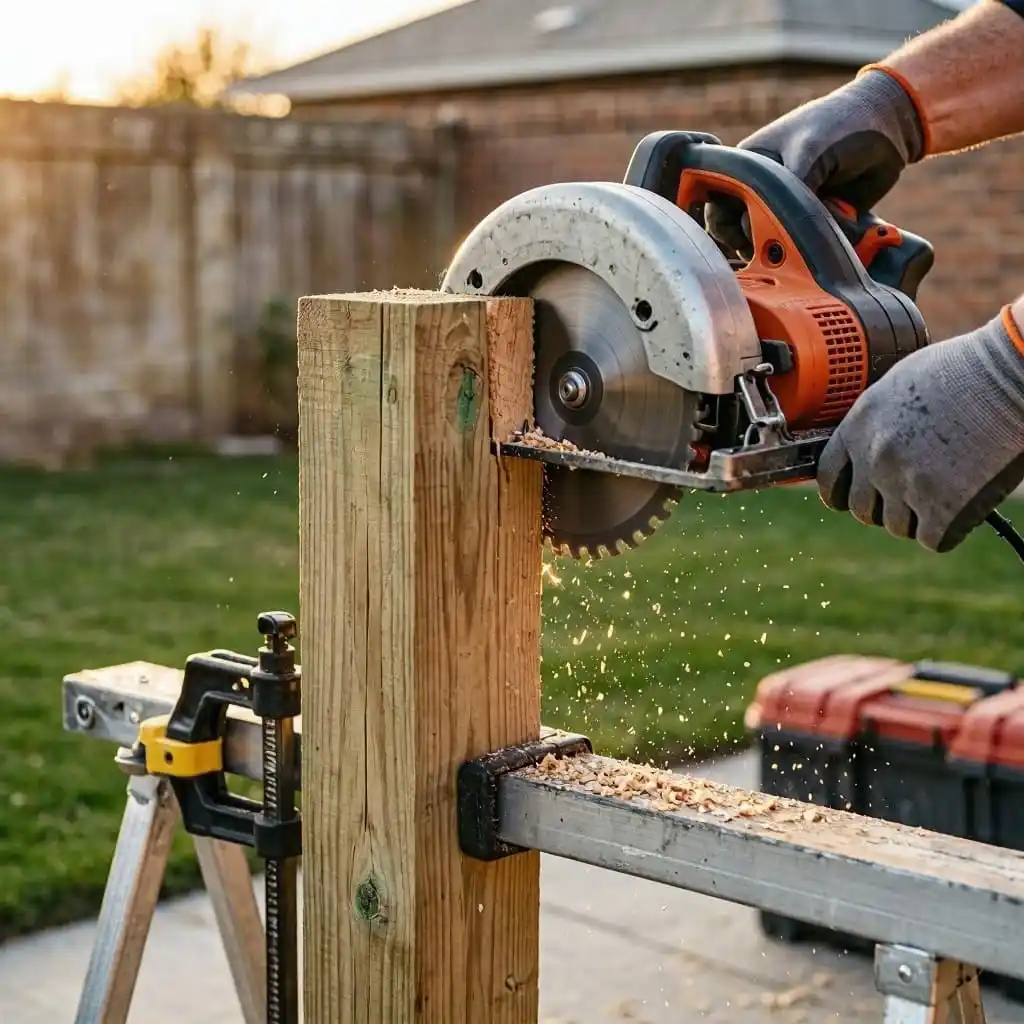
Mark the Cut Clearly
Start by measuring the required length and marking the fence post with a pencil. Use a square to create a straight line across the face of the post. For a square post, continue the line around the other faces so you have a clear reference from every side.
Align the Saw Correctly
Place the saw’s base plate flat against the timber and line up the blade’s cut-line indicator with your pencil mark. Most circular saws have an arrow, notch or groove that shows approximately where the blade will cut.
If your saw has a laser guide, you can use it to help follow the cut line, but always make sure you understand how the laser is aligned with the blade.
Keep the Saw Moving Steadily
Start the saw according to the manufacturer’s instructions and allow the blade to reach its normal operating speed before beginning the cut. Move the saw forward at a steady, controlled pace.
Don’t force the saw through the timber. If the blade struggles or slows significantly, stop and check the setup, blade and material.
Keep the Base Plate Flat
Keep the circular saw’s base plate firmly against the fence post throughout the cut.
Avoid twisting or rocking the saw, as this can affect the accuracy of the cut and the quality of the finished edge.
Use a Guide for Extra Accuracy
If you need a particularly accurate cut, a suitable straightedge or guide can help keep the saw travelling in a consistent direction.
For a simple crosscut on a square fence post, however, careful marking and the saw’s built-in cut-line indicator may be sufficient.
What If the Saw Cannot Cut Through the Post?
If the post is too thick for your circular saw to cut completely through in one pass, don’t force the saw.
A larger saw with greater cutting capacity or another suitable saw may be a better option.
Trying to force a circular saw beyond its intended cutting capacity can affect control and produce a poor result.
Beginner Tip
Before making the cut, check:
Measure → Mark → Support → Align → Cut steadily
Taking your time with the setup is often the easiest way to get a straight, accurate fence-post cut.
Can a 165mm Circular Saw Cut a Fence Post?
A 165mm circular saw can cut timber fence posts, but whether it can cut completely through the post in one pass depends on the post’s actual dimensions. A typical 165mm circular saw has a cutting depth of around 55–57mm at 90°, although the exact capacity varies between models.
What Does That Mean for Common Fence Posts?
Consider these typical square post sizes:
| Fence Post Size | Approx. Width | Can a Typical 165mm Saw Cut Through in One Pass? |
|---|---|---|
| 3 × 3 | 75mm | No |
| 4 × 4 | 100mm | No |
| 5 × 5 | 125mm | No |
| 6 × 6 | 150mm | No |
The reason is simple: even the smaller 75mm post is wider than the approximately 55–57mm cutting depth available from a typical 165mm saw.
So Can You Still Use a 165mm Saw?
Yes. A 165mm circular saw can still be useful for working with fence posts, particularly for smaller cuts, trimming and situations where the material thickness is within the saw’s cutting capacity.
However, you should not assume that a 165mm saw will cut completely through a standard square fence post in one pass.
If the post is thicker than the saw’s maximum cutting depth, consider a tool with greater cutting capacity or another suitable cutting method.
What About Cutting From More Than One Direction?
For a thick timber post, it may be possible to work from more than one side in some situations, but this requires careful setup and accurate alignment.
For beginners, it’s generally better to use a tool and cutting method that is comfortably suited to the size of the post rather than trying to extend a saw’s capabilities.
Check Your Actual Saw
Not every 165mm circular saw has exactly the same cutting capacity. Before starting, check the manufacturer’s specifications for your particular model.
A saw with a slightly different maximum cutting depth may give you more or less capacity than the typical figure.
Key Takeaway
A 165mm circular saw is useful for many DIY timber jobs, but standard square fence posts are often too thick to cut completely through in one pass.
Always compare the actual post thickness with your saw’s stated cutting depth before deciding whether it is suitable for the job.
How to Cut Thick Fence Posts
Thick fence posts can be challenging to cut with a standard circular saw because the timber may be wider than the saw’s maximum cutting depth. Before starting, measure the actual post and compare it with the cutting capacity of your saw.
Check the Post Size
A large fence or gate post can easily be 100mm, 125mm or 150mm square, while a typical 165mm circular saw may only cut around 55–57mm deep at 90°.
This means a standard circular saw will not normally cut completely through a large post in one pass.
Don’t Force the Saw
If the post is thicker than your saw’s cutting capacity, don’t try to force the blade through the timber.
Forcing the saw can make the cut harder to control and may place unnecessary strain on the tool and blade.
Instead, consider whether a more suitable saw is available for the size of timber you’re working with.
Consider a Larger Circular Saw
If you regularly work with large timber posts, a circular saw with a greater blade diameter and cutting capacity may be more appropriate.
However, don’t choose a larger saw simply because it has a bigger blade. Make sure its actual cutting capacity is suitable for the post sizes you expect to cut.
Other Tools for Thick Fence Posts
Depending on the job, other tools may be more suitable.
Reciprocating saw: Useful for rough construction, renovation and awkward timber cuts where a highly finished edge isn’t essential.
Hand saw: A practical option for occasional cuts where you don’t need to make large numbers of cuts.
Suitable larger saw: If you’re regularly cutting large posts accurately, a tool specifically designed for the required cutting capacity may be the better choice.
What About Cutting From Multiple Sides?
Working from more than one side can sometimes be used when a piece of timber is thicker than the saw’s cutting depth.
However, getting the cuts to meet accurately can be difficult, particularly on a large square post.
For a beginner, using a tool with sufficient cutting capacity is generally the simpler approach.
Think About the Weight of the Post
Large fence posts can be heavy and awkward to position.
Make sure the post is properly supported and stable before cutting. If it is too large or heavy to handle safely on your own, get appropriate assistance.
Key Takeaway
When cutting thick fence posts, the important question isn’t simply what size blade your circular saw has.
Instead, check the actual cutting depth of the saw against the actual thickness of the post.
If the post is too thick, choose a more suitable cutting method rather than trying to make the circular saw do more than it is designed to do.
Cutting Treated Timber Fence Posts
Many timber fence posts sold in the UK are pressure-treated to help protect the wood from outdoor conditions. A circular saw can be used to cut treated timber posts when the saw and blade are suitable for the job.
Use a Suitable Wood-Cutting Blade
Choose a sharp blade designed for cutting timber and compatible with your circular saw.
For general DIY work, a 24–40 tooth blade can provide a useful balance between cutting speed and finish.
Always check the blade manufacturer’s recommendations before use.
Treated Timber Can Be Tougher to Cut
Treated timber can sometimes be harder or more abrasive to cut than untreated timber.
Don’t force the circular saw through the post. Allow the blade to cut at a controlled pace and replace or sharpen the blade if it becomes noticeably dull.
Take Care With the Cut End
Once you cut a treated fence post, the freshly exposed end may no longer have the same factory-applied treatment as the original timber surface.
If the timber manufacturer or treatment supplier recommends a suitable end-grain preservative or treatment product, follow those instructions before installing or exposing the cut end to outdoor conditions.
The correct product depends on the type of treatment and timber, so don’t assume that any wood treatment is suitable.
Wear Appropriate Protection
Cutting timber produces dust and debris, so use appropriate eye protection and follow the safety instructions supplied with your circular saw and blade.
Where dust is produced, use suitable dust control and ventilation measures.
For additional general guidance, you can also refer to the HSE guidance on using work equipment safely.
Check the Timber Before Cutting
Inspect treated fence posts before cutting, particularly if they have already been used.
Look for:
- Nails
- Screws
- Staples
- Brackets
- Other metal fixings
- Damaged or split timber
Never cut through timber containing metal with a standard wood-cutting blade unless the blade is specifically designed and approved for that purpose.
Key Takeaway
A circular saw can be useful for cutting treated timber fence posts, but use a suitable sharp blade, support the post properly and follow the manufacturer’s recommendations.
If you cut a treated post, check whether the exposed end needs additional treatment before it is installed outdoors.
Common Mistakes When Cutting Fence Posts
Cutting a fence post with a circular saw is straightforward when the post, saw and blade are properly matched. However, a few common mistakes can lead to inaccurate cuts, damaged timber or unnecessary wear on the saw.
1. Not Checking the Post Size
One of the most common mistakes is assuming that a circular saw will cut through any fence post. Measure the actual post and compare its thickness with your saw’s cutting capacity before starting.
2. Using the Wrong Blade
A blade designed for the wrong material or application can produce a poor cut and may not be suitable for the timber. Use a blade designed for the type of wood you’re cutting and check that it is compatible with your circular saw.
3. Poor Support
A long or heavy fence post can move while you’re cutting if it isn’t properly supported. Make sure the post is stable and supported along its length where necessary.
4. Cutting Without Checking for Metal
Used or reclaimed fence posts may contain hidden nails, screws, staples or brackets. Inspect the timber carefully before cutting. A standard wood-cutting blade should not be used to cut through hidden metal.
5. Setting the Depth Incorrectly
Don’t assume that maximum cutting depth is always the correct setting. Check the saw manufacturer’s instructions and consider what is beyond the timber, particularly if you’re cutting an installed post.
6. Rushing the Cut
Trying to push the circular saw through the timber too quickly can affect the quality of the cut and make the saw harder to control. Keep the saw moving at a controlled pace and don’t force it through the post.
7. Not Marking the Cut Properly
An inaccurate or unclear mark can result in a post being cut too short or at the wrong angle.
Use a tape measure and square to create a clear, straight cut line before starting.
8. Ignoring the Kerf
Remember that the blade removes a small amount of material as it cuts. This is called the kerf.
Mark the waste side of the cut clearly so you know which part of the post is being removed.
9. Forgetting About the Offcut
Think about what will happen to the section of timber being cut away. The offcut should not cause the post to move unexpectedly or interfere with the blade during the cut.
Beginner Tip
Before starting, use this simple checklist:
Measure → Mark → Check the blade → Support the post → Check the cutting depth → Cut steadily
Taking a few extra seconds to prepare can make fence-post cutting much easier and more accurate.
Tips for Getting Cleaner Fence Post Cuts
If you want your fence posts to have a clean, square-looking finish, a few simple techniques can make a noticeable difference.
The saw itself is only part of the equation. A sharp blade, accurate marking and good support are just as important.
Use a Sharp Blade
A sharp blade will generally produce a cleaner cut and make it easier for the saw to move through the timber.
For general treated softwood fence posts, a suitable 24–40 tooth wood-cutting blade is a practical choice for many DIY jobs. Replace or sharpen the blade when it becomes noticeably dull, following the manufacturer’s recommendations.
Mark All the Way Around the Post
For a square fence post, don’t rely on a single mark on one face.
Use a square to mark the cut line clearly and transfer it around the post. This gives you a reference on each face and can help maintain a square cut.
Use the Saw’s Cut-Line Indicator
Most circular saws have an arrow, notch or groove on the base plate that helps indicate the blade’s cutting path. Line this up carefully with your marked cut line.
If your saw has a laser guide, you can use it as an additional reference, but a laser is not essential for making an accurate cut.
Keep the Saw Base Flat
Keep the circular saw’s base plate sitting flat against the timber while cutting. Avoid twisting or rocking the saw, as this can affect the angle of the cut and the quality of the finished edge.
Support the Post Properly
A stable fence post is easier to cut accurately. Use suitable supports to prevent the post from moving or flexing during the cut, while keeping the blade path clear.
Make a Test Cut
If you’re using a new blade or working with an unfamiliar type of timber, consider making a test cut on an offcut first. This lets you check the quality of the cut before working on the post you actually need.
Don’t Force the Saw
Let the blade do the work. Move the circular saw forward at a controlled pace rather than forcing it through the timber. If the saw struggles, stop and check the blade, material and setup.
Think About the Finished Edge
If the cut end of the post will be visible, taking extra care with the blade and marking can help produce a neater result. For treated outdoor timber, also check whether the exposed end needs additional treatment after cutting.
Beginner Tip
For a cleaner fence-post cut, remember:
Sharp blade + accurate marking + good support + steady cutting = better results.
A little extra preparation can make a significant difference to the finished post.
Frequently Asked Questions
Can you cut fence posts with a circular saw?
Yes, you can cut wooden fence posts with a circular saw as long as the post is within the saw’s cutting capacity and you use a suitable wood-cutting blade.
Can a 165mm circular saw cut a 4×4 fence post?
A typical 165mm circular saw has a cutting depth of around 55–57mm at 90°, while a 4×4 fence post is around 100×100mm. This means a typical 165mm circular saw cannot cut completely through a 4×4 post in one pass.
Always check the actual cutting depth of your particular saw.
What size circular saw do I need for fence posts?
It depends on the size of the posts you are cutting. A 165mm circular saw is useful for smaller timber and trimming jobs, but larger fence posts can exceed its cutting capacity.
If you regularly cut large 100×100mm, 125×125mm or 150×150mm posts, a saw with greater cutting capacity may be more suitable.
What blade should I use to cut treated fence posts?
For general treated softwood fence posts, a 24–40 tooth carbide-tipped wood blade is a sensible choice for many DIY jobs.
A lower tooth count can cut faster, while a higher tooth count can give a cleaner finish. Always make sure the blade is suitable for your saw and the material being cut.
Can you cut treated timber fence posts with a circular saw?
Yes. Treated softwood fence posts can normally be cut with a suitable circular saw and wood-cutting blade.
Remember that cutting exposes fresh timber at the cut end, so follow the timber manufacturer’s or treatment supplier’s advice about protecting the newly exposed end grain where appropriate.
Can you cut a fence post that is already installed?
You can use a circular saw for some installed-post trimming jobs, but extra care is needed.
Before cutting, check what is around and behind the post, including fence fixings, brackets, screws, cables, pipes and other hidden obstructions. Make sure the saw can be used safely and that the cutting path is clear.
Can a circular saw cut hardwood fence posts?
Yes, provided the saw and blade are suitable for the hardwood being cut.
Hardwood can be more demanding than softwood, so use a suitable quality blade and check the manufacturer’s recommendations for the saw and blade.
Why won’t my circular saw cut all the way through a fence post?
The most common reason is simply that the post is thicker than the saw’s maximum cutting depth.
For example, a typical 165mm circular saw may cut around 55–57mm deep at 90°, while common fence posts can be 75mm, 100mm or even 150mm square.
If the post is too large for the saw, don’t force the tool through the timber. Choose a suitable saw or another appropriate cutting method instead.
Can a reciprocating saw cut fence posts?
Yes. A reciprocating saw can be useful for cutting larger posts, particularly during fencing repairs, renovation work or awkward cuts where a perfectly clean finish is not the main priority.
For accurate straight cuts, however, a suitable circular saw may provide a cleaner and more controlled result when the post is within its cutting capacity.
What is the best way to get a straight cut on a fence post?
Mark the post carefully using a square and make sure the cutting line continues around the faces of the post.
Align the saw’s cut-line indicator with your mark and keep the base plate flat against the timber while making the cut. For particularly important or repetitive cuts, a suitable guide can help improve consistency.
Do you need a laser guide to cut fence posts?
No. A laser guide can make it easier to see the intended cutting line, but it is not essential.
Most circular saws have a notch, groove or arrow on the shoe that helps indicate the blade’s cutting path. Check your saw’s instructions to understand exactly how its indicator works.
Can you cut a fence post with a hand saw instead?
Yes. A hand saw can be a practical option if you only need to cut one or two posts and don’t want to use a power tool.
It can take longer and may require more effort, particularly with larger posts, but it is still a useful option for occasional DIY work.
Can you cut concrete or metal fence posts with a circular saw?
Not with a standard wood-cutting setup.
Concrete, metal and other specialist fence-post materials require the correct cutting equipment and blade for the material. Never assume that a normal wood-cutting circular saw blade is suitable for these materials.
Final Verdict
Yes, you can cut fence posts with a circular saw, and it can be an excellent tool for cutting smaller wooden posts and trimming timber to length.
The main thing to remember is that the size of the fence post matters. A typical 165mm circular saw can cut around 55–57mm deep at 90°, so it will not normally cut completely through common 75mm, 100mm or larger square fence posts in a single pass.
Before cutting, check the actual dimensions of the post and compare them with your circular saw’s maximum cutting depth. Use a suitable wood-cutting blade, support the post securely and mark the cut carefully with a square.
For treated softwood fence posts, a 24–40 tooth carbide-tipped blade is a sensible choice for many general DIY jobs. If you need a particularly clean finish, a higher tooth-count blade may be preferable.
If you’re regularly cutting large fence posts, a larger saw or another suitable cutting tool may be more practical. A reciprocating saw can also be useful for rougher fencing and renovation work where the finish of the cut is less important.
The key points are:
- Check the post size before cutting
- Check your saw’s actual cutting depth
- Use a suitable blade for the timber
- Support the post securely
- Mark the cut accurately
- Check for nails, screws, brackets and other hidden metal
- Take extra care when cutting an installed post
- Don’t force the saw if the timber is too thick
For most DIY jobs, choosing the right saw for the size of the post is more important than simply choosing a larger blade. If the post is within your saw’s cutting capacity, a circular saw can make quick, accurate and clean cuts.