
Can You Cut Decking With a Circular Saw?
Yes, a circular saw is an excellent tool for cutting decking boards. It is particularly useful when you need to make straight crosscuts or trim decking boards to length during a new deck installation or renovation.
Most timber decking boards are relatively easy for a suitable circular saw to cut because their thickness is normally well within the cutting capacity of common DIY circular saws. The main things to consider are the type of decking, blade, cutting depth, support and accuracy.
Quick Answer
A circular saw can cut:
- Timber decking boards
- Treated softwood decking
- Hardwood decking, with a suitable blade
- Composite decking, when the manufacturer allows circular saw cutting
For most DIY decking projects, a 165mm circular saw should provide plenty of cutting capacity for standard decking boards.
A suitable wood-cutting blade with around 24–40 teeth is a good starting point for timber decking. A higher-tooth-count blade can be useful when you want a cleaner finished edge.
What About Composite Decking?
Composite decking can also be cut with a circular saw, but the correct blade is particularly important. Composite decking products can differ in their construction and recommended cutting methods, so always check the manufacturer’s instructions before cutting.
Some manufacturers specify particular blade types or tooth counts for their products.
Why Use a Circular Saw for Decking?
A circular saw is useful for decking because it can make:
- Quick crosscuts
- Straight cuts
- Consistent cuts across multiple boards
- Accurate length cuts
- Cuts when trimming boards during installation
For longer or particularly accurate cuts, a suitable straightedge or guide can help keep the saw following the intended line.
What Should You Check First?
Before cutting decking, check:
- What type of decking you’re cutting
- The actual thickness of the board
- That your blade is suitable
- Your saw’s maximum cutting depth
- That the decking is properly supported
- That the cutting area is clear
For beginners, the important point is simple: a circular saw is one of the most useful power tools for cutting decking, provided the saw and blade are suitable for the material.
What You Need Before Cutting Decking
Before cutting decking with a circular saw, it helps to have everything prepared so you can concentrate on making accurate cuts. You don’t need a huge collection of equipment. For most DIY decking projects, the basics are enough.
Circular Saw
You’ll need a circular saw with enough cutting capacity for the decking you’re working with.
A 165mm circular saw is generally more than capable of cutting standard timber decking boards, although you should always check the actual cutting depth of your particular saw.
Suitable Decking Blade
Use a blade designed for the material you’re cutting. For timber decking, a suitable wood-cutting blade with around 24–40 teeth can be a good general-purpose choice.
If you’re cutting hardwood or composite decking, check the manufacturer’s recommendations because the appropriate blade can vary.
Measuring and Marking Tools
You’ll normally need:
- Tape measure
- Pencil
- Combination square or straightedge
- Suitable saw guide or straightedge for longer cuts
Accurate measuring and marking are just as important as having the right saw.
Stable Supports
Decking boards are long and can flex or move if they’re not properly supported. Use a stable work surface or suitable supports to keep the board secure while cutting.
Make sure the blade has enough clearance underneath the board and cannot contact the supports.
Clamps
Clamps can be useful for holding decking securely, particularly when making cuts away from an existing structure. If using clamps, position them so they don’t interfere with the movement of the saw or the cutting path.
Personal Protective Equipment
At a minimum, consider suitable:
- Eye protection
- Hearing protection
- Work clothing
- Safety footwear
Depending on the material and working environment, appropriate dust control or respiratory protection may also be necessary.
Check the Decking Before Cutting
Before making a cut, inspect the board for:
- Splits
- Cracks
- Knots
- Screws or nails
- Warping
- Damage
This is particularly important with existing or reclaimed decking, which may contain old fixings. Also check the area around and underneath the board for anything that could be damaged by the blade.
For beginners, having the right blade, accurate measuring tools and secure support will make the cutting process much easier.
Common Decking Sizes and Types in the UK
Decking boards come in a range of sizes and materials, so it’s worth checking the actual dimensions before choosing your saw and blade. For most standard timber decking, a 165mm circular saw will have more than enough cutting depth for a single board.
Common Timber Decking Sizes
Typical decking board dimensions vary between manufacturers, but common UK sizes include:
| Decking board | Approx. dimensions | Common use |
|---|---|---|
| Narrow decking | Around 21 × 100mm | Smaller decks and garden projects |
| Standard decking | Around 27 × 120mm | General domestic decking |
| Wide decking | Around 32 × 140mm | Larger boards and heavier-duty projects |
| Hardwood decking | Around 20–25 × 90–145mm | Premium decking and outdoor areas |
These are typical examples rather than fixed UK standard sizes. Always measure the actual board you’re working with.
Timber Decking
Timber decking is commonly made from treated softwood or hardwood. Treated softwood decking is popular for domestic projects because it is widely available and relatively easy to cut.
Hardwood decking can be denser and harder on blades, so a suitable sharp blade is particularly important.
Composite Decking
Composite decking is made from a mixture of materials, commonly including wood fibres and plastic. It can be cut with a circular saw on many products, but the manufacturer’s instructions should always be checked first.
Different composite decking systems can have different recommendations for blade type, tooth count and cutting technique.
Check the Actual Thickness
The thickness of the decking is particularly important when checking your circular saw’s cutting capacity.
For example, a board that is around 27mm thick is comfortably within the cutting capacity of most 165mm circular saws.
Even a board around 32mm thick is normally well within the capacity of a typical 165mm saw.
The important measurement is the actual thickness of the board, not simply its advertised or nominal size.
What Are Decking Boards Used For?
Decking boards are mainly used for outdoor projects such as:
- Garden decking
- Raised decking areas
- Steps and platforms
- Outdoor seating areas
- Garden walkways
- Small landscaping projects
Because decking boards are usually long and relatively narrow, proper support becomes particularly important when cutting them.
For more information about circular saw cutting capacity, see my guide to how deep a circular saw can cut.
For beginners, the main takeaway is simple: standard timber decking is normally well within the cutting capacity of a 165mm circular saw, but always measure the actual board and check your saw’s specification.
What Circular Saw Blade Is Best for Decking?
The best circular saw blade for decking depends on the material you’re cutting and the type of finish you want. For standard timber decking, a good-quality wood-cutting blade with around 24–40 teeth is a sensible choice for most DIY projects.
24T Blades for Fast Cuts
A blade with around 18–24 teeth can be useful when speed is more important than having a particularly fine finish. These blades can work well for:
- Treated softwood decking
- Construction-style timber
- Rougher outdoor projects
- Cuts where the edge will not be highly visible
The larger spaces between the teeth allow the blade to remove material quickly, although the cut can be rougher.
30–40T Blades for General Decking
For most DIY decking projects, a 30–40 tooth blade provides a useful balance between cutting speed and finish. This can be a good choice when cutting standard softwood decking boards to length.
A 40T blade may also be preferable when you want a cleaner-looking finished edge.
Higher Tooth Counts for Cleaner Cuts
If you’re working with hardwood decking or want a particularly clean finished edge, a blade with around 40–60 teeth may be worth considering. The additional teeth can produce a smoother cut, although the saw will generally cut more slowly.
Always choose a blade that is suitable for the particular material.
What Blade for Composite Decking?
Composite decking requires a little more care when choosing a blade. Different composite decking products can have different compositions and manufacturer recommendations.
Some products may recommend a fine-tooth carbide-tipped blade, while others specify a particular tooth count or blade type. Always check the manufacturer’s instructions before cutting composite decking.
Check the Blade Is Compatible With Your Saw
Before fitting any replacement blade, check:
- Blade diameter
- Bore size
- Maximum RPM rating
- Material suitability
- Manufacturer’s instructions
The blade must be compatible with your particular circular saw. For more information about tooth counts and choosing blades, see my guide to the best circular saw blades for DIY UK.
For most beginners cutting ordinary timber decking, a 30–40T wood-cutting blade is a sensible starting point. If you’re mainly making fast construction cuts, a lower-tooth-count blade can be useful, while higher tooth counts can help when the finished edge matters.
How to Mark Decking for Cutting
Accurate marking is important when cutting decking because even a small measurement error can leave a board too short or too long for the area you’re fitting it into. For most cuts, all you need is a tape measure, pencil and a straightedge or combination square.

Measure the Board Carefully
Measure from the end of the decking board and mark the required length with a sharp pencil. For example, if the board needs to finish at 1,200mm, measure 1,200mm from the reference end and make a clear mark.
Check the measurement before cutting. If you’re cutting several boards to the same length, it’s worth checking the first one carefully before repeating the measurement.
Draw a Clear Cutting Line
Use a combination square or straightedge to draw a line across the full width of the decking board. A clear line gives you something to follow with the saw’s cut-line indicator.
For longer or particularly accurate cuts, a suitable saw guide or straightedge can also help keep the saw travelling consistently.
Use the Saw’s Cut-Line Indicator
Many circular saws have an arrow, notch, groove or other marking on the shoe that indicates the blade’s cutting path. Line this indicator up with your pencil mark before starting the cut.
Some saws also have separate markings for 90° and 45° cuts, so check the markings on your particular saw.
If your circular saw has a laser guide, this can also help indicate the cutting path.
A laser isn’t essential, however. The saw’s built-in cut-line indicator and a clearly marked line are often all you need for straightforward DIY cuts.
Mark the Waste Side
If you’re cutting a decking board to a specific finished length, it can help to mark the section that will become waste with an X. This makes it clear which side of the cutting line is being removed.
Remember that the blade has a kerf, meaning it removes a small amount of material as it cuts.
Check Before Cutting
Before starting the saw, check:
- The required finished length
- The cutting line
- Which section is waste
- The saw’s cut-line indicator
- The actual board dimensions
- That the decking is properly supported
- That the cutting path is clear
Taking a few extra seconds to check your measurements can prevent an otherwise good decking board from being cut incorrectly.
For beginners, measure twice, mark clearly and check the saw’s cut-line indicator before cutting.
How to Support Decking Before Cutting
Decking boards are often long and slightly flexible, so proper support is particularly important when cutting them with a circular saw. A board that moves, bends or becomes unstable during a cut can make accurate cutting much more difficult.
Support the Decking Securely
Place the decking on a stable work surface or suitable supports so it cannot move around while you’re cutting. Because decking boards can be quite long, you may need more than one support point to prevent the board from sagging.
Make sure the supports are positioned so the blade has clear space underneath the cutting line.
Keep the Blade Path Clear
Before cutting, check underneath and around the decking for anything that could come into contact with the blade.
Look for:
- Cables
- Pipes
- Screws
- Nails
- Tools
- Clamps
- Other objects
This is especially important if you’re cutting decking that has already been installed or is being modified in place.
Use Clamps When Appropriate
Clamps can help keep a decking board secure while you make a cut. If you use them, position them so they cannot interfere with the saw, blade or cutting path. Don’t rely on holding the board in place with your hand while cutting.
Think About the Offcut
Consider what will happen to the section of decking that you’re removing. A long offcut can move or fall as the cut is completed, particularly if it is unsupported.
Arrange the decking so the main board remains stable while the offcut can separate without causing the board or saw to move unexpectedly.
Supporting Long Decking Boards
Long boards can be awkward to handle, particularly when working alone. Use suitable supports along the length of the board and make sure you have enough room to operate the saw comfortably.
If a board is particularly long, heavy or difficult to control, consider getting assistance rather than trying to manage the material and saw at the same time.
Cutting Decking Already Installed
If you’re trimming an existing deck, take extra care before making any cut. Check what is underneath the board and consider nearby joists, fixings and other parts of the deck.
You need to make sure the blade will not contact anything other than the material you’re intending to cut.
For beginners, the simple rule is: support the decking securely, keep the blade path clear and make sure the board cannot move unexpectedly during the cut.
How to Set the Correct Cutting Depth
Before cutting decking, check that your circular saw has enough cutting capacity for the board you’re working with.
Most standard decking boards are relatively thin, so a typical 165mm circular saw will normally have more than enough capacity. However, you should always check the actual specification of your saw.
Measure the Decking Thickness
Start by measuring the actual thickness of the decking board. Common timber decking boards may be around 20–32mm thick, although dimensions vary between products and manufacturers.
Don’t rely solely on the advertised size. Measure the actual board if you’re unsure.
Check Your Saw’s Cutting Depth
As a general guide, many circular saws provide approximately:
| Circular saw size | Typical depth at 90° |
|---|---|
| 165mm | Around 55–57mm |
| 184mm | Around 60–65mm |
| 185mm | Around 60–65mm |
These are typical ranges rather than universal specifications. Always check your particular saw’s manufacturer’s specifications or instruction manual.
Set the Depth for the Board
If your saw has an adjustable cutting-depth setting, adjust it according to the manufacturer’s instructions and the material you’re cutting. There is no need to assume that the saw should always be set to its maximum depth.
The appropriate setting depends on the saw, material and type of cut.
What About Composite Decking?
If you’re cutting composite decking, check the manufacturer’s instructions before setting up the saw.
Composite products can vary in thickness and construction, and the manufacturer may provide specific recommendations for cutting.
Be Careful When Cutting Installed Decking
If you’re trimming decking that is already installed, the situation is different from cutting a loose board on a workbench.
You need to consider what is underneath the decking and make sure the blade will not contact joists, fixings, cables, pipes or other objects.
For more information about circular saw cutting capacity, see my guide to how deep a circular saw can cut.
For beginners, the key point is simple: measure the decking, check your saw’s actual cutting depth and make sure the blade and saw are suitable before starting the cut.
For additional guidance on using work equipment safely, see the HSE guidance on using work equipment safely.
How to Cut Decking Straight With a Circular Saw
A circular saw is a good choice when you need to make straight, accurate cuts across decking boards. With the right setup, you can produce clean and consistent cuts without needing specialist equipment.
1. Mark the Cut Line Clearly
- Measure the required length and mark the decking board using a pencil and square.
- Extend the line across the full width of the board so it is easy to follow as you cut.
- Remember to account for the kerf, which is the small amount of material removed by the blade.
2. Use the Saw’s Cut-Line Indicator
Most circular saws have a small arrow, notch or groove on the base plate that helps show where the blade will cut. Line this indicator up with your pencil mark before starting the saw.
Some circular saws also have separate indicators for 90° and 45° cuts, while some models include a laser guide. A laser can make the cutting line easier to follow, but it is not essential for making a straight cut.
Always check your saw’s instructions so you know exactly which indicator corresponds with the blade.
3. Support the Decking Board Properly
Make sure the decking is securely supported before cutting. The board should not move while you are cutting, and the section being cut off should be able to separate without trapping the blade.
For longer decking boards, use suitable supports at appropriate points along the board rather than allowing it to flex excessively.
4. Keep the Saw Moving Steadily
Start the saw according to the manufacturer’s instructions and allow the blade to reach its normal operating speed before entering the timber. Keep the saw moving forward at a steady, controlled pace.
Don’t force the saw through the decking. If the blade slows significantly, stop and check that the blade is suitable, sharp and free from obstruction.
5. Use a Straightedge for Longer Cuts
If you need a particularly accurate cut, a straightedge or suitable saw guide can help keep the circular saw travelling in a straight line.
This can be useful when:
- Cutting several boards to the same length
- Making long rip cuts
- You need a particularly clean or accurate edge
- The cut line is difficult to follow by eye
For a simple crosscut across a decking board, however, the saw’s built-in cut-line indicator is often enough.
Beginner Tip
Before making the cut, check five things:
Measure → Mark → Support → Check the cut line → Cut steadily
Taking a few extra seconds to check the setup can make a noticeable difference to the accuracy and finish of your decking cuts.
How to Cut Thick Decking With a Circular Saw
Most standard timber decking is relatively thin, so a 165mm circular saw will usually have more than enough cutting depth for a normal crosscut.
However, some hardwood decking, thicker timber boards or specialist decking products can be thicker. In these situations, it is worth checking the actual board thickness against your saw’s maximum cutting depth.
Check the Thickness First
Typical decking thicknesses can vary from around 20mm to 32mm, although thicker products are available.
As a general guide:
| Circular Saw Size | Typical Cutting Depth at 90° |
|---|---|
| 165mm | Around 55–57mm |
| 184mm | Around 60–65mm |
| 185mm | Around 60–65mm |
These are typical figures rather than guaranteed specifications. Always check the manufacturer’s specifications for your particular saw. For most standard decking boards, even a 165mm saw should be capable of cutting completely through the board in one pass.
What If the Decking Is Too Thick?
If the decking is thicker than your circular saw’s cutting capacity, don’t try to force the saw through the material.
Depending on the job, you may be better using:
- A larger circular saw with greater cutting depth
- A suitable mitre saw if you need repeated accurate crosscuts
- A hand saw for an occasional cut
- Another suitable saw recommended for the particular decking material
For hardwood or composite decking, also check the manufacturer’s recommendations before choosing a blade or cutting method.
Take Extra Care With Hardwood
Hardwood decking can be denser than typical softwood decking. This means the correct blade becomes particularly important.
A suitable, sharp blade with an appropriate tooth count can help produce a cleaner cut and reduce unnecessary strain on the saw.
What About Cutting Installed Decking?
If you are cutting decking that has already been installed, extra care is needed. Before cutting, make sure you know what is underneath the board. Joists, fixings and other materials may be directly below the decking.
Never assume there is clear space beneath the cut.
Key Takeaway
For most standard UK decking boards, a 165mm circular saw should provide plenty of cutting depth.
If you are working with unusually thick decking, hardwood or composite boards, check the actual thickness, saw capacity and blade requirements before cutting.
How to Cut Multiple Decking Boards to the Same Length
When building a deck, you may need to cut several decking boards to exactly the same length. A circular saw can make this much quicker, but accurate measuring and consistent marking are important.
Measure Each Board Carefully
Although it can be tempting to measure the first board and use it as a template for every other board, decking boards can vary slightly in length and may not be perfectly straight. For the best results, measure each board individually before cutting.
Mark the required length with a pencil and use a square to create a clear cut line across the board.
Use a Stop or Simple Cutting Guide
If you have several boards that need to be exactly the same length, a simple stop block can make the process easier. Position the stop so that each board can be placed against it in the same position before marking or cutting.
This can help reduce small measuring differences between boards. Make sure any guide, stop or clamp is positioned safely and cannot interfere with the circular saw or blade.
Check the First Cut
Before cutting a whole batch, make the first cut and check that the finished length is correct. Measure the cut board and, if necessary, adjust your setup before continuing with the remaining boards.
This can save you from ending up with several boards cut to the wrong length.
Keep the Boards Supported
Long decking boards can flex when they are not properly supported. Use suitable supports to keep the board stable during cutting, while making sure the blade has a clear path underneath.
If the boards are particularly long or awkward to handle, getting another person to help support them can make the job easier and safer.
Don’t Rush the Cuts
Once your setup is correct, it can be tempting to cut through the remaining boards as quickly as possible. Keep each cut controlled and check the board is correctly positioned before starting the saw.
A few extra seconds checking each board is preferable to discovering that several boards have been cut incorrectly.
Beginner Tip
For repeated decking cuts, think of the process as:
Measure → Mark → Position → Check → Cut → Repeat
A simple, consistent setup can make a big difference to both accuracy and the amount of wasted decking.
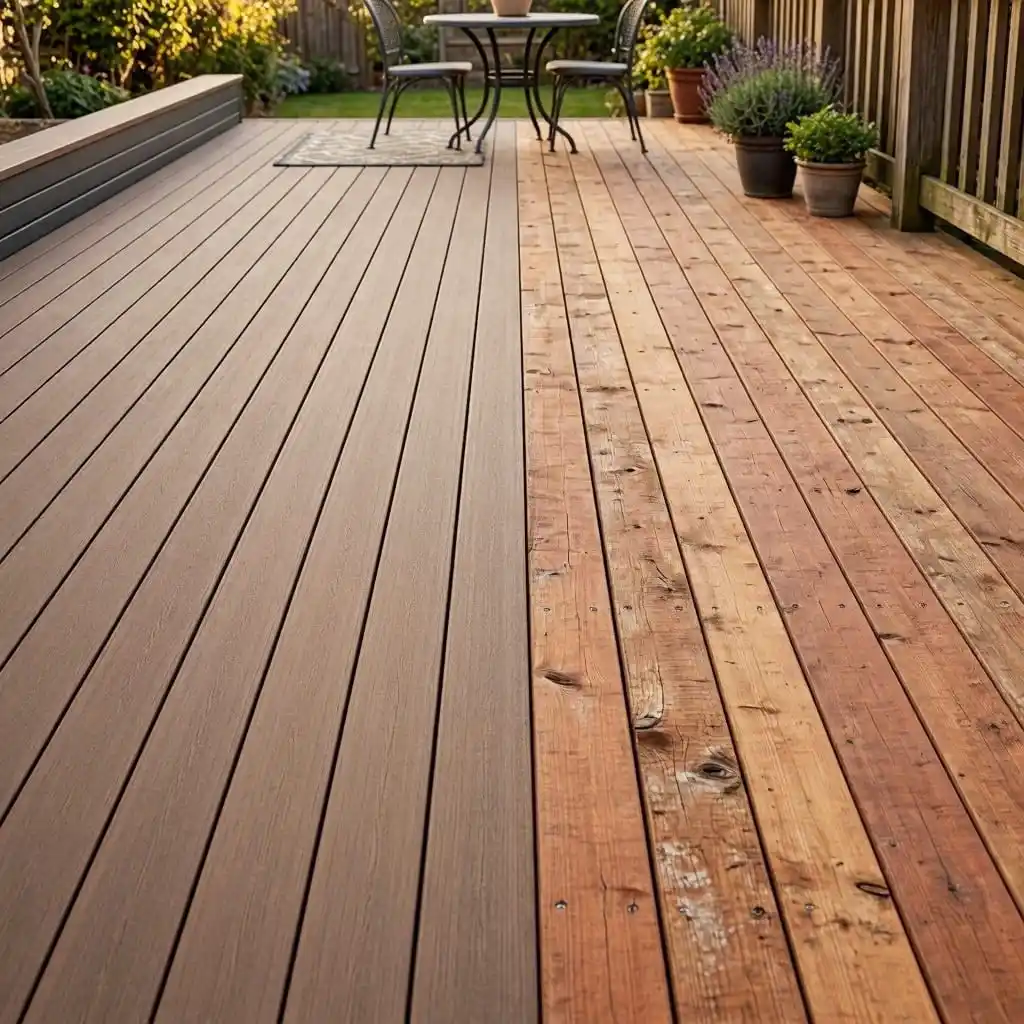
How to Cut Composite Decking With a Circular Saw
A circular saw can be used to cut composite decking, but it is important to check the manufacturer’s recommendations before choosing a blade or cutting method.
Composite decking is made from a mixture of materials, commonly including wood fibres and plastic or polymer components. Because products differ between manufacturers, the best blade and cutting method can also vary.
Can You Use a Normal Circular Saw?
In many cases, yes. A standard circular saw can be suitable for cutting composite decking when fitted with a blade recommended for the particular product. However, don’t assume that the blade you use for ordinary timber decking is automatically suitable.
Check the decking manufacturer’s instructions for:
- Recommended blade type
- Recommended tooth count
- Maximum blade speed
- Cutting direction or technique
- Any specific safety requirements
Choose the Right Blade
Some composite decking manufacturers recommend a fine-tooth carbide-tipped blade or another specific blade designed for composite materials.
The exact recommendation varies, so checking the product instructions is more important than simply choosing a blade based on tooth count.
A sharp, suitable blade can help produce a cleaner edge and reduce unnecessary damage to the decking.
Support the Board Properly
Composite decking should be properly supported before cutting. Because some composite boards can be more flexible than timber, make sure the board is stable and does not move excessively during the cut.
For longer boards, provide suitable support along their length while keeping the area underneath the blade clear.
Mark the Cut Carefully
Measure the required length and mark the board clearly with a pencil and square. Use your circular saw’s cut-line indicator to follow the marked line, or use a suitable guide if greater accuracy is required.
Take Care With Heat and Cutting Debris
Some composite materials can behave differently from natural timber when cut. Avoid forcing the saw through the board and keep the cut controlled. Follow the manufacturer’s guidance regarding dust, debris and ventilation.
If the manufacturer provides specific cutting instructions, those should take priority over general advice.
What About the Cut Edge?
The cut edge of composite decking may look different from the factory-finished edge. Depending on the product, the manufacturer may recommend a particular method for finishing or concealing exposed cut ends.
If the decking system uses matching end caps, fascia or other finishing components, check the installation instructions before cutting.
Key Takeaway
A circular saw can be a useful tool for cutting composite decking, but the manufacturer’s instructions should come first.
Check the recommended blade, support the board securely and make controlled cuts rather than assuming composite decking should be treated exactly like ordinary timber.
Common Mistakes When Cutting Decking
Cutting decking with a circular saw is relatively straightforward, but a few common mistakes can lead to inaccurate cuts, damaged boards or unnecessary waste.
Here are some of the main things to avoid.
1. Not Measuring the Board Properly
A small measuring error can make a decking board too short for the job. Measure carefully and mark the required length clearly before making the cut. If you’re cutting several boards, don’t assume every board is exactly the same length. Check each one before cutting.
2. Using the Wrong Blade
A blade designed for a particular material may not be suitable for another. For timber decking, use a suitable wood-cutting blade. For composite decking, check the manufacturer’s blade recommendations. A blunt or unsuitable blade can also produce a poorer finish and make cutting harder.
3. Cutting Without Proper Support
Decking boards can be long and flexible. If a board is poorly supported, it can move or flex while you’re cutting. This can make it harder to maintain control and may affect the quality of the cut. Make sure the board is adequately supported and stable before starting.
4. Setting the Cutting Depth Incorrectly
Your circular saw should have enough cutting depth to pass through the decking, but the depth should still be set appropriately for the material and circumstances. Always check your saw’s instructions and consider what is underneath the board, particularly when cutting decking that has already been installed.
5. Ignoring the Saw’s Cut-Line Indicator
Trying to follow a pencil line without understanding where the blade actually cuts can lead to inaccurate results. Most circular saws have an arrow, notch or other marking on the base plate to help indicate the blade’s cutting path.
Take a moment to understand how your particular saw’s indicator works before making the cut.
6. Forgetting About the Blade Kerf
The blade removes a small amount of material as it cuts. This is known as the kerf. If you measure and mark without considering where the blade will remove material, you can end up slightly shorter than intended.
Mark the waste side of the cut clearly so you know which side of the line needs to be removed.
7. Rushing the Cut
A circular saw should be allowed to do the cutting at a controlled pace. Pushing the saw too quickly can affect the quality of the cut, while forcing it through the material can place unnecessary strain on the saw and blade. Keep the saw steady and let the blade work at its normal cutting speed.
8. Not Checking What Is Underneath
This is particularly important when cutting decking that has already been installed. Before cutting, check for joists, screws, nails, cables, pipes or other obstructions beneath the board. Never assume that the area below the decking is clear.
Beginner Tip
Most decking cutting mistakes can be avoided by taking a few seconds to check:
Measure → Mark → Support → Blade → Depth → Cut
A careful setup usually produces a better result than trying to save time by rushing into the cut.
Tips for Getting Cleaner Decking Cuts
If you want your decking cuts to look neat and professional, a few simple techniques can make a noticeable difference. You don’t necessarily need an expensive circular saw. A suitable sharp blade, accurate marking and good support are often more important.
Use a Sharp, Suitable Blade
A sharp blade will generally produce a cleaner cut than a worn or damaged one. Choose a blade designed for the material you’re cutting and check the manufacturer’s recommendations, particularly with hardwood or composite decking.
For general timber decking, a 30–40 tooth blade can provide a useful balance between cutting speed and finish.
For more visible cuts, a higher-tooth-count blade may produce a cleaner edge, although it will generally cut more slowly.
Mark the Cut Accurately
A clear, accurate cut line makes it much easier to follow the correct cutting path. Use a pencil and square to mark across the full width of the decking board.
For repeated cuts, consider using a suitable guide or stop to help maintain consistency.
Support the Board Properly
Good support can make a big difference to the quality of the cut. If the board moves or flexes while you’re cutting, it can be harder to keep the saw travelling straight. Support longer boards at suitable points and make sure the blade has a clear path underneath.
Don’t Force the Saw
Allow the circular saw to cut through the decking at a controlled pace. If you push too hard, you can make the saw work unnecessarily hard and potentially affect the quality of the cut. A steady movement is usually better than trying to rush through the board.
Cut With the Finished Side Positioned Carefully
When appearance matters, think about which side of the decking will be most visible. Circular saw blades can sometimes cause more breakout or splintering on one side of the material than the other.
The exact result depends on the saw, blade and material, so check the blade manufacturer’s guidance and make a test cut on an offcut where possible.
Keep the Saw Base Plate Flat
Keep the circular saw’s base plate sitting flat against the decking throughout the cut. This helps the blade maintain a consistent cutting angle and makes it easier to follow your marked line. Avoid twisting the saw during the cut.
Make a Test Cut
If you’re using an unfamiliar blade or cutting an expensive decking material, make a test cut on an offcut first.
This lets you check the quality of the edge before cutting your finished boards.
This is particularly useful with hardwood and composite decking, where the material can behave differently from ordinary softwood.
Beginner Tip
For cleaner decking cuts, remember:
Sharp blade + accurate marking + good support + steady cutting = better results.
You don’t need to rush. Taking a little extra time with the setup can save you from having to replace or re-cut a damaged board.
Frequently Asked Questions
Can you cut decking with a circular saw?
Yes. A circular saw is well suited to cutting most timber decking boards to length. A suitable blade, accurate marking and good support will help produce clean, straight cuts.
What size circular saw do I need for decking?
For most standard timber decking, a 165mm circular saw is more than capable. Typical decking boards are relatively thin compared with the cutting depth available from a 165mm saw. Always check the actual thickness of your decking and the cutting capacity of your particular saw.
What blade should I use to cut decking?
For timber decking, a suitable wood-cutting blade is usually the best choice. Around 30–40 teeth can provide a good balance between cutting speed and finish for general DIY work. For hardwood or composite decking, check the manufacturer’s recommendations before choosing a blade.
Can you cut composite decking with a circular saw?
Yes, in many cases. However, composite decking products can differ considerably, so you should check the manufacturer’s instructions for the recommended blade and cutting method.
Can you cut decking with a 165mm circular saw?
Yes. A 165mm circular saw will normally have plenty of cutting depth for standard timber decking. Typical 165mm saws can cut around 55–57mm deep at 90°, although the exact capacity varies between models.
Can you cut decking that is already installed?
You can, but extra care is needed. Before cutting installed decking, check what is underneath the board. Joists, screws, nails, cables, pipes and other obstructions may be hidden below the surface.
How do you get a clean cut on decking?
Use a sharp, suitable blade, mark the cut accurately, support the board properly and move the circular saw steadily through the material. Making a test cut on an offcut can also help when working with an unfamiliar decking material.
Should I use a high-tooth-count blade for decking?
A higher-tooth-count blade can produce a cleaner cut but will generally cut more slowly. For ordinary timber decking, a medium-tooth-count blade can be a good compromise. For visible or finer cuts, a higher-tooth-count blade may be worth considering.
Can a circular saw cut hardwood decking?
Yes, provided the saw and blade are suitable for the material. Hardwood can be denser than softwood, so using the correct sharp blade and allowing the saw to cut at a controlled pace is important.
Can a circular saw cut thick decking?
Yes, provided the decking is within the saw’s cutting capacity. Check the actual thickness of the board against your circular saw’s maximum cutting depth before starting. If the material is too thick, consider a more suitable saw rather than trying to force the circular saw through it.
Is a circular saw good for cutting decking boards to length?
Yes. One of the main advantages of a circular saw is that it can make quick, straight and repeatable crosscuts. For larger decking projects, a suitable guide or stop can also help make repeated cuts more consistent.
Final Verdict
Yes, a circular saw is an excellent choice for cutting decking.
For most DIY decking projects, a 165mm circular saw should provide more than enough cutting capacity for standard timber decking. It can make quick, straight crosscuts and is particularly useful when you have several boards to cut to length.
The most important things to get right are:
- Choose a suitable blade for the decking material.
- Measure and mark each board carefully.
- Support the decking securely before cutting.
- Set the cutting depth appropriately.
- Use the saw’s cut-line indicator or a suitable guide for accurate cuts.
- Keep the saw moving steadily and don’t force it through the material.
- Check what is underneath if you’re cutting installed decking.
- Follow the manufacturer’s instructions for hardwood and composite decking.
For most beginners, there’s no need to buy a larger circular saw simply because you’re cutting decking. Choose a saw based on the thickness of the material you actually plan to cut and the type of DIY work you expect to do.
A good 165mm circular saw, combined with the right blade and careful setup, will handle the majority of everyday decking cuts with ease.
Looking for a New Circular Saw or Upgrading Your Setup?
For my breakdown of top-rated corded and cordless tools, check out my Circular Saw Buying Guide UK for Beginners