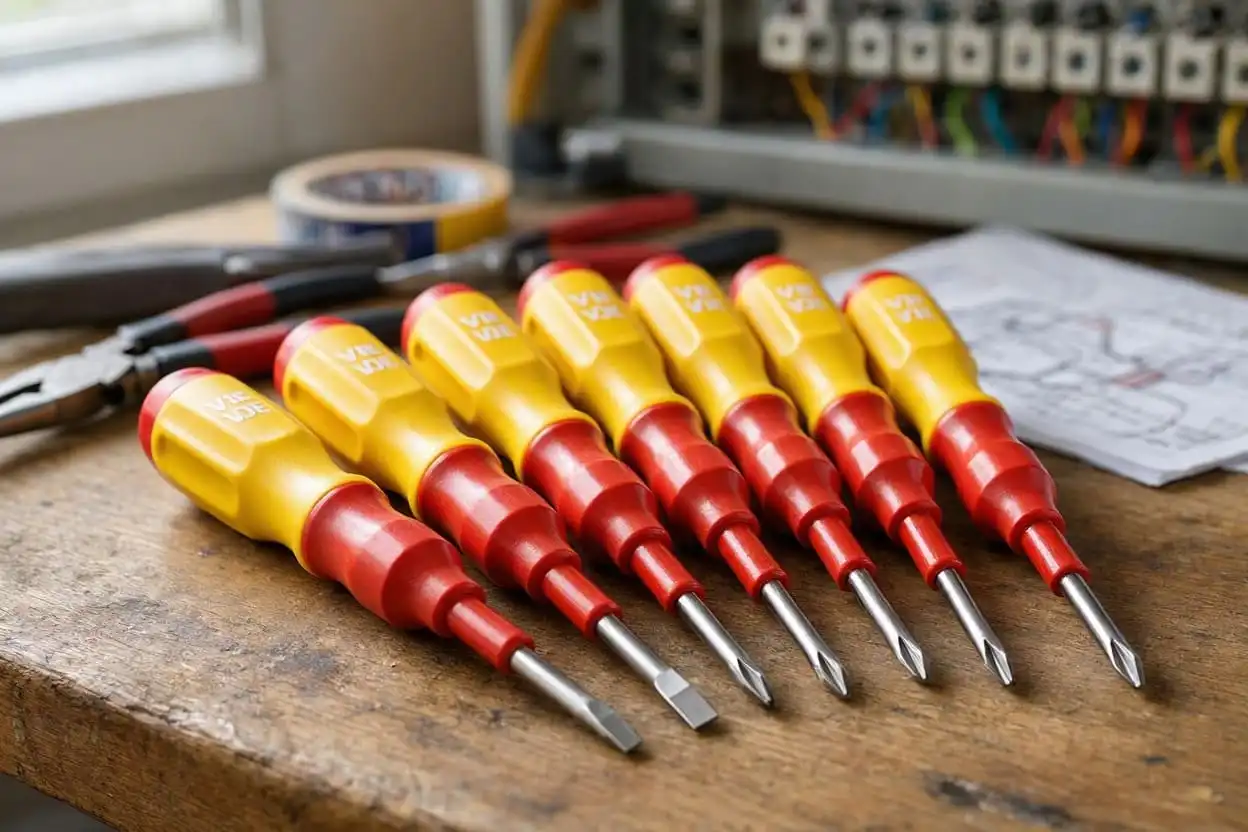
VDE insulated screwdrivers are designed for electrical work where specially tested insulation is required. They look similar to ordinary screwdrivers, but their insulated shafts and handles are manufactured and tested to meet specific electrical safety standards.
You’ll often see VDE screwdrivers marked 1000V. This marking relates to the voltage rating used in their testing, but it does not mean that working on live electrical equipment is safe. Electrical circuits must be properly isolated and verified dead before work begins, and anyone who is not competent to carry out electrical work should use a qualified electrician.
For DIY users, understanding the difference between insulated and standard screwdrivers can help when choosing tools for a home toolkit. It is also important to know what the markings mean, how to recognise a suitable set and how to check that the insulation remains in good condition.
In this guide, I will explain what VDE insulated screwdrivers are, what the 1000V marking means, which types are available and what to look for when buying a set in the UK. We’ll also cover basic inspection and care, along with common mistakes to avoid.
What Does VDE Mean?
VDE stands for the German organisation Verband der Elektrotechnik Elektronik Informationstechnik. It is associated with testing, certification and standards covering electrical, electronic and related products.
When you see a VDE mark on an insulated screwdriver, it indicates that the product has been assessed under the relevant certification scheme. However, it is important to check the actual product and its markings rather than assuming that any screwdriver with a coloured insulated handle is suitable for electrical work.
What Does the 1000V Marking Mean?
Many insulated screwdrivers carry a 1000V marking. These tools are designed and tested for electrical safety in accordance with applicable standards, commonly including IEC 60900 for hand tools used on or near live parts.
The 1000V marking is not permission to work on live circuits. Electrical work should be carried out with the supply isolated and the absence of voltage verified using appropriate equipment and safe procedures.
How Can You Recognise a Suitable VDE Screwdriver?
When choosing insulated screwdrivers, look for:
- Clear manufacturer identification and product information.
- Appropriate voltage markings, such as 1000V.
- Evidence that the tool meets the relevant standard, such as IEC 60900, where applicable.
- Insulation that is complete, clean and free from cuts, cracks or other damage.
- A reputable manufacturer and traceable product details.
Do not rely on handle colour alone. Red and yellow handles are common on insulated screwdrivers, but colours by themselves do not prove that a tool has been tested or certified.
The key point: VDE marking and suitable insulation help identify tools designed for electrical safety, but they do not replace safe isolation procedures, training or professional competence.
It is also worth reading the UK’s Health and Safety Executive’s electrical safety guidance.
VDE Insulated Screwdrivers vs Standard Screwdrivers
VDE insulated screwdrivers and standard screwdrivers may look similar, but they are designed with different priorities in mind. Standard screwdrivers are general-purpose tools for everyday fastening, while insulated screwdrivers are specifically designed and tested for electrical safety applications.
The main difference is the insulation around the shaft and handle, along with the testing and standards that the insulated tool is designed to meet.
Key Differences
| Feature | VDE insulated screwdriver | Standard screwdriver |
|---|---|---|
| Main purpose | Electrical work where appropriately rated insulated tools are required | General DIY, repairs and assembly |
| Insulated shaft | Specially designed and tested insulation | Usually an exposed metal shaft |
| Voltage marking | Often marked 1000V, with relevant standard information | Normally has no electrical voltage rating |
| Construction | Insulation must meet applicable requirements and remain undamaged | Construction varies according to the tool’s intended use |
| Typical uses | Suitable electrical maintenance tasks when required by the procedure | Furniture assembly, general repairs and workshop tasks |
| Inspection | Insulation needs careful checking before use | Check the tip, shaft and handle for damage |
If you want to find out more about standard screwdriver sets then check out my article on the best screwdriver sets.
Can You Use a Standard Screwdriver for Electrical Work?
A standard screwdriver should not be treated as an insulated electrical tool. Its ordinary handle may provide some grip, but it is not designed or tested to provide the same electrical protection as a suitable insulated screwdriver.
Even when using a correctly rated insulated tool, the safe approach is to isolate the circuit and verify that it is dead before starting work. The presence of a VDE marking does not make live electrical work safe.
Do You Need VDE Screwdrivers for Everyday DIY?
For general household jobs such as assembling furniture, tightening cabinet hinges or repairing wooden items, a standard screwdriver set is usually sufficient.
A VDE insulated set is a specialist purchase for appropriate electrical tasks. If you do not carry out electrical maintenance, you may not need one in your everyday DIY toolkit. If electrical work is required and you are not competent to perform it safely, use a qualified electrician.
The important distinction: Choose your screwdriver for the job, and never assume that a standard screwdriver is electrically safe simply because it has a plastic handle.
Types and Sizes of VDE Insulated Screwdrivers
VDE insulated screwdrivers are available with different tip shapes and sizes to suit the screws commonly found in electrical equipment. Choosing the correct tip is important because a poor fit can damage the screw head and make it harder to turn.
Most sets contain a selection of slotted and cross-head screwdrivers, while larger sets may include additional types.
Slotted VDE Screwdrivers
Slotted screwdrivers have a flat blade designed for screws with a single straight recess. They are still found in some electrical fittings and terminal connections.
Blade widths vary, so choose one that fits the screw head properly. A blade that is too narrow can slip, while one that is too wide may not fit into the recess.
Phillips and Pozidriv VDE Screwdrivers
Phillips and Pozidriv are two common cross-head screwdriver types.
- Phillips (PH): Has a cross-shaped recess and is commonly found in general fastening applications.
- Pozidriv (PZ): Has additional smaller ribs between the main cross-shaped sections and is common in UK screws.
Although they look similar, they are not interchangeable. Using the wrong type can lead to slipping and damage. Choose the correct tip and size for the screw.
Torx VDE Screwdrivers
Torx screwdrivers have a six-point star-shaped tip. They are used in some electrical equipment and other products where Torx screws are specified.
Not every VDE set includes Torx drivers, so check the contents if you need this type.
Common Screwdriver Sizes
The exact sizes included vary by manufacturer and set. A useful selection for general electrical maintenance may include:
| Screwdriver type | Examples of common sizes |
|---|---|
| Slotted | 2.5mm, 3.5mm and 5.5mm blade widths |
| Phillips | PH1 and PH2 |
| Pozidriv | PZ1 and PZ2 |
| Torx | T10 and T15, where required |
These are examples, not a universal set specification. The right sizes depend on the screws and equipment you need to work with. As with any screwdriver, the tip must fit the screw head correctly. Our guide to screwdriver sizes explained covers common size markings and how to choose a suitable fit.
Should You Buy Individual Drivers or a Set?
If you only need one or two specific sizes, individual VDE screwdrivers may be sufficient. A set is more practical if you regularly encounter different screw types and sizes.
Before buying, check the manufacturer’s list of included tools rather than relying on the number of pieces advertised on the packaging.
Tip: If you’re unsure which screwdriver tip a screw requires, our guide to choosing the right screwdriver explains how to identify common screw heads and select a suitable size.
How to Choose VDE Insulated Screwdrivers
Choosing a VDE insulated screwdriver set is about more than finding the lowest price or the largest number of pieces. You need tools that are suitable for the intended work, properly marked and comfortable to use.
Before buying, check the following features.
1. Check the Certification and Markings
Look for clear manufacturer details and evidence that the tools meet the relevant requirements for insulated hand tools, commonly IEC 60900.
Many sets are marked 1000V, but do not rely on that marking alone. Check the product documentation and buy from a reputable supplier so you can verify what the certification covers.
2. Choose the Screwdriver Types You Need
A set containing slotted, Phillips and Pozidriv drivers will cover many common screw types. If your work involves Torx screws, check whether suitable insulated Torx drivers are included.
Think about the screws you are likely to encounter rather than choosing a set simply because it contains more pieces.
3. Check the Sizes Included
A set should contain sizes suitable for the fasteners you expect to work with. For many common tasks, a selection of smaller and medium-sized drivers is useful, but the correct sizes depend on the equipment.
Check the contents list carefully. Some sets count additional accessories or duplicate tools as separate pieces, so the headline number does not always tell you how useful the set will be.
4. Look at Handle Comfort and Grip
A comfortable handle can make controlled turning easier, particularly when working in confined spaces or handling small screws.
Look for handles that feel secure in the hand and allow you to apply controlled pressure. However, comfort and grip do not prove electrical safety; the tool must still be appropriately certified and undamaged.
5. Inspect the Insulation and Build Quality
The insulation is a critical part of the tool. Look for a well-finished shaft covering and clear markings, with no visible cuts, cracks, peeling or other defects.
Buy from a supplier that provides clear product information and warranty details. Avoid unbranded products with unclear certification claims.
6. Consider Storage and Organisation
A case or holder can help keep the screwdrivers organised and protect them during storage. This is particularly useful if you own several sizes or need to keep tools together for regular maintenance.
Storage is a convenience, though, not a substitute for inspecting each tool before use.
7. Buy Only What You Need
A large set may offer more flexibility, but it may not be worthwhile if you only need a few specific drivers. A smaller, well-chosen set from a reputable manufacturer may be a better purchase than a larger set with unclear specifications.
Buying tip: Check the exact model number, included sizes and certification information before ordering. Do not choose an insulated screwdriver set on handle colour or piece count alone.
How to Inspect and Look After VDE Insulated Screwdrivers
VDE insulated screwdrivers need more careful inspection than ordinary workshop screwdrivers because their insulation is an essential safety feature. Keeping them clean and storing them properly can help you spot damage before it becomes a problem.
Always inspect an insulated screwdriver before use. Never rely on a voltage marking or certification if the tool appears damaged.
Check the Insulation Before Use
Look carefully along the insulated shaft and around the handle for signs of damage, including:
- Cuts, cracks or splits in the insulation.
- Peeling, loose or damaged insulation.
- Deep scratches or other visible defects.
- Damage caused by heat, chemicals or excessive wear.
- Illegible markings where the tool’s identity or rating can no longer be confirmed.
If you find damage or have doubts about the condition of the insulation, remove the tool from service. Do not try to repair it with electrical tape or another covering.
Check the Screwdriver Tip
The tip should also be in good condition. A badly worn or damaged tip may slip out of a screw head, making controlled work more difficult.
If the tip is rounded, chipped or otherwise damaged, replace the tool rather than continuing to use it where accurate engagement is important.
Clean the Screwdrivers Properly
Follow the manufacturer’s cleaning instructions. Usually, wiping the tool with a clean, dry or slightly damp cloth is sufficient for ordinary dirt.
Avoid abrasive cleaners, solvents or chemicals unless the manufacturer confirms they are suitable for the insulation. These products may damage the surface or affect its condition.
Store Them Carefully
Keep VDE screwdrivers in a clean, dry place away from excessive heat, direct sunlight and chemicals that could damage the insulation.
A dedicated case or holder can prevent the tools from being scratched or damaged by other equipment. Avoid leaving them loose in a toolbox where sharp metal tools can repeatedly rub against the insulated surfaces.
Can You Test the Insulation Yourself?
A visual inspection is useful, but it cannot prove that a screwdriver remains electrically safe. Do not attempt improvised electrical tests or assume that an undamaged appearance guarantees protection.
If a tool has been damaged, exposed to conditions outside the manufacturer’s limits or is otherwise suspect, follow the manufacturer’s guidance and replace it or have it assessed through an appropriate process.
Remember: If the insulation is damaged or you are uncertain about the tool’s condition, do not use it for electrical safety applications.
Common Mistakes When Buying or Using VDE Insulated Screwdrivers
VDE insulated screwdrivers are specialist tools, so it is important to understand what you are buying and how to use them appropriately. Avoiding a few common mistakes can help you choose a suitable set and recognise when a tool should not be used.
Assuming a Plastic Handle Means a Screwdriver Is Insulated for Electrical Work
Many ordinary screwdrivers have plastic handles, but this does not mean they have been designed or tested for electrical safety.
Look for appropriate markings, manufacturer information and evidence that the tool meets the relevant requirements. Do not judge electrical suitability by handle colour or appearance alone.
Treating the 1000V Marking as Permission to Work Live
The 1000V marking relates to the tool’s design and testing. It does not make live electrical work safe.
Electrical circuits should be isolated and verified dead using appropriate procedures and equipment before work begins. If you are not competent to carry out the work safely, use a qualified electrician.
Buying a Set Without Checking the Contents
A large set may contain more pieces than you need, while a smaller set may omit a screwdriver type you regularly use.
Check the exact model and the list of included sizes and tip types before purchasing. Choose tools that match the work you expect to carry out.
Using the Wrong Screwdriver Size
Even a correctly rated insulated screwdriver can slip if its tip is the wrong size or type for the screw.
Use a tip that fits securely and replace worn or damaged tools. Avoid forcing a screwdriver into a screw head that it does not fit properly.
Continuing to Use Damaged Insulation
Cuts, cracks, peeling or other damage can compromise the insulation. Do not continue using a suspect screwdriver for electrical safety applications.
Do not attempt to repair the insulation with tape or another improvised covering. Remove the tool from service and follow the manufacturer’s guidance.
Assuming an Insulated Screwdriver Replaces Safe Working Procedures
Insulated tools are only one part of electrical safety. They do not replace isolation, verification that a circuit is dead, suitable training or an understanding of the equipment being worked on.
The key lesson: Choose a properly specified tool, inspect it before use and never rely on insulated screwdrivers as a substitute for safe electrical working practices.
Frequently Asked Questions
What does VDE mean on a screwdriver?
VDE refers to a German organisation associated with electrical engineering testing and certification. On an insulated screwdriver, the marking helps identify a tool assessed under the relevant certification scheme. Always check the product’s markings and documentation.
What does 1000V mean on a VDE screwdriver?
The 1000V marking relates to the tool’s electrical insulation rating and testing. It does not mean that it is safe to work on live electrical equipment. Circuits should be isolated and verified dead before work begins.
Are VDE screwdrivers worth buying for DIY?
They can be useful for people who carry out appropriate electrical maintenance and need suitably rated insulated tools. For everyday DIY such as assembling furniture or repairing cabinets, a standard screwdriver set is generally sufficient.
Can VDE insulated screwdrivers be used as normal screwdrivers?
They can generally be used for ordinary fastening tasks when the tip and size are suitable. However, they should be inspected carefully, used within the manufacturer’s instructions and kept free from damage. Their insulation does not make them suitable for every application.
How can you tell if a VDE screwdriver is genuine?
Check the manufacturer, model number, markings and product documentation. Look for evidence of compliance with the relevant insulated-tool standard, such as IEC 60900 where applicable. Purchase from a reputable supplier rather than relying on handle colour or a seller’s unsupported claims.
When should you replace a VDE screwdriver?
Remove it from service if the insulation is cut, cracked, peeling or otherwise damaged, or if the tool’s condition is uncertain. A worn or damaged tip is another reason to replace it. Do not attempt to restore electrical protection with tape or improvised repairs.
Final Thoughts
VDE insulated screwdrivers are specialist tools designed and tested for electrical safety applications. When choosing a set, look for clear certification information, suitable screwdriver types and sizes, comfortable handles and insulation that is easy to inspect.
Avoid buying based solely on price, handle colour or the number of pieces advertised. A smaller set from a reputable manufacturer may be more useful than a larger set with unclear specifications.
Most importantly, insulated screwdrivers do not make live electrical work safe. Electrical circuits should be isolated and verified dead using appropriate procedures and equipment. If you are not competent to carry out electrical work safely, use a qualified electrician.
For more practical advice, explore our other UKToolGuide articles on choosing the right screwdriver and selecting a screwdriver set for DIY.