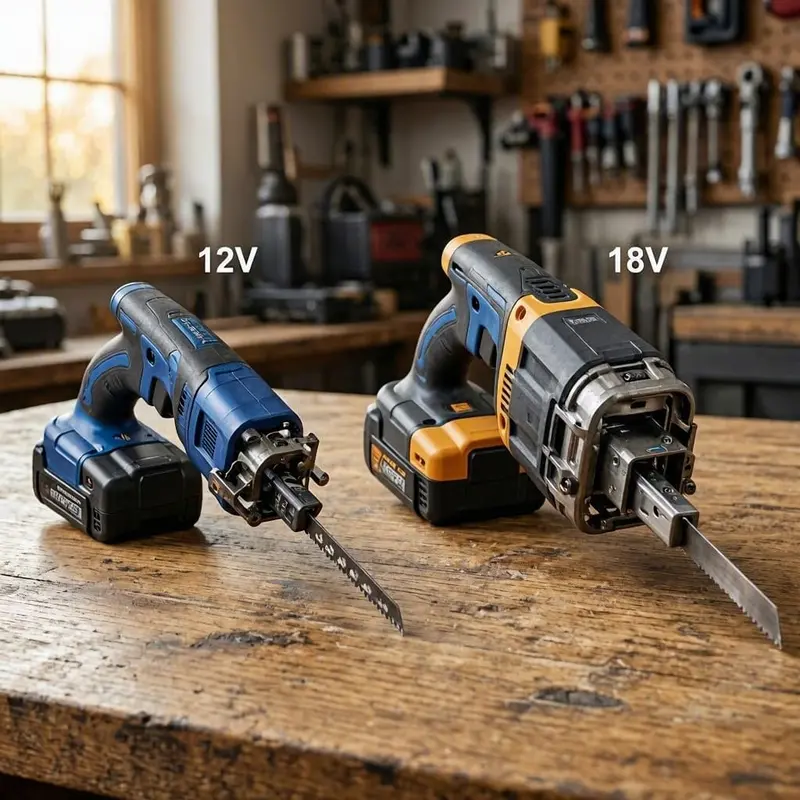
If you’re looking to buy a cordless reciprocating saw, one of the first decisions you’ll come across is which battery voltage to choose. You’ll commonly see compact 12V reciprocating saws alongside more powerful 18V models.
But does 18V automatically mean the saw is better?
Not necessarily.
A 12V reciprocating saw can be an excellent choice for lightweight DIY, particularly if you value a compact and easy-to-handle tool.
An 18V model, however, is generally the better all-round choice if you’re planning to tackle heavier DIY, renovation or demolition work.
For most UK DIY beginners, I’d choose 18V, but there are situations where 12V makes more sense.
Let’s look at the differences.
Quick Answer: 12V or 18V Reciprocating Saw?
For most DIY beginners:
18V is the best all-round choice.
It generally gives you more cutting capability and access to a wider range of full-size cordless tools.
However, a 12V reciprocating saw can be a better option if you mainly need a lightweight tool for smaller jobs and working in confined spaces.
| Feature | 12V | 18V |
|---|---|---|
| Power | Good for light work | Better for heavier work |
| Weight | Usually lighter | Usually heavier |
| Size | More compact | Usually larger |
| Runtime | Depends on battery | Depends on battery |
| Demolition | Limited | Excellent |
| Cutting timber | Good | Excellent |
| Cutting pipe | Good for suitable applications | Excellent |
| Tight spaces | Excellent | Good |
| Heavy DIY | Limited | Excellent |
| Occasional DIY | Excellent | Excellent |
| Professional use | Limited | Better suited |
| Battery ecosystem | Smaller | Much larger |
| Best for | Light/compact work | General DIY |
What Does 12V Mean?
The voltage refers to the electrical system used by the cordless tool and its battery. A 12V reciprocating saw is generally designed around a smaller battery and motor system.
The lower voltage doesn’t mean that the tool is incapable. Modern 12V cordless tools can be surprisingly powerful for their size. They’re particularly useful where portability matters.
For example:
- Cutting plastic pipe
- Light timber cutting
- Small demolition jobs
- Pruning
- Working in confined spaces
The main limitation is that 12V systems generally aren’t intended to replace larger professional-grade 18V or higher-voltage tools for heavy-duty work.
What Does 18V Mean?
An 18V reciprocating saw uses a larger cordless platform designed to provide greater overall performance. 18V is one of the most common cordless tool platforms you’ll encounter in the UK.
You’ll find 18V systems from manufacturers including:
- Makita
- DeWalt
- Bosch Professional
- Ryobi
- Milwaukee
- Metabo
- Hikoki
One of the biggest advantages isn’t simply the voltage. It’s the battery ecosystem that comes with it.
Once you’ve bought into an 18V system, you can potentially use the same batteries across many different tools.
Does 18V Mean More Power?
Generally, an 18V system has greater potential for power than a 12V system. However, voltage alone doesn’t tell you how powerful a tool actually is.
Other factors include:
- Motor design
- Motor efficiency
- Gearbox
- Stroke length
- Stroke rate
- Blade
- Battery capacity
- Electronic controls
- Overall tool design
This is important when comparing cordless tools. Don’t simply look at:
12V vs 18V and assume the 18V tool will always outperform every 12V model in every situation.
Is an 18V Reciprocating Saw Better?
For general DIY, I’d say yes. An 18V saw gives you more flexibility.
You can use it for:
- Timber
- Demolition
- Pipework
- Pallets
- Garden work
- Renovation
- Cutting wood containing nails
- Metal cutting with suitable blades
It’s much more likely to cope comfortably when the job becomes demanding. But if you only need a reciprocating saw occasionally for light work, a 12V model can be perfectly adequate.
Is a 12V Reciprocating Saw Powerful Enough?
For many small DIY jobs, yes. This is where beginners can sometimes make the mistake of assuming that 12V means “weak”. A good 12V reciprocating saw can be very useful.
It’s particularly suited to:
- Small branches
- Plastic pipe
- Thin timber
- Light demolition
- Small renovation jobs
- Cutting in confined spaces
The problem comes when you ask it to perform jobs better suited to a full-size saw.
For example, repeated heavy demolition of thick timber is generally better suited to an 18V or more powerful machine.
12V vs 18V for Cutting Wood
Both can cut wood. The difference is the type and quantity of wood you’re cutting.
12V
Good for:
- Small timber
- Light construction
- Small branches
- Occasional cutting
18V
Better for:
- Thick timber
- Demolition
- Timber containing nails
- Repeated cutting
- Larger projects
If you’re dismantling an old shed, I’d choose 18V. If you’re trimming a few small pieces of timber, 12V may be all you need.
12V vs 18V for Demolition
This is where the difference becomes more obvious.
18V wins.
Demolition work can put considerable demands on a reciprocating saw.
You’re often cutting:
- Thick timber
- Nails
- Screws
- Mixed materials
- Old pipework
- Structural components
An 18V saw is much better suited to this kind of work. If demolition is one of your main reasons for buying a reciprocating saw, I’d choose 18V.
12V vs 18V for Cutting Metal
Both systems can cut metal with the correct blade. However, I’d generally favour 18V for heavier metal cutting.
A suitable 12V saw can be useful for:
- Small pipe
- Thin metal
- Light plumbing work
An 18V model is more appropriate when you’re dealing with:
- Larger pipe
- Heavier metal
- Repeated cutting
- Renovation work
Remember that the blade is extremely important. A powerful saw with the wrong blade can perform worse than a smaller saw with the right blade.
12V vs 18V for Cutting Pipes
Both can be useful. For occasional plumbing work, a compact 12V saw can be particularly handy.
The smaller body can make it easier to reach into confined areas. However, for repeated pipe cutting and heavier renovation work, I’d prefer an 18V model.
12V advantage
Compactness
18V advantage
Power and versatility
Which Is Better for Tight Spaces?
This is one area where 12V can win. Smaller tools can be easier to manoeuvre when you’re working:
- Under sinks
- Inside cupboards
- Between studs
- Behind fittings
- In small service areas
- In awkward corners
If you regularly work in confined spaces, don’t automatically dismiss 12V. The smallest and lightest tool isn’t always the most powerful, but it can be the easiest to use.
Which Is Lighter?
Generally, a 12V reciprocating saw will be lighter and more compact than a comparable 18V model.
That’s because the battery and tool platform are smaller. This can make a significant difference when you’re holding the tool:
- Above your head
- At arm’s length
- In an awkward position
- For extended periods
For occasional users, this can be a bigger benefit than you might expect.
Does 18V Have Better Battery Runtime?
Not necessarily. This is an important point. Voltage and battery capacity aren’t the same thing.
Battery capacity is normally expressed in amp-hours (Ah).
For example, you may see:
- 12V 2.0Ah
- 12V 4.0Ah
- 18V 2.0Ah
- 18V 4.0Ah
- 18V 5.0Ah
- 18V 6.0Ah
You can’t simply look at the voltage and predict how long the saw will run.
Runtime depends on:
- Battery capacity
- Material
- Blade
- Cutting pressure
- Cutting speed
- Motor efficiency
- Tool design
For more information, see our dedicated guide:
Battery Run Times for Reciprocating Saw UK
Understanding Voltage and Amp-Hours
This is worth explaining because it can be confusing for beginners.
Voltage
Think of voltage as part of the electrical system’s operating level.
Amp-hours
Amp-hours indicate battery capacity.
A higher Ah battery generally stores more energy than a lower Ah battery within the same battery system.
So:
18V doesn’t automatically mean longer runtime.
An 18V 2Ah battery and an 18V 5Ah battery don’t have the same capacity.
Likewise, comparing a 12V battery and an 18V battery purely by their Ah figures isn’t a complete comparison.
12V vs 18V Battery Weight
This is another area where there is a trade-off. A larger-capacity battery can provide longer runtime, but it also adds weight.
For example, a compact 12V saw with a small battery can be extremely easy to manoeuvre. An 18V saw with a larger battery may feel considerably heavier.
That isn’t necessarily a disadvantage. If you’re cutting thick timber, the extra power and runtime may be well worth it.
Which Is Better for Occasional DIY?
If you’re only going to use your reciprocating saw occasionally, either could work.
I’d decide based on the type of work.
Choose 12V if:
You’re mainly doing light DIY and want something small and easy to handle.
Choose 18V if:
You want one reciprocating saw that can handle a wider range of jobs as your DIY projects become more ambitious.
For most UK DIY beginners, I’d still lean towards 18V.
Which Is Better for Renovation?
18V.
Renovation can involve a surprisingly wide range of materials.
You might find yourself cutting:
- Timber
- Nails
- Copper pipe
- Plastic pipe
- Plasterboard
- Metal
- Old fittings
An 18V reciprocating saw gives you more headroom when the job becomes difficult.
Which Is Better for Garden Work?
It depends on what you’re cutting. For occasional pruning, a compact 12V reciprocating saw with a suitable pruning blade can be very convenient.
For thicker branches and more demanding work, an 18V model is likely to be more capable.
However, a reciprocating saw shouldn’t automatically replace a dedicated chainsaw or pruning saw.
Use the tool appropriate for the size and type of job.
12V vs 18V for Beginners
If you’re completely new to cordless power tools, I’d actually consider the battery system before deciding between 12V and 18V.
Ask yourself:
What other cordless tools am I likely to buy?
If you think you’ll eventually want:
- Drill
- Impact driver
- Jigsaw
- Circular saw
- Angle grinder
- Multi-tool
- Garden tools
then an 18V platform can be a very useful foundation.
The Battery Ecosystem Matters
This is perhaps the biggest reason I’d recommend 18V to many DIY beginners. Suppose you buy an 18V drill from a particular manufacturer.
Later you decide you need:
- Reciprocating saw
- Jigsaw
- Circular saw
If they’re all compatible with your existing batteries, you may be able to buy the tools as bare tools.
You don’t need to purchase another battery and charger every time.
That can save a considerable amount of money as your tool collection grows.
Popular 18V Battery Systems
Some of the major cordless systems you’ll encounter in the UK include:
Makita 18V LXT
A large system covering DIY and professional tools.
DeWalt 18V XR
A comprehensive professional-oriented platform.
Bosch Professional 18V
A large professional system with many compatible tools.
Ryobi ONE+
Particularly interesting for DIYers because the platform covers both power tools and garden equipment.
Milwaukee M18
A large professional system aimed primarily at demanding users.
If you’re buying your first cordless tool, don’t just choose the cheapest saw.
Consider whether you’ll still want to use that battery platform five years from now.
12V vs 18V: Cost
A 12V tool can sometimes be cheaper than an 18V equivalent. However, the price difference isn’t always enormous.
And the cost of the battery and charger needs to be considered.
For example:
12V bare tool + battery + charger
versus
18V bare tool + battery + charger
The cheaper tool isn’t necessarily cheaper overall.
Bare Tool vs Kit
This is particularly important for beginners.
Bare tool
Normally supplied without battery and charger.
Best if you already own compatible batteries.
Kit
Usually includes:
- Tool
- Battery
- Charger
Better if you’re starting from scratch.
Before buying, check exactly what’s included in the box.
A surprisingly large number of beginners buy a bare cordless tool without realising that the battery and charger aren’t included.
Should You Buy 12V and 18V Tools?
You don’t necessarily need to choose only one system.
Some DIYers use:
12V for compact tools
and
18V for heavier tools.
For example, you might use a compact 12V drill for everyday jobs while keeping 18V tools for:
- Circular saw
- Reciprocating saw
- Grinder
- Heavy-duty drill
However, if you’re just starting your tool collection, keeping the number of battery platforms under control can make things simpler and cheaper.
12V vs 18V Reciprocating Saw: Pros and Cons
12V Advantages
- Lightweight
- Compact
- Easy to manoeuvre
- Good for confined spaces
- Convenient for light DIY
- Less tiring
12V Disadvantages
- Less suited to heavy demolition
- Limited for demanding cutting
- Smaller battery ecosystem depending on manufacturer
- May be outgrown as DIY projects become more ambitious
18V Advantages
- More capable for demanding work
- Excellent general-purpose platform
- Wide choice of tools
- Better suited to renovation
- Good for demolition
- Larger range of batteries and accessories
18V Disadvantages
- Usually heavier
- Usually larger
- Can cost more
- May be unnecessary for very light DIY
Which Voltage Is Best for You?
Here’s a simple guide.
Choose 12V if you:
- Want a compact tool
- Mainly do light DIY
- Work in confined spaces
- Occasionally cut small timber
- Occasionally cut pipe
- Value low weight
Choose 18V if you:
- Want one versatile reciprocating saw
- Are renovating
- Do demolition
- Cut thick timber
- Cut timber containing nails
- Cut pipe regularly
- Plan to build a cordless tool collection
My Recommendation for Most UK DIY Beginners
If you’re unsure, I’d choose 18V. Not because 12V is bad, it’s because 18V gives you more room to grow.
You might initially buy the saw for a small DIY project and then discover that it’s useful for:
- Dismantling a shed
- Cutting old flooring
- Removing timber
- Cutting pipe
- Pruning branches
- Renovating a room
An 18V model is more likely to cope with all of those jobs comfortably.
If you already know that you’ll only use the saw for occasional light work, however, a 12V model can be an excellent choice.
What About 20V MAX?
If you’re researching cordless tools, you may also come across 20V MAX. This can be confusing when you’re comparing it with 18V.
The important thing is that tool manufacturers can label their battery platforms differently, and the number on the box doesn’t tell you everything about real-world performance.
For a beginner, don’t choose a saw simply because:
20V > 18V > 12V
Instead, compare the complete tool system.
Look at:
- Motor
- Battery
- Cutting performance
- Stroke rate
- Stroke length
- Weight
- Ergonomics
- Reviews
- Warranty
- Battery availability
The battery platform and tool design are more important than chasing the biggest voltage number.
What Other Features Should You Look For?
Voltage isn’t the only thing that matters.
When choosing a reciprocating saw, I’d also look for:
Variable-speed trigger
Useful for controlling the cutting speed.
Tool-free blade change
Makes switching between blades much easier.
Adjustable shoe
Helps you control the cut.
Brushless motor
Can offer efficiency and good long-term performance.
Good vibration control
Particularly useful during longer cutting sessions.
LED work light
Helpful when working in dark areas.
Comfortable grip
Don’t underestimate this.
Reasonable weight
Particularly important for overhead work.
Don’t Forget the Blade
One of the easiest mistakes to make is focusing entirely on the saw.
The blade makes a huge difference.
For example, you can buy blades designed for:
- Softwood
- Hardwood
- Demolition
- Wood with nails
- Metal
- Plastic
- Pruning
A 12V saw with an appropriate blade can perform extremely well on a light job.
An 18V saw with a poor or inappropriate blade may perform badly.
Always choose the blade for the material you’re cutting.
12V vs 18V: What About Brushless Motors?
You’ll find both 12V and 18V brushless reciprocating saws.
Brushless technology can offer benefits such as:
- Improved efficiency
- Reduced maintenance
- Longer motor life
- Good battery utilisation
But brushless doesn’t automatically make a 12V saw more powerful than an 18V saw. Likewise, a brushed 18V saw can still be an excellent DIY tool. Consider the whole tool rather than one specification.
Common Mistakes When Choosing Voltage
Assuming higher voltage is always better
It’s not.
Ignoring weight
A smaller tool can sometimes be more useful.
Forgetting the battery
The battery is a major part of the cordless system.
Buying a bare tool accidentally
Check whether a battery and charger are included.
Ignoring the battery ecosystem
Your future tools matter too.
Choosing based only on price
The cheapest tool may not be the cheapest system over several years.
12V vs 18V Reciprocating Saw: Final Verdict
For the majority of UK DIY beginners, 18V is the best all-round choice.
It offers a good balance of:
- Power
- Versatility
- Battery availability
- Tool choice
- Runtime
- Future expansion
A 12V reciprocating saw makes more sense when your priorities are:
- Low weight
- Compact size
- Ease of handling
- Light DIY
- Confined spaces
So the decision is fairly simple:
Choose 12V for lightweight, compact DIY.
Choose 18V for general DIY and heavier work.
If you’re planning to build a collection of cordless power tools, I’d put even more emphasis on choosing a battery platform that offers the other tools you’ll eventually need.
Frequently Asked Questions
Is 18V better than 12V for a reciprocating saw?
For heavier DIY and general-purpose use, 18V is usually the better choice. A 12V saw can be preferable for light work and confined spaces.
Is 12V powerful enough for DIY?
Yes. A good 12V reciprocating saw can handle many light DIY jobs, including suitable timber, plastic and pipe cutting.
Can a 12V reciprocating saw cut metal?
Yes, provided the saw is designed for the application and you use the correct metal-cutting blade.
Is 18V enough for demolition?
For most DIY demolition work, an 18V reciprocating saw can be a very capable choice. Heavy professional demolition may require a more powerful system.
Does 18V mean longer battery life?
Not automatically. Battery capacity, measured in Ah, and the amount of work being done have a major effect on runtime.
Is a 12V reciprocating saw lighter?
Generally, yes. 12V tools and batteries are usually smaller and lighter than comparable 18V models.
Should I buy a 12V or 18V reciprocating saw first?
For most DIY beginners, I’d choose 18V because it provides more room for heavier work and future tool purchases.
Can I use an 18V battery on any 18V tool?
No. Batteries are generally designed for specific manufacturer battery platforms and aren’t universally interchangeable simply because they have the same voltage.
Is 20V better than 18V?
Don’t choose a saw based purely on the voltage printed on the box. Manufacturers use different ways of describing their battery systems, and tool performance depends on many other factors.
Final Thoughts
Choosing between a 12V and 18V reciprocating saw isn’t really about finding the biggest number. It’s about choosing the tool that matches the work you’re going to do.
A compact 12V saw can be an excellent little problem-solver for light DIY.
But if you’re looking for one reciprocating saw that can handle a broad range of jobs, I’d choose 18V.
For a UK DIY beginner building a cordless tool collection, an 18V platform also gives you plenty of opportunity to add other tools later without buying a completely new battery and charger system each time.
And that’s ultimately what makes 18V such an attractive choice.
It’s not just about the reciprocating saw—it’s about the tool system you’re building around it.
Related UKToolGuide Articles
- Best Reciprocating Saw for DIY UK
- Reciprocating Saw Buying Guide DIY UK
- Battery Run Times for Reciprocating Saw UK
- Reciprocating Saw vs Jigsaw
- Reciprocating Saw vs Circular Saw
- Reciprocating Saw Blades: A Beginner’s Guide
- What Can You Cut With a Reciprocating Saw?
- Best Reciprocating Saw Blades for Wood
- Best Reciprocating Saw Blades for Metal