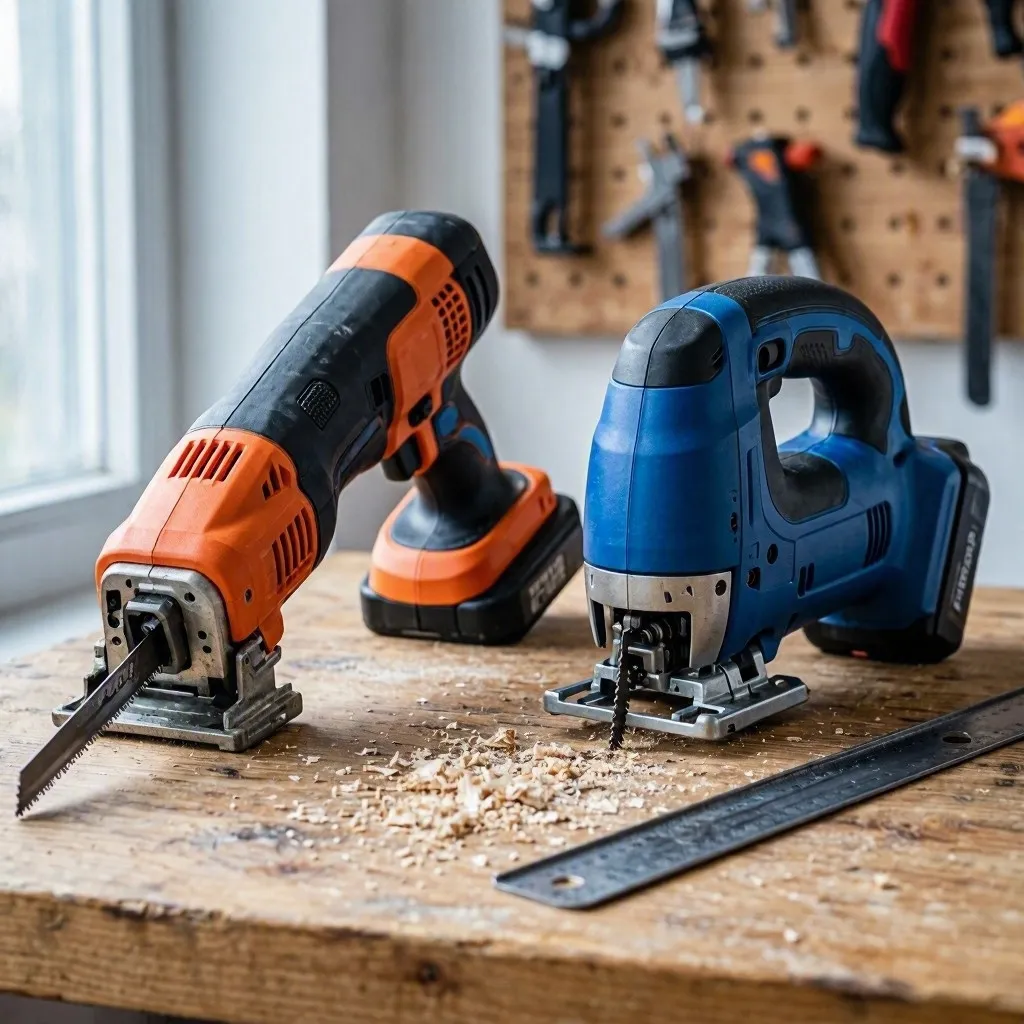
If you’re building your first collection of DIY power tools, you may be wondering whether you need a reciprocating saw or a jigsaw.
Although both tools use a blade that moves backwards and forwards, they’re designed for quite different types of work.
- A jigsaw is generally better when you need controlled, accurate cuts, particularly in wood.
- A reciprocating saw is better when you need to cut quickly, dismantle materials or reach awkward places.
For a DIY beginner, the easiest way to remember the difference is:
Jigsaw = controlled cutting.
Reciprocating saw = fast, rough and awkward cutting.
Neither tool is simply “better”.
The right choice depends on what you’re planning to cut.
Table of Contents
Quick Answer: Reciprocating Saw or Jigsaw?
If you’re mainly doing woodworking and want reasonably accurate cuts, choose a jigsaw.
If you’re doing renovation, demolition, cutting pipes, dismantling timber or cutting in awkward locations, choose a reciprocating saw. You can read more about what a reciprocating saw is used for.
| If You Want To… | Better Choice |
|---|---|
| Cut straight lines in wood | Jigsaw |
| Cut curves in wood | Jigsaw |
| Cut shapes from sheet material | Jigsaw |
| Cut laminate | Jigsaw |
| Cut worktops | Jigsaw |
| Dismantle timber | Reciprocating saw |
| Cut timber with nails | Reciprocating saw |
| Cut pipes | Reciprocating saw |
| Cut metal pipe | Reciprocating saw |
| Demolish old structures | Reciprocating saw |
| Cut branches | Reciprocating saw |
| Make accurate woodworking cuts | Jigsaw |
| Cut in awkward locations | Reciprocating saw |
For most DIY beginners, a jigsaw is probably the more useful first purchase if woodworking is your main interest. If renovation and demolition are your priorities, I’d choose the reciprocating saw.
What Is a Reciprocating Saw?
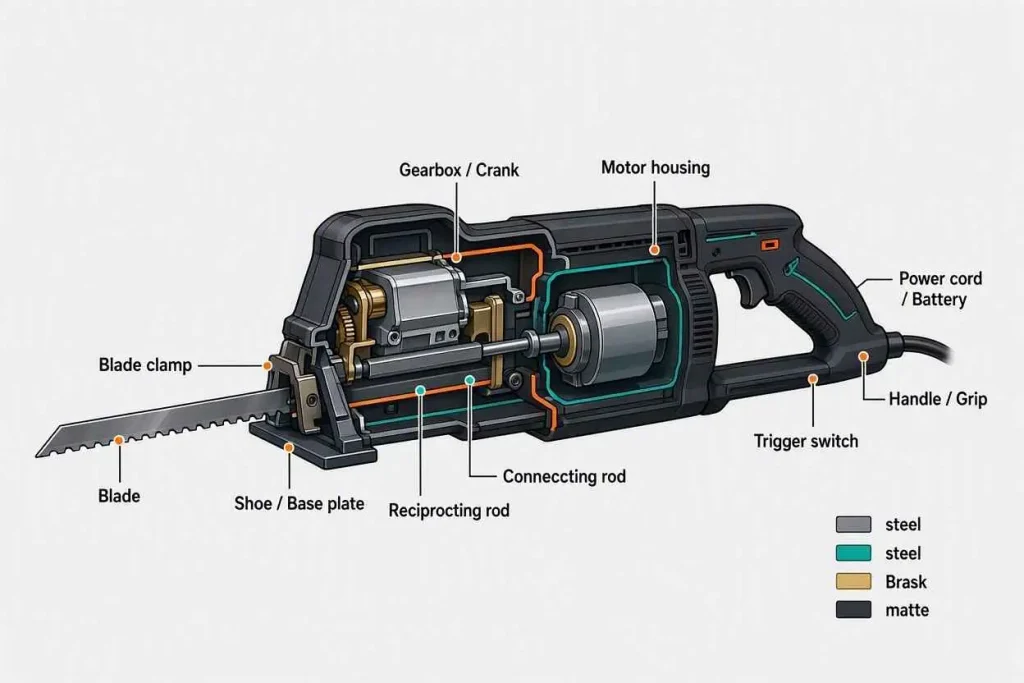
A reciprocating saw uses a narrow blade that moves rapidly backwards and forwards.
It’s sometimes called a:
- Recip saw
- Sabre saw
- Sawzall
The blade extends out from the front of the tool and is usually supported against the workpiece by a shoe. One of its biggest advantages is its ability to cut materials that are already installed.
For example, you can use one to cut:
- Timber
- Metal
- Plastic pipe
- Wooden pallets
- Nails
- Screws
- Plasterboard
- Branches
- Old fixtures
The saw isn’t primarily designed for precision. It’s designed to get through material quickly.
What Is a Jigsaw?
A jigsaw also uses a reciprocating blade, but its design is very different. The blade normally moves vertically through the material, while the saw’s base plate sits on top of the workpiece.
Jigsaws are particularly useful for:
- Straight cuts
- Curved cuts
- Cut-outs
- Notches
- Wood
- Plastic
- Thin metal
- Laminate
Many jigsaws also have features designed specifically to improve cutting accuracy. That makes them much more suitable for woodworking than a reciprocating saw.
The Biggest Difference Between Them
The biggest difference isn’t simply the way the blades move. It’s what each tool is designed to achieve. A jigsaw is designed to give you control.
A reciprocating saw is designed to give you access and speed.
Imagine you need to cut a neat curve in a piece of plywood then use a jigsaw.
Now imagine you’re removing an old timber stud wall containing nails, then use a reciprocating saw.
That’s the fundamental difference.
Reciprocating Saw vs Jigsaw Comparison
| Feature | Reciprocating Saw | Jigsaw |
|---|---|---|
| Main purpose | Demolition & rough cutting | Controlled cutting |
| Wood | Excellent for rough cuts | Excellent |
| Metal | Excellent with correct blade | Good for thinner metal |
| Plastic | Good | Good |
| Pipe | Excellent | Poor |
| Timber with nails | Excellent | Not ideal |
| Curved cuts | Possible but rough | Excellent |
| Straight cuts | Rough | Good |
| Precision | Low–medium | Medium–high |
| Demolition | Excellent | Poor |
| Tight spaces | Excellent | Limited |
| Garden work | Excellent with pruning blade | Not suitable |
| Worktop cut-outs | Not ideal | Excellent |
| Beginner woodworking | Not ideal | Excellent |
Which Is Better for Cutting Wood?
For most woodworking jobs, the jigsaw wins. A jigsaw gives you much more control over the cut.
It’s particularly useful for:
- Plywood
- MDF
- Chipboard
- Softwood
- Hardwood
- Worktops
- Shelving
You can also use different blades to achieve different finishes.
A reciprocating saw can certainly cut wood, but the result is generally much rougher.
Which Is Better for Cutting Timber?
Most DIYers will want to be cutting wood at some point. It depends on the type of cut that you want to make.
Cutting a piece of timber to length
Jigsaw: Good
Reciprocating saw: Good for rough cuts
Cutting a neat shape
Jigsaw: Excellent
Reciprocating saw: Poor
Dismantling timber
Jigsaw: Poor
Reciprocating saw: Excellent
Cutting old timber containing nails
Jigsaw: Not recommended
Reciprocating saw: Excellent with a suitable demolition blade
So if you’re building something, use the jigsaw. If you’re taking something apart, reach for the reciprocating saw.
Which Is Better for Cutting Metal?
This is more complicated. Both tools can cut metal when fitted with the correct blade. However, their ideal applications differ.
A jigsaw can be useful for:
- Thin sheet metal
- Aluminium
- Thin steel
- Controlled cut-outs
A reciprocating saw is better suited to:
- Metal pipe
- Steel pipe
- Metal profiles
- Demolition
- Bolts
- Heavier metal sections
The important thing is to use the correct blade. Never use a wood blade to cut metal.
Which Is Better for Cutting Pipes?
The reciprocating saw wins easily.
This is one of its biggest advantages. The narrow blade can reach around:
- Copper pipe
- Plastic pipe
- Steel pipe
- Other suitable pipework
It is particularly useful during renovation and demolition. A jigsaw generally isn’t designed for this type of work.
Important safety warning
Never cut a pipe unless you know what it contains. Before cutting, make sure you have correctly identified the pipe and isolated any relevant supply.
Be particularly careful with:
- Gas pipes
- Pressurised water
- Heating systems
- Electrical services
If you’re unsure what you’re looking at, stop before cutting.
Which Is Better for Curved Cuts?
The jigsaw.
This is one of the main reasons people buy jigsaws. You can use them to cut:
- Circles
- Arcs
- Curved furniture components
- Decorative shapes
- Worktop cut-outs
A reciprocating saw can technically make curved cuts, but it isn’t designed for accurate curves.
Its flexible blade can wander away from your cutting line.
Which Is Better for Straight Cuts?
Again, the jigsaw is generally the better choice. A jigsaw can follow a marked line reasonably accurately, particularly when combined with:
- A guide
- Fence
- Straight edge
- Suitable blade
A reciprocating saw is much harder to control accurately.
The blade can flex and wander.
If appearance matters, use the jigsaw.
Which Is Better for Demolition?
The reciprocating saw wins by a considerable margin. This is where the tool really comes into its own.
You can use a reciprocating saw to dismantle:
- Timber frames
- Old cupboards
- Pallets
- Stud walls
- Flooring
- Pipework
- Fittings
- Garden structures
With the right demolition blade, you can even cut through timber containing nails. That’s something you wouldn’t normally want to do with a standard jigsaw.
Reciprocating Saw vs Jigsaw for DIY Renovation
If you’re renovating a house, I’d ideally have both.
They perform different jobs.
Jigsaw
Use it for:
- Cutting worktops
- Cutting shelves
- Making shapes
- Cutting plywood
- Installing flooring
- Cutting panels
Reciprocating saw
Use it for:
- Removing old timber
- Cutting pipes
- Removing old fixtures
- Dismantling structures
- Cutting nails
- Demolition
Having both gives you much more flexibility.
Which Is Easier for a Beginner?
I’d give the advantage to the jigsaw for controlled cutting.
A jigsaw sits on the workpiece, which gives you a stable base. This makes it relatively easy to follow a marked line.
A reciprocating saw can feel more aggressive. The blade moves quickly and the tool can kick or vibrate if you’re not holding it correctly.
That doesn’t mean it’s difficult to use.
It just means you should start with simple jobs and learn how the tool behaves. If you need more advice on buying a jigsaw then read this article.
Which Is Safer?
Neither tool should be considered inherently “safe”. Both have rapidly moving cutting blades and need to be used correctly.
However, the type of work you’re doing makes a difference.
A jigsaw’s base plate generally provides a stable reference against the workpiece.
A reciprocating saw can be more difficult to control because you’re often cutting into existing structures.
With either tool:
- Wear appropriate eye protection.
- Secure the workpiece where possible.
- Keep both hands away from the blade.
- Check for hidden cables and pipes.
- Use the correct blade.
- Don’t force the tool.
- Allow the blade to stop before putting the tool down.
- Remove the battery before changing blades.
Which Has More Power?
This isn’t a useful way of choosing between them. You can buy powerful versions of both tools. A high-powered reciprocating saw doesn’t automatically make it better than a jigsaw. They are designed for different purposes.
Instead, ask:
What do I need the saw to do?
If the answer is demolition and pipe cutting, buy a reciprocating saw. If the answer is accurate woodworking, buy a jigsaw.
Which Uses More Battery?
There’s no simple answer.
Battery consumption depends on:
- Material
- Blade
- Cutting speed
- Pressure
- Tool
- Battery capacity
- Cutting time
A reciprocating saw can consume considerable battery power during heavy demolition. A jigsaw can also use significant power when cutting thick material. If you’re buying cordless, look at the battery ecosystem rather than just the claimed runtime.
Reciprocating Saw vs Jigsaw Blades
The blades are completely different.
Reciprocating saw blades
These are generally longer and wider. You’ll find blades designed for:
- Wood
- Metal
- Demolition
- Wood with nails
- Plastic
- Pruning
Jigsaw blades
Jigsaw blades are much narrower and shorter.
They are available for:
- Fine wood cutting
- Fast wood cutting
- Laminate
- Metal
- Plastic
- Curved cutting
You cannot simply swap blades between the two tools.
Which Is Better for Cutting Worktops?
Jigsaw.
If you’re installing a kitchen worktop and need to cut around:
- Sink
- Hob
- Corner
- Pipe
- Appliance
a jigsaw is generally the right tool.
It gives you much better control for creating the required shape.
A reciprocating saw would be unnecessarily aggressive for this type of work.
Which Is Better for Cutting Pallets?
This is where the reciprocating saw becomes extremely useful.
Old pallets can contain:
- Nails
- Screws
- Hardened timber
- Damaged wood
A demolition blade designed for wood with embedded metal can make short work of dismantling them.
A jigsaw isn’t the tool I’d choose.
Which Is Better for Cutting Branches?
A reciprocating saw can be used with a suitable pruning blade.
This makes it useful for:
- Cutting branches
- Removing dead wood
- Garden maintenance
- Cutting awkward branches
A jigsaw isn’t designed for garden pruning.
However, for regular tree and hedge work, a dedicated pruning saw or chainsaw may be more appropriate depending on the job.
Can a Jigsaw Replace a Reciprocating Saw?
Not really.
You can make some cuts with both tools, but their strengths are different.
A jigsaw isn’t a good substitute for a reciprocating saw when you’re:
- Cutting pipes
- Dismantling structures
- Cutting nails
- Working in awkward locations
- Removing old materials
Similarly, a reciprocating saw isn’t a good replacement for a jigsaw when you’re:
- Cutting worktops
- Cutting curves
- Making accurate shapes
- Cutting panels
- Doing detailed woodworking
Can a Reciprocating Saw Replace a Jigsaw?
Again, not really. You could use a reciprocating saw to make rough cuts in timber. But if you need accuracy, you’ll quickly discover why the jigsaw exists.
The reciprocating saw’s blade can flex and wander, making it difficult to maintain a precise cutting line.
Should I Buy a Jigsaw or Reciprocating Saw First?
This depends on your DIY plans.
Buy a jigsaw first if you mainly want to:
- Build furniture
- Cut shelves
- Install worktops
- Cut plywood
- Make curved cuts
- Cut shapes
- Work with timber
Buy a reciprocating saw first if you mainly want to:
- Renovate
- Demolish
- Remove old fixtures
- Cut pipe
- Dismantle timber
- Cut nails
- Cut branches
If you’re still unsure
Think about your next three DIY projects. Write them down. Then ask which saw would be useful for most of them. That will probably give you your answer.
What If I Can Afford Both?
Then I’d recommend having both. They’re complementary tools rather than direct competitors.
A good DIY tool collection could eventually include:
- Drill/driver
- Jigsaw
- Circular saw
- Reciprocating saw
- Multi-tool
- Angle grinder
You don’t need to buy all of these at once. Build your collection around the work you actually do.
Cordless vs Corded: Does the Choice Change?
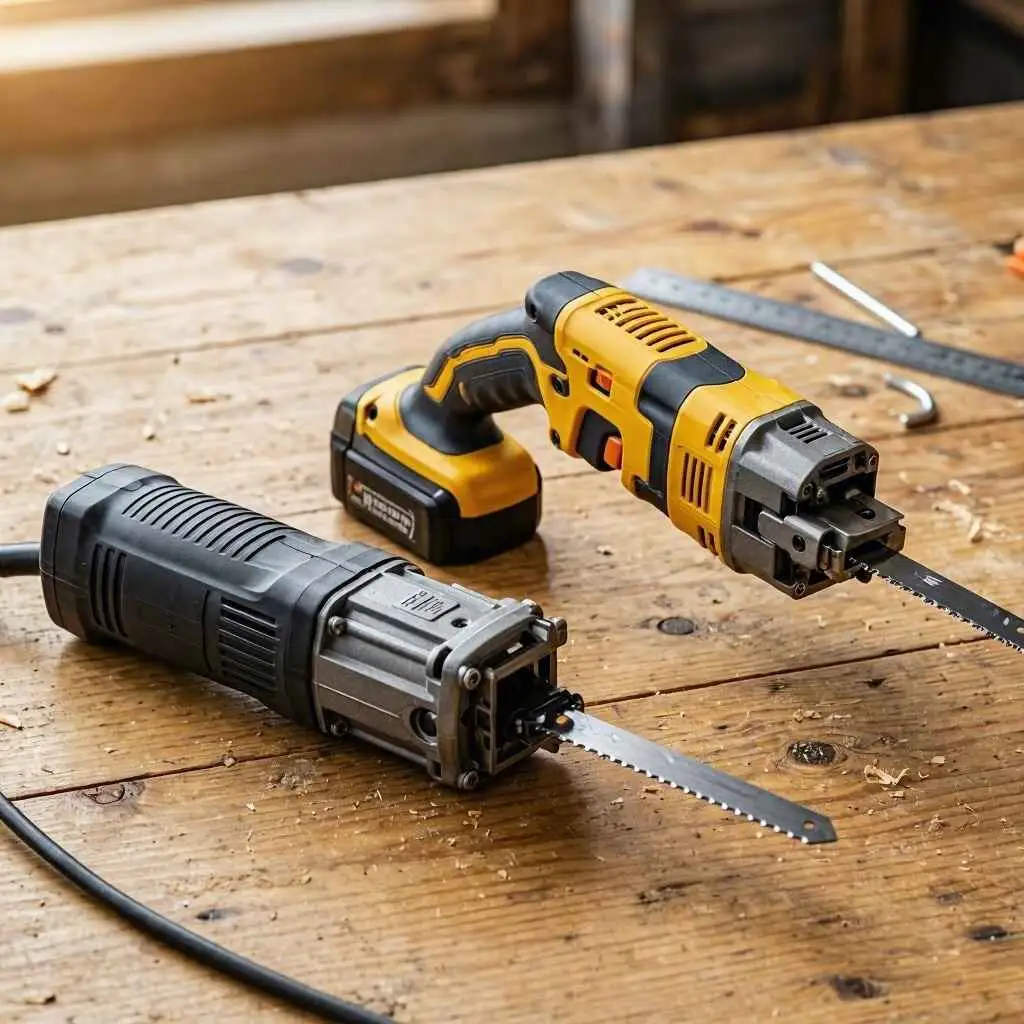
The same basic rules apply.
Both jigsaws and reciprocating saws are available as:
- Corded
- Cordless
For a modern DIY tool collection, cordless is often the most convenient. If you already own an 18V battery platform, buying the matching saw as a bare tool can also be considerably cheaper.
For example, if you already own Makita 18V LXT batteries, the Makita reciprocating saw range becomes more attractive.
The same applies to:
- DeWalt XR
- Bosch Professional 18V
- Ryobi ONE+
- Milwaukee M18
The battery ecosystem can be more important than the small differences between individual saws.
Reciprocating Saw vs Jigsaw: Cost
There’s no universal winner on price. You can buy budget versions of both. When comparing cordless models, remember to include:
- Tool
- Battery
- Charger
- Blades
A £100 bare tool isn’t necessarily cheaper than a £160 kit if you don’t already own the battery.
Reciprocating Saw vs Jigsaw: Which Should You Choose?
Here’s the simple version.
| Your Main Job | Choose |
|---|---|
| Accurate woodworking | Jigsaw |
| Curved cuts | Jigsaw |
| Worktops | Jigsaw |
| Plywood | Jigsaw |
| Shelving | Jigsaw |
| Demolition | Reciprocating saw |
| Pipe cutting | Reciprocating saw |
| Cutting nails | Reciprocating saw |
| Dismantling timber | Reciprocating saw |
| Garden pruning | Reciprocating saw |
| Awkward access | Reciprocating saw |
| Mixed renovation work | Both |
It might also be worth reading how to use a reciprocating saw.
My Verdict for UK DIY Beginners
If you’re choosing between the two and only want one saw, I’d make the decision based on your type of DIY.
Choose a jigsaw if:
Your DIY involves mainly woodworking and you care about the appearance and accuracy of your cuts.
Choose a reciprocating saw if:
Your DIY involves renovation, demolition, pipework, dismantling or awkward cuts.
Buy both if:
You’re planning to take on a wide variety of DIY projects. The important thing is not to think of one as an upgrade over the other. They’re different tools for different jobs. A jigsaw is your controlled cutting tool.
A reciprocating saw is your demolition and problem-solving tool.
Frequently Asked Questions
Is a reciprocating saw better than a jigsaw?
No. They are designed for different purposes. A jigsaw is generally better for accurate woodworking, while a reciprocating saw is better for demolition, pipe cutting and rough cutting.
Can a reciprocating saw cut curves?
Yes, but it isn’t the best tool for accurate curved cuts. A jigsaw is much better suited to this.
Can a jigsaw cut metal?
Yes. With the correct metal-cutting blade, a jigsaw can cut suitable thin metal.
Can a reciprocating saw cut wood?
Yes. It’s excellent for rough wood cutting and particularly useful for demolition and timber containing nails.
Which is better for beginners?
For general woodworking, a jigsaw is usually easier to control. For renovation and demolition, a reciprocating saw can be extremely useful.
Which is better for cutting pipes?
A reciprocating saw is the better choice.
Which is better for cutting worktops?
A jigsaw is the better choice because it can make controlled curved and shaped cuts.
Can I use the same blades in both tools?
No. Jigsaw blades and reciprocating saw blades use different fittings and designs.
Do I need both?
Not necessarily. If your DIY is mainly woodworking, start with a jigsaw. If you’re renovating or demolishing, a reciprocating saw may be more useful.
Final Thoughts
The reciprocating saw and jigsaw may look similar on paper because they both use reciprocating blades, but they serve very different purposes.
- For clean, controlled woodworking, choose the jigsaw.
- For demolition, pipe cutting, dismantling and awkward access, choose the reciprocating saw.
If you’re building a UK DIY tool collection from scratch, there’s no need to buy both immediately.
Start with the tool that matches the jobs you’re most likely to do. And as your DIY projects become more ambitious, adding the other tool can give you a much more versatile setup.
New Saw or Upgrading Your Existing Setup
If you want to upgrade your existing reciprocating saw or want to know the latest models, then check out my Reciprocating Saw Buying Guide UK.