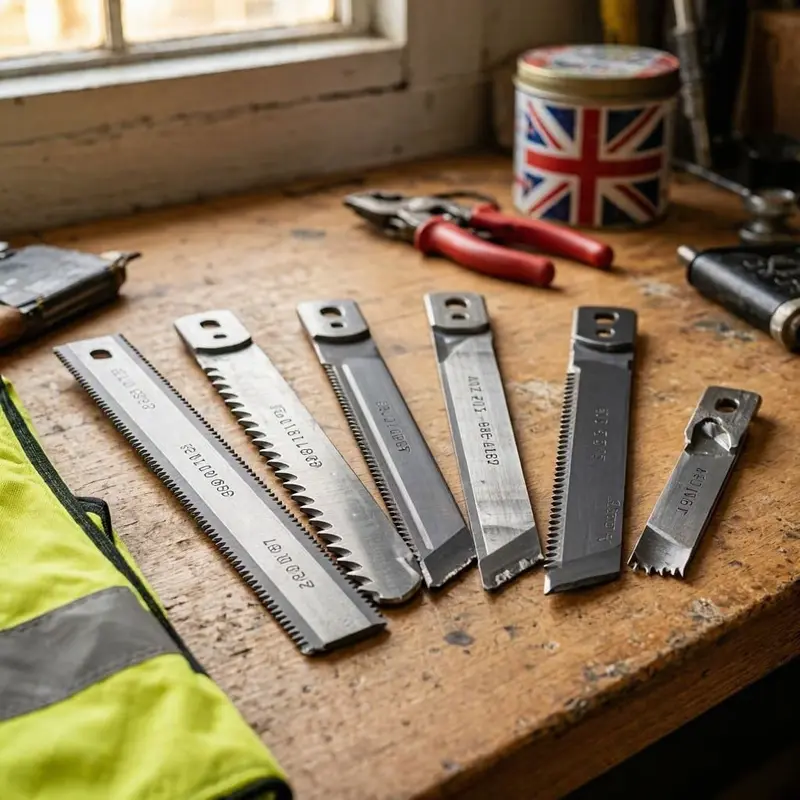
A reciprocating saw can be an extremely useful tool for cutting metal, but choosing the right blade is important.
A blade that’s excellent for cutting thin sheet metal isn’t necessarily the best choice for thick steel pipe. Likewise, a blade designed for ordinary mild steel may not be the best option for tough stainless steel.
For a DIY beginner, the good news is that you don’t need to understand every blade specification before buying.
The main things to consider are:
- What type of metal you’re cutting
- How thick the metal is
- The blade’s TPI
- Blade length
- Bi-metal or carbide construction
- How often you’ll use the blade
- Whether you need speed or durability
In this guide, I’ll explain the different types of metal-cutting reciprocating saw blades and help you choose the right one for your DIY projects.
Quick Answer: What Is the Best Reciprocating Saw Blade for Metal?
For general DIY metal cutting, I’d start with a good-quality bi-metal blade.
Bi-metal blades offer a useful combination of flexibility, durability and cutting performance and are available in a wide range of tooth configurations. For example, Bosch’s S918BF is a bi-metal blade designed for regular-strength steel and is specified for material thicknesses of 2–8mm.
For thinner metal, a finer-tooth blade can be more appropriate. Bosch’s S918AF, for example, has 24 TPI and is specified for material from 1–3mm thick.
For particularly tough steel or heavy-duty applications, carbide-tipped blades are available.
So rather than looking for one “best” blade, it’s better to choose the blade that matches the metal you’re cutting.
Our Recommended Metal-Cutting Blade Types
Rather than simply choosing blades based on brand, I’d divide them into categories according to the job.
| Type | Best For | Beginner Friendly |
|---|---|---|
| Bi-metal general-purpose | Mild steel and general metal | ⭐⭐⭐⭐⭐ |
| Fine-tooth metal blade | Thin sheet metal | ⭐⭐⭐⭐⭐ |
| Progressive-tooth blade | Different metal thicknesses | ⭐⭐⭐⭐⭐ |
| Heavy-duty bi-metal | Tougher applications | ⭐⭐⭐⭐ |
| Carbide-tipped | Tough steel/stainless steel | ⭐⭐⭐⭐ |
| Long metal blade | Larger pipe and profiles | ⭐⭐⭐⭐ |
1. Best All-Round Metal Blade: Bi-Metal
For most DIY users, bi-metal is the best place to start. A bi-metal blade combines different materials to produce a blade that’s both durable and reasonably flexible.
This makes it useful for general metal cutting.
Bosch’s S918BF is one example. It’s a 150mm bi-metal blade with a 14 TPI tooth pitch and is designed for regular-strength steel, metal pipes and profiles. Bosch specifies it for material between 2mm and 8mm thick.
Why choose bi-metal?
Advantages include:
- Good durability
- Good flexibility
- Suitable for general DIY
- Available in many TPI configurations
- Suitable for a range of metals
For a beginner who doesn’t know exactly which metal blade to buy, a quality bi-metal blade suitable for the material you’re cutting is a sensible starting point.
2. Best for Thin Sheet Metal
Thin metal requires a different approach. A blade with a finer tooth pattern can be more suitable than a coarse metal blade.
For example, Bosch’s S918AF has 24 TPI and is specified for material between 1mm and 3mm thick.
This makes this type of blade useful for applications such as:
- Thin sheet steel
- Thin metal profiles
- Light metal fabrication
- Thin pipe
Don’t automatically assume that a higher TPI is better, though.
The blade needs to match the material thickness.
3. Best Progressive-Tooth Blade
Progressive-tooth blades are particularly useful when you may encounter different material thicknesses.
Instead of every tooth having exactly the same spacing, the tooth pitch changes along the blade.
Bosch’s S123XF Progressor for Metal, for example, uses a progressively increasing tooth pitch and is specified for steel materials from 1–8mm thick. Its stated tooth pitch is 8–18 TPI.
This can make a progressive blade a useful all-rounder if your DIY projects involve a mixture of metal thicknesses.
4. Best for Stainless Steel
Stainless steel can be more demanding than ordinary mild steel.
If you’re cutting stainless steel regularly, I’d look for a blade specifically designed for tough metals or stainless steel.
Carbide-tipped options are available for particularly demanding applications.
For example, Bosch’s Expert range includes blades designed specifically for tough steel and stainless-steel pipes.
A suitable carbide blade can cost more than a standard bi-metal blade, but it may make sense if you’re regularly cutting difficult materials.
5. Best for Tough Steel
If you’re cutting tough steel, don’t automatically reach for a basic metal blade.
This is where higher-performance blades can become worthwhile.
Bosch’s Expert S955HHC, for example, uses carbide technology and is designed for tough steel and stainless-steel pipes, with a stated recommended wall thickness of 3–8mm.
For extremely demanding applications, carbide technology can offer significantly greater blade life than standard blades.
6. Best for Thick Metal
Thicker metal can require a more robust blade. One example is Bosch’s Expert S1255CHC, which is designed for tough steel and cast iron.
It’s a 300mm blade with carbide teeth and is specified for cutting material up to 12mm thick.
This type of blade is aimed at more demanding work rather than occasional DIY.
For most beginners, there’s no need to buy a heavy-duty carbide blade unless your projects actually require it.
7. Best Long Metal Blade
Blade length becomes increasingly important when cutting large pipe, profiles or other deep material.
Longer blades are available in sizes such as:
- 225mm
- 230mm
- 250mm
- 300mm
A 300mm blade can give you significantly more reach than a 150mm blade.
However, longer isn’t automatically better.
A long blade can be less convenient in confined spaces and may flex more if you’re applying sideways pressure.
Choose the shortest blade that provides enough cutting depth for the job.
What TPI Is Best for Cutting Metal?
TPI means teeth per inch.
It’s one of the most important specifications to understand when buying a metal-cutting blade.
As a general rule:
Higher TPI = finer teeth = generally more suitable for thinner material
Lower TPI = larger teeth = generally more suitable for thicker material
But there is more to it than simply choosing the highest or lowest TPI.
For example:
| Approx. TPI | Typical Application |
|---|---|
| 8–10 TPI | Thicker metal / tougher applications |
| 10–14 TPI | General metal cutting |
| 14–18 TPI | General and medium metal |
| 18–24 TPI | Thin metal |
| 24+ TPI | Very thin sheet/specialist applications |
These are general guidelines rather than strict rules.
Always check the manufacturer’s recommended material thickness.
Bosch’s examples demonstrate why. Its S918BF is 14 TPI and recommended for 2–8mm material, while its S918AF is 24 TPI and recommended for 1–3mm material.
Why Does TPI Matter When Cutting Metal?
Imagine trying to cut a very thin piece of sheet metal with a blade designed for thick steel.
The large teeth can catch aggressively and make the cut difficult to control.
A finer tooth pattern gives you more teeth engaged with the material.
On the other hand, using an extremely fine blade on thick steel can make the cutting process unnecessarily slow.
That’s why the material thickness should guide your blade choice.
Bi-Metal vs Carbide Reciprocating Saw Blades
This is another area where beginners can become confused.
Bi-metal blades
Bi-metal blades are an excellent general-purpose option.
They offer:
- Good durability
- Flexibility
- Relatively good value
- Wide range of applications
For occasional DIY metal cutting, they’re often all you need.
Carbide blades
Carbide-tipped blades are designed for more demanding applications.
They can be particularly useful for:
- Tough steel
- Stainless steel
- Cast iron
- Heavy-duty metal cutting
They generally cost more than basic bi-metal blades.
Which should you buy?
For occasional DIY:
Start with bi-metal.
For regular heavy-duty metal cutting:
Consider carbide.
Best Reciprocating Saw Blade for Steel
For ordinary mild steel, a good-quality bi-metal blade is a sensible choice.
Choose the TPI and blade specification according to the thickness.
For example, Bosch’s S918BF is designed for regular-strength steel and material between 2mm and 8mm thick.
If you’re cutting a mixture of steel thicknesses, a progressive-tooth blade can be useful.
Best Reciprocating Saw Blade for Stainless Steel
Stainless steel can be harder on blades.
If you’re only making an occasional cut, a suitable quality bi-metal blade may be sufficient.
If you’re cutting stainless steel regularly, consider a specialist blade.
Bosch’s Expert range includes carbide blades designed for stainless-steel pipes and tough steel.
The important thing is to check that the blade specifically lists stainless steel as a suitable material.
Best Reciprocating Saw Blade for Aluminium
Aluminium is a non-ferrous metal and can be cut with an appropriate metal-cutting blade.
However, don’t choose a blade simply because it says “metal”.
Check that the manufacturer lists aluminium or non-ferrous metals among the intended applications.
Blade selection should also take the thickness of the aluminium into account.
Best Reciprocating Saw Blade for Copper Pipe
Copper pipe is another common DIY application.
A suitable fine-to-medium metal-cutting blade can work well.
However, the blade is only part of the job.
Before cutting copper pipe, make absolutely sure:
- You know what the pipe carries.
- The relevant supply has been isolated.
- The pipe isn’t pressurised.
- There aren’t cables or other services nearby.
If you’re unsure, stop before cutting.
Best Blade for Metal Pipe
Metal pipe is one of the areas where a reciprocating saw can be extremely useful.
The narrow blade can reach around pipes and into areas where larger cutting tools may be awkward.
For example, Bosch’s S123XF is specified for steel pipes and profiles from 1–8mm thick.
For thicker or tougher pipes, a specialist carbide blade may be more appropriate.
Best Blade for Cutting Bolts
If you’re using a reciprocating saw to cut bolts, choose a suitable metal-cutting blade.
A fine-to-medium tooth blade is generally more appropriate than a coarse wood blade.
This can be particularly useful during:
- Demolition
- Renovation
- Vehicle repairs
- Removing seized fixings
- Dismantling old structures
Remember that the cut end of a bolt can be extremely sharp.
Best Blade for Metal With Nails
If you’re cutting wood that contains nails, don’t automatically buy a pure metal-cutting blade.
Instead, look for a wood-and-metal or demolition blade.
These are designed to deal with the combination of timber and metal.
This is particularly useful for:
- Pallets
- Old timber
- Roof timbers
- Demolition
- Construction timber
Are Expensive Metal Reciprocating Saw Blades Worth It?
Sometimes. If you’re only cutting a couple of pieces of mild steel, you may not need an expensive specialist blade.
But if you’re regularly cutting:
- Thick steel
- Stainless steel
- Cast iron
- Heavy pipe
- Tough metal
then a more advanced blade may offer better value.
The important thing is to match the blade to the job.
Don’t buy a £30 specialist blade for a job that a £10–£15 bi-metal blade can comfortably handle.
On the other hand, don’t expect a cheap general-purpose blade to perform like a specialist carbide blade when cutting tough steel.
How Many Metal Blades Should a DIY Beginner Buy?
You don’t need a huge collection.
I’d start with:
One general-purpose bi-metal blade
For ordinary steel and general metal work.
One finer-tooth blade
For thin sheet metal and lighter material.
One wood-and-metal/demolition blade
If you’re likely to cut timber containing nails.
You can then add specialist blades when a particular project requires them.
Should You Buy a Reciprocating Saw Metal Blade Set?
A set can be good value if it contains blades with different TPI and applications.
However, don’t be fooled by a large number of blades.
A 20-piece set isn’t necessarily better than a five-piece set if most of the blades aren’t useful for your projects.
Look for a selection covering:
- Fine metal
- General metal
- Thicker metal
- Wood and nails
Do Reciprocating Saw Blades Fit All Brands?
Many standard reciprocating saw blades use a 1/2-inch universal shank or S-shank fitting.
Bosch states that its S918BF, for example, fits all S-shank reciprocating saws.
However, you should still check compatibility before purchasing.
Also consider whether the blade’s:
- Length
- Thickness
- Application
- Cutting capacity
are suitable for your particular saw.
How Long Do Metal Reciprocating Saw Blades Last?
There’s no fixed lifespan.
Blade life depends on:
- Type of metal
- Thickness
- Blade quality
- Cutting technique
- Saw speed
- Pressure
- Heat
- Number of cuts
A blade cutting thin mild steel may last considerably longer than one being used on thick stainless steel.
Signs that a blade may need replacing include:
- Cutting becomes noticeably slower
- More pressure is required
- Excessive heat
- Increased vibration
- Teeth appear damaged
- The cut becomes difficult to control
Why Does My Metal Blade Get Hot?
Metal cutting naturally creates heat.
However, excessive heat can indicate a problem.
Possible causes include:
- Wrong blade
- Blunt blade
- Too much pressure
- Incorrect TPI
- Cutting material that’s too thick
- Poor technique
If the blade becomes excessively hot, stop and allow it to cool.
Don’t simply keep forcing it through the material.
How to Get the Best Results When Cutting Metal
1. Use the correct blade
This is the most important step.
2. Secure the material
Metal should not be allowed to move unexpectedly during cutting.
3. Use the correct TPI
Match the blade to the material thickness.
4. Don’t force the saw
Let the blade do the cutting.
5. Keep the shoe against the workpiece
This helps improve stability and control.
6. Avoid twisting the blade
Sideways pressure can damage the blade.
7. Replace worn blades
A fresh blade can make a dramatic difference.
Safety When Cutting Metal
Metal cutting requires appropriate PPE and care.
Before starting:
- Wear suitable eye protection.
- Wear appropriate protective equipment.
- Secure the workpiece.
- Check the blade is properly installed.
- Keep hands away from the blade.
- Keep other people away from the cutting area.
- Be aware of sharp edges.
- Allow hot metal to cool before handling it.
- Disconnect the battery or power supply before changing blades.
Always follow the manufacturer’s safety instructions for the saw and blade.
Be Particularly Careful With Pipes
This deserves its own warning.
Never cut a pipe unless you know what it contains.
A pipe could carry:
- Water
- Heating water
- Gas
- Waste
- Other substances
You also need to consider pipes that may be pressurised.
If you aren’t certain what a pipe is or what it carries, don’t cut it.
Reciprocating Saw vs Angle Grinder for Metal
Both tools can cut metal, but they’re very different.
| Reciprocating Saw | Angle Grinder |
|---|---|
| Uses a reciprocating blade | Uses a rotating disc |
| Good for awkward access | Excellent for many exposed cuts |
| Useful for pipes | Useful for sheet and sections |
| No abrasive disc required | Can generate sparks |
| Useful for demolition | Can also grind and clean metal |
| Generally less spark-heavy | Often produces significant sparks |
For demolition and awkward pipework, a reciprocating saw can be extremely convenient.
For workshop metal fabrication, an angle grinder may be more versatile.
Reciprocating Saw vs Hacksaw
Don’t overlook the humble hacksaw.
For a single small cut, a hacksaw can be perfectly adequate.
Hacksaw advantages
- Cheap
- Simple
- No battery
- Good control
- Quiet
Reciprocating saw advantages
- Much faster for repeated cuts
- Less physical effort
- Useful in awkward locations
- Excellent for demolition
If you’re only cutting one small bolt, a hacksaw might be all you need.
If you’re dismantling an old metal structure, the reciprocating saw starts to make much more sense.
Metal Reciprocating Saw Blade Comparison
| Blade Type | Best For | Typical TPI Direction | Material |
|---|---|---|---|
| Fine metal blade | Thin sheet | High | Thin steel |
| General bi-metal | General DIY | Medium | Mild steel |
| Progressive tooth | Mixed thickness | Variable | Steel/profiles |
| Heavy-duty bi-metal | Tougher work | Medium | Steel |
| Carbide | Tough steel | Specialist | Tough steel/stainless |
| Long metal blade | Deep cuts | Varies | Pipe/profiles |
Don’t use this table as a substitute for the manufacturer’s specifications.
The stated material thickness for the specific blade should always take priority.
Frequently Asked Questions
What is the best reciprocating saw blade for metal?
For general DIY, a good-quality bi-metal blade is a sensible starting point. Choose the TPI and blade specification according to the type and thickness of metal.
What TPI is best for cutting metal?
Higher TPI blades are generally used for thinner metal, while lower TPI blades can be appropriate for thicker material. The manufacturer’s recommended thickness is more important than a generic TPI rule.
Can I use a wood blade to cut metal?
No. Use a blade specifically designed for metal.
Can a reciprocating saw cut steel?
Yes. A suitable metal-cutting blade can cut steel.
Can a reciprocating saw cut stainless steel?
Yes, but stainless steel can be demanding. Use a blade specifically rated for stainless steel where appropriate.
Can a reciprocating saw cut aluminium?
Yes. Use a blade that the manufacturer recommends for aluminium or non-ferrous metals.
Can a reciprocating saw cut copper pipe?
Yes, with an appropriate metal-cutting blade. Make sure the pipe is safe and isolated before cutting.
Are carbide reciprocating saw blades worth it?
They can be, particularly when cutting tough steel, stainless steel or cast iron. For occasional mild-steel DIY, a quality bi-metal blade will often be sufficient.
Are bi-metal reciprocating saw blades good?
Yes. Bi-metal blades are a very useful general-purpose choice for many metal-cutting applications.
How thick metal can a reciprocating saw cut?
It depends entirely on the saw and blade. Individual blades can have very different specifications. For example, Bosch’s S918BF is recommended for 2–8mm material, while its S1255CHC is specified for up to 12mm tough steel and cast iron.
Final Verdict
For most DIY beginners, I wouldn’t recommend buying the most expensive metal-cutting reciprocating saw blade available.
Instead, start with a good-quality bi-metal blade that matches the material you’re most likely to cut.
If you’re mainly cutting thin sheet metal, choose a finer blade.
If you’re cutting a mixture of thicknesses, a progressive-tooth blade can be useful.
If you’re regularly cutting tough steel or stainless steel, consider stepping up to a carbide-tipped blade.
Most importantly, match the blade to the material and its thickness.
A £10 blade that’s correctly matched to the job can outperform a much more expensive blade that’s being used incorrectly.
What to Read Next?
If you’re building your reciprocating saw knowledge, these articles make useful next steps:
- Reciprocating Saw Blades: A Beginner’s Guide
- What TPI Reciprocating Saw Blade Do I Need?
- What Can You Cut With a Reciprocating Saw?
- Can You Cut Metal With a Reciprocating Saw?
- Best Reciprocating Saw Blades for Wood UK
- Best Reciprocating Saw for DIY UK