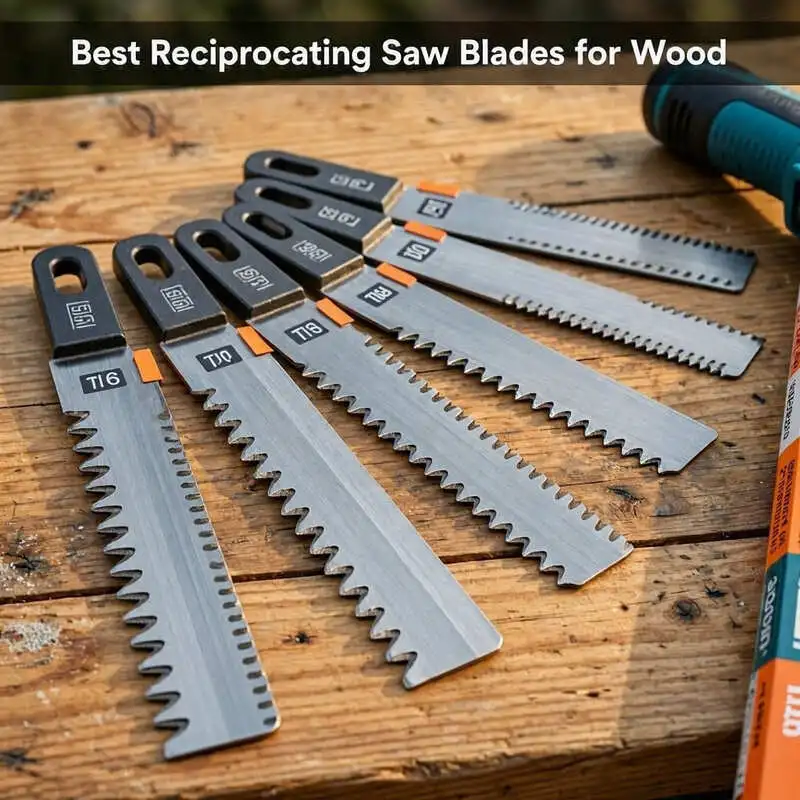
Choosing the right reciprocating saw blade can make a huge difference to how quickly and easily you can cut wood.
The problem is that there are a lot of blades to choose from. Some are designed for fast cutting through timber, others are better for demolition, while some are designed specifically for wood containing nails.
If you’re new to reciprocating saws, it’s easy to look at the number of teeth, blade length and different materials and wonder which one you actually need. The good news is that you don’t necessarily need a huge collection of blades.
For most DIY jobs, a few good-quality blades covering general wood cutting, demolition and wood containing nails will be enough.
In this guide, we’ll look at what makes a good reciprocating saw blade for wood and the types of blades worth considering.
Quick Answer: Which Reciprocating Saw Blade Is Best for Wood?
For most DIY beginners, I’d look for a general-purpose wood blade with a coarse tooth pattern for ordinary timber.
If you’re cutting pallets, old timber or wood containing nails, choose a bi-metal demolition blade designed specifically for wood with nails.
For large pieces of timber or firewood, a longer coarse-tooth blade can be useful.
There isn’t one blade that’s best for every wood-cutting job.
The best choice depends on:
- The type of wood
- The thickness of the material
- Whether nails are present
- Whether you want speed or a cleaner cut
- The length of blade required
- How frequently you use the saw
Our Recommended Reciprocating Saw Blades for Wood
Best for General Wood Cutting
Bosch S1542K Reciprocating Saw Blade
The Bosch S1542K is a useful option for general wood cutting. It is designed specifically for wood applications and is available in the UK.
It’s a good example of the type of blade I’d look at for ordinary timber and general DIY cutting.
Best for Wood With Nails
DeWalt DT2307L 2X Life Wood & Nail Reciprocating Blades · 4.7
The DeWalt DT2307L is specifically aimed at cutting wood and nails, making this type of blade particularly useful for pallets, demolition and old timber.
Best Budget-Friendly Option
Bosch S644D Sabre Saw Blades · 4.8
The Bosch S644D is another popular wood-cutting option and is available in packs, making it worth considering if you need several replacement blades.
Important: Prices and availability can change, so I’d recommend checking the current Amazon UK price before publishing or updating this article.
What Makes a Good Reciprocating Saw Blade for Wood?
Before buying a blade, there are several specifications worth understanding.
The most important are:
- Tooth design
- TPI
- Blade length
- Blade thickness
- Blade material
- Intended application
You don’t need to understand every technical specification, but knowing the basics can help you avoid buying the wrong blade.
1. Choose the Blade for the Type of Wood
The first question should always be:
What am I cutting?
For example, cutting a new piece of softwood is very different from cutting an old pallet containing rusty nails.
You might choose:
| Job | Blade Type |
|---|---|
| Softwood | Wood-cutting blade |
| General timber | General-purpose wood blade |
| Hardwood | Suitable wood blade |
| Plywood | Wood blade |
| Pallets | Demolition/bi-metal blade |
| Timber with nails | Wood-and-nail blade |
| Green wood | Suitable wood/pruning blade |
| Large timber | Long coarse-tooth blade |
The manufacturer’s recommended application should always take priority.
2. Look at the TPI
TPI means teeth per inch.
It’s one of the easiest ways to distinguish coarse and fine blades.
Generally:
Low TPI = larger teeth and faster cutting
High TPI = smaller teeth and finer cutting
For wood, you will commonly encounter relatively coarse blades.
As a general starting point:
| TPI | Typical Wood Application |
|---|---|
| 3–5 TPI | Very fast cutting and thick timber |
| 5–8 TPI | General timber and demolition |
| 8–12 TPI | Finer wood cutting |
| 12+ TPI | Specialist/finer applications |
These aren’t fixed rules.
The actual tooth design and manufacturer’s recommended application are more important than simply choosing a particular TPI.
For a fuller explanation, see our What TPI Reciprocating Saw Blade Do I Need? guide.
3. Consider the Blade Length
Blade length matters more than many beginners realise.
Common reciprocating saw blade lengths include approximately:
- 150mm
- 200mm
- 225mm
- 230mm
- 250mm
- 300mm
A longer blade can be useful when cutting thick timber.
For example, Bosch’s S1617K wood blade is 300mm long and has a stated maximum cutting capacity of up to 250mm.
However, longer isn’t always better. A blade that’s unnecessarily long can flex more during cutting.
For general DIY, something around 150–230mm can be a useful starting point.
4. Blade Thickness
Blade thickness affects how the blade behaves during cutting.
A thicker blade can provide additional strength and stability, which can be useful for demanding demolition work.
A thinner blade can provide more flexibility and may be better suited to certain cutting applications.
If you’re cutting ordinary timber, you don’t necessarily need the thickest blade available.
Again, look at the manufacturer’s intended application.
5. HCS or Bi-Metal?
You may see terms such as HCS and Bi-Metal when shopping for reciprocating saw blades.
HCS
HCS stands for High Carbon Steel.
These blades are commonly used for wood and similar softer materials.
For example, Bosch describes its S1111K as an HCS blade intended for firewood, nail-free coarse wood and green wood.
Bi-Metal
Bi-metal blades combine different metals to provide a combination of flexibility and durability.
They’re particularly useful when cutting wood containing nails because the blade needs to deal with both timber and metal.
For example, Bosch’s S922HF is a bi-metal blade designed for wood and metal and is optimised for soft nails, mild steel and non-ferrous metal components embedded in wood.
For ordinary clean timber, an HCS wood blade may be perfectly suitable.
For demolition timber containing nails, I’d favour a suitable bi-metal demolition blade.
Best Reciprocating Saw Blade for General Wood Cutting
If you’re mainly cutting ordinary timber, you don’t need a specialist demolition blade.
Look for a blade specifically designed for wood.
A good general-purpose wood blade should be suitable for jobs such as:
- Cutting construction timber
- Trimming timber
- Cutting softwood
- Cutting hardwood
- General DIY
- Rough cutting
The Bosch S1542K is an example of a wood-specific reciprocating blade available to UK buyers.
Bosch S1542K Reciprocating Saw Blades · The important thing isn’t necessarily buying this exact blade.
It’s understanding the type of blade you need.
Best Reciprocating Saw Blade for Pallets
Pallets are slightly different. They often contain nails, and those nails can quickly damage an ordinary wood blade.
For pallet dismantling, I’d look for a blade specifically described as suitable for:
- Wood with nails
- Pallets
- Demolition
- Wood and metal
The DeWalt DT2307L is an example of this type of blade.
DeWalt 2X Recip Blade DT2307L 6TPI for Wood & Nails
The 6 TPI configuration is a useful example of the coarse tooth pattern commonly used for demanding wood-and-nail applications.
Best Reciprocating Saw Blade for Demolition
For demolition, I’d prioritise durability over producing a perfectly clean cut.
Demolition blades are designed to cope with demanding materials and may be used for:
- Old timber
- Timber containing nails
- Pallets
- Construction wood
- Renovation
- General demolition
For particularly tough demolition, carbide technology is also available.
Bosch’s EXPERT Wood with Metal Demolition S1167XHM, for example, uses carbide technology and is designed for wood containing tough metal and demanding demolition applications.
This is the sort of blade I’d consider when durability is more important than keeping the cost as low as possible.
Best Reciprocating Saw Blade for Hardwood
Hardwood can be more demanding than ordinary softwood.
If you’re cutting hardwood, choose a blade specifically rated for the application.
Don’t assume that the blade with the largest teeth will automatically be best.
Consider:
- Wood type
- Thickness
- Desired cutting speed
- Blade length
- Manufacturer recommendations
If you’re making furniture or precision woodworking cuts, however, a reciprocating saw isn’t usually the ideal tool.
Best Blade for Cutting Large Timber
If you’re cutting large pieces of timber, blade length becomes particularly important.
A longer blade can allow you to cut through deeper material.
For example, Bosch’s 300mm S1617K is designed for wood and offers a stated cutting capacity of up to 250mm.
But remember: The blade needs to be suitable for your saw and the application.
Don’t buy a very long blade simply because it has a larger cutting capacity.
Best Reciprocating Saw Blade for Clean Wood Cuts
This is where it’s important to set expectations.
A reciprocating saw isn’t really a precision woodworking tool.
Even with a fine blade, it can be difficult to achieve the same finish as you would with a:
- Circular saw
- Track saw
- Mitre saw
- Jigsaw
- Hand saw
If you need the cleanest possible reciprocating-saw cut, look for a finer-tooth blade designed for wood and concentrate on controlling the saw.
Avoid forcing it through the timber.
Are Expensive Reciprocating Saw Blades Worth It?
Sometimes. If you’re only going to cut a few pieces of softwood, an inexpensive blade may do everything you need.
If you’re regularly cutting:
- Hardwood
- Thick timber
- Pallets
- Timber containing nails
- Construction materials
- Demolition materials
then paying more for a better-designed blade can make sense.
The real question isn’t:
“What’s the cheapest blade?”
It’s:
“What’s the best blade for the work I’m doing?”
A blade that lasts longer and cuts faster can provide better value even if the initial purchase price is higher.
How Many Reciprocating Saw Blades Do I Need?
You don’t need dozens.
For a DIY beginner, I’d start with three types:
1. General wood blade
For ordinary timber.
2. Demolition/wood-and-nail blade
For pallets, old timber and renovation.
3. Fine or specialist wood blade
For situations where you want more controlled cutting.
You can then buy additional specialist blades as your projects require them.
Should You Buy a Reciprocating Saw Blade Set?
A blade set can be a good option if you’re starting from scratch.
The advantage is that you get several blade types in one purchase.
However, check the contents carefully.
Some large sets contain lots of blades you’ll rarely use.
For a beginner, I’d rather see you buy a smaller set of useful blades than a 30- or 40-piece set full of specialist blades that sit unused.
Look for a set containing a useful combination of:
- Wood blades
- Wood-and-nail blades
- Metal blades
- Multi-material blades
Do Reciprocating Saw Blades Fit All Saws?
Many reciprocating saw blades use a standard fitting, and manufacturers sell blades designed to fit saws from multiple brands.
Bosch, for example, states that several of its reciprocating saw blades fit all S-shank reciprocating saws.
However, you should always check compatibility before buying.
Also check:
- Maximum blade length
- Blade thickness
- Saw manufacturer’s recommendations
- Application suitability
Never assume that because a blade fits physically, it’s automatically suitable for your particular saw.
How Long Should a Reciprocating Saw Blade Last?
There’s no simple answer.
Blade life depends on:
- Material
- Material thickness
- Blade quality
- Cutting technique
- Saw power
- Number of cuts
- Whether nails are present
A blade cutting clean softwood may last much longer than one repeatedly cutting through timber containing nails.
If the blade starts cutting noticeably slower or requires excessive pressure, check whether it needs replacing.
How Do I Know When a Wood Blade Is Blunt?
Look for signs such as:
- Slower cutting
- Increased effort
- Excessive heat
- More vibration
- Poor cutting performance
- Difficulty starting cuts
Don’t keep forcing a blade simply because it technically still cuts.
A fresh blade can make the job significantly easier.
How to Get the Best Performance From a Wood Blade
Even the best blade won’t perform well if you use the wrong technique.
Let the blade do the work
Don’t force the saw through the timber.
Keep the shoe against the workpiece
This helps maintain control.
Secure the timber
A moving workpiece makes cutting more difficult and less predictable.
Use the correct blade
A wood blade is not automatically suitable for wood containing nails.
Don’t twist the blade
Sideways pressure can damage or break the blade.
Replace worn blades
A blunt blade wastes time and can make the saw feel underpowered.
Safety When Cutting Wood
Before cutting, check the material carefully.
This is particularly important with:
- Old timber
- Pallets
- Floorboards
- Walls
- Roofing
- Demolition materials
You may encounter hidden nails, screws, cables or pipes.
Wear suitable eye protection and follow the manufacturer’s instructions.
If you’re cutting into a wall, floor or ceiling, know what’s behind the material before you start.
Our Reciprocating Saw Blade Buying Checklist
Before buying a blade, ask yourself:
What am I cutting?
Wood, demolition timber, pallets or something else?
Does it contain nails?
If yes, look for a suitable bi-metal/demolition blade.
How thick is it?
Choose a suitable blade length and tooth configuration.
Do I need speed or a cleaner cut?
Coarse blades generally favour speed, while finer blades can offer more controlled cutting.
Does the blade fit my saw?
Check the manufacturer’s specifications.
Am I buying enough?
A small selection is often better than a huge set of blades you’ll never use.
Reciprocating Saw Wood Blade Comparison
| Blade Type | Best For | Beginner Friendly? |
|---|---|---|
| General wood blade | Timber and softwood | Yes |
| Coarse wood blade | Fast cutting | Yes |
| Fine wood blade | More controlled cuts | Yes |
| Demolition blade | Renovation and demolition | Yes |
| Bi-metal wood & nail blade | Pallets and nailed timber | Yes |
| Long wood blade | Thick timber | Yes |
| Carbide demolition blade | Very demanding applications | Useful for experienced users |
Frequently Asked Questions
What is the best reciprocating saw blade for wood?
For general DIY, a good-quality wood-cutting blade with a suitable coarse tooth pattern is a good starting point. If you’re cutting wood containing nails, use a dedicated bi-metal or demolition blade instead.
What TPI is best for wood?
A lower TPI is generally suitable for fast cutting of thicker wood, while a higher TPI can provide a finer cut. Around 5–8 TPI is a useful general starting range for many wood-cutting applications.
What is the best blade for cutting pallets?
A demolition or bi-metal blade specifically designed for wood containing nails is usually the best choice.
Can I use a metal blade to cut wood?
A metal blade may physically cut some wood, but a blade designed specifically for wood is normally the better choice.
Are Bosch reciprocating saw blades good?
Bosch offers a wide range of reciprocating saw blades for wood, metal, demolition and other applications. The important thing is to choose the specific blade for the job rather than judging a blade simply by brand.
Are DeWalt reciprocating saw blades good?
DeWalt produces a range of reciprocating saw blades, including blades designed specifically for wood and nails. As with any brand, check the particular blade’s application and specifications.
How long should a reciprocating saw blade be for wood?
It depends on the thickness of the material. Around 150–230mm is useful for many general DIY applications, while longer blades are available for thicker timber.
Are expensive reciprocating saw blades worth it?
They can be, particularly if you’re doing demanding work such as demolition, cutting hardwood or dealing with wood containing nails. For occasional light DIY, a basic blade may be perfectly adequate.
Final Verdict
There isn’t one reciprocating saw blade that’s best for every type of wood.
For most DIY beginners, I’d build a small collection around three different applications:
General timber: a good-quality wood-cutting blade.
Pallets and demolition: a bi-metal blade designed for wood containing nails.
Thick timber: a longer, coarse-tooth blade when the material requires it.
The most important thing is to match the blade to the job.
Don’t choose a blade simply because it’s the longest, has the most teeth or is the most expensive.
Choose the blade that’s designed for the material you’re cutting.
For UK DIYers, that’s the approach I’d recommend when building your first reciprocating saw blade collection.
What to Read Next?
If you’re buying blades because you’re planning to cut metal as well as wood, our next guide looks specifically at the best reciprocating saw blades for metal.
You may also want to read:
- Reciprocating Saw Blades: A Beginner’s Guide
- What TPI Reciprocating Saw Blade Do I Need?
- Can You Cut Wood With a Reciprocating Saw?
- Can You Cut Metal With a Reciprocating Saw?
- What Can You Cut With a Reciprocating Saw?
- Best Reciprocating Saw Blades for Metal