If you’ve just bought a reciprocating saw, or you’re thinking about buying one, you might be surprised by the number of different blades available.
There are blades for wood, metal, demolition, plastic and even specialist materials. They also come in different lengths, thicknesses and tooth patterns.
The good news is that choosing a reciprocating saw blade doesn’t have to be complicated.
For most DIY jobs, you only need to understand a few basic things:
- What material you’re cutting
- What type of blade you need
- The number of teeth per inch (TPI)
- The length of the blade
- Whether you need a general-purpose or specialist blade
This guide explains the basics in simple terms so you can choose the right reciprocating saw blade for your next DIY project.
Table of Contents
What Is a Reciprocating Saw Blade?
A reciprocating saw blade is a long, narrow cutting blade designed to fit into a reciprocating saw. Unlike a circular saw blade, which rotates, a reciprocating saw blade moves backwards and forwards at high speed.
The blade does the actual cutting, so choosing the correct blade is extremely important.
You can have a powerful reciprocating saw, but if you use the wrong blade for the material, the saw may cut slowly, vibrate excessively or produce a poor result. Some blades are designed for one particular material, while others are intended for cutting several different materials.
Why Does the Blade Matter So Much?
It’s easy for a beginner to think that the saw itself determines what you can cut. In reality, the blade has a huge influence on the job.
For example, a blade designed for cutting timber isn’t necessarily suitable for cutting steel. Likewise, a fine-tooth metal blade isn’t the right choice for quickly cutting through a thick piece of softwood.
Using the correct blade can:
- Make cutting faster
- Produce a better result
- Reduce unnecessary vibration
- Help prevent premature blade wear
- Reduce the need to force the saw
- Make the job easier to control
The basic rule is:
Choose the blade for the material you’re cutting, not simply the saw you’re using.
Types of Reciprocating Saw Blades
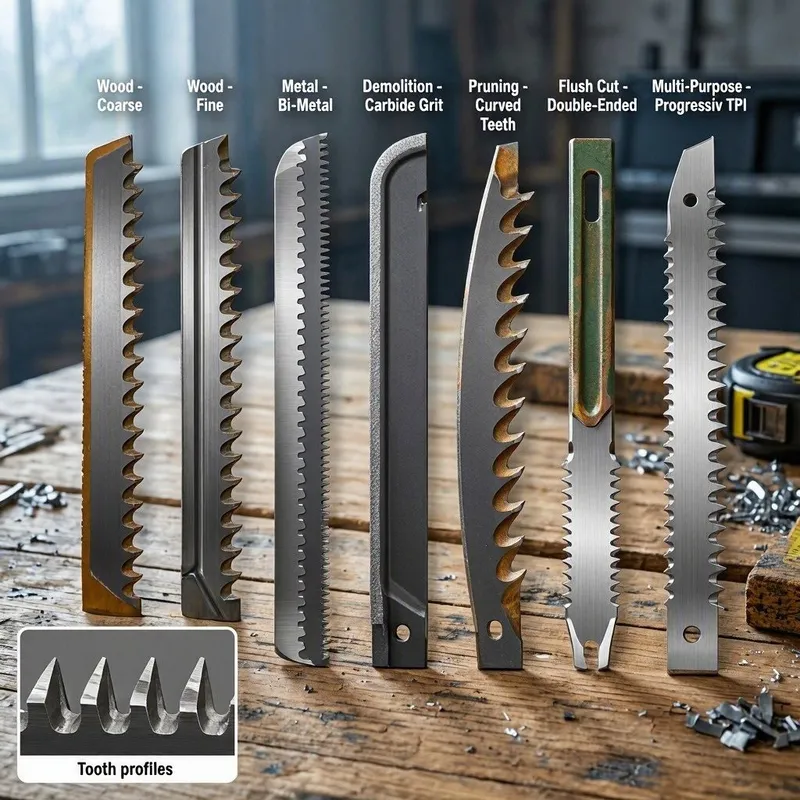
There are several common types of reciprocating saw blades that DIY users are likely to encounter.
1. Wood-Cutting Blades
Wood blades are designed primarily for cutting timber and other wood-based materials.
They generally have relatively large teeth and are available in different tooth patterns depending on the type of cutting required.
You may use a wood blade for:
- Softwood
- Hardwood
- Timber
- Plywood
- Chipboard
- Pallets
- Wooden framing
- General DIY cutting
Some wood blades are designed for particularly fast cutting, while others are intended to provide a cleaner cut.
Wood with nails
If you’re dismantling old timber, you may encounter nails, screws or other metal fixings.
A standard wood blade isn’t necessarily the best choice for this situation.
Instead, look for a demolition or bi-metal blade designed for wood containing nails.
These blades are specifically designed to cope with the combination of wood and metal.
2. Metal-Cutting Blades
Metal-cutting reciprocating saw blades normally have smaller teeth than coarse wood blades.
They’re available for different types and thicknesses of metal.
You may find blades intended for:
- Mild steel
- Stainless steel
- Aluminium
- Metal pipe
- Sheet metal
- Metal profiles
The correct blade depends on the material and its thickness.
A blade suitable for thin sheet metal isn’t necessarily the best choice for thick steel pipe.
For example, Bosch lists a 24 TPI reciprocating blade for thin metal applications, demonstrating how much finer metal blades can be compared with coarse wood-cutting blades.
3. Demolition Blades
Demolition blades are designed for tough cutting jobs where durability is more important than producing a neat finish.
They’re particularly useful when you’re dismantling old structures.
Typical applications include:
- Cutting timber
- Cutting timber containing nails
- Demolishing wooden frames
- Cutting through mixed materials
- Renovation work
- General demolition
Some demolition blades use a thicker construction to withstand demanding applications.
If you’re taking apart an old shed, for example, a demolition blade may be much more suitable than a fine wood-cutting blade.
4. Bi-Metal Blades
You will often see the term bi-metal when shopping for reciprocating saw blades.
Bi-metal blades are made using two different types of metal joined together.
The construction is intended to combine a flexible blade body with harder cutting teeth.
This makes bi-metal blades particularly useful for demanding applications and for cutting materials such as metal or wood containing nails.
They are available in different tooth configurations, so “bi-metal” alone doesn’t tell you exactly what the blade is designed to cut.
Always check the manufacturer’s recommended applications.
5. Multi-Material Blades
Multi-material blades are designed to handle more than one type of material.
For a DIY beginner, these can be particularly convenient because you don’t necessarily need a completely different blade every time the material changes.
Depending on the particular blade, applications can include combinations of:
- Wood
- Wood with nails
- Plastic
- Metal
- Pipe
- Other common renovation materials
However, a multi-material blade isn’t automatically the best choice for every job.
If you’re doing a lot of cutting in one particular material, a specialist blade may provide better performance.
6. Pruning Blades
Some reciprocating saws can be used for garden work when fitted with a suitable pruning blade.
Pruning blades are designed for cutting wood and branches.
They can be useful for:
- Cutting branches
- Removing deadwood
- Cutting garden timber
- Breaking down branches for disposal
However, make sure the blade is specifically suitable for the application and follow the saw manufacturer’s instructions.
What Does TPI Mean?
One of the most confusing specifications for beginners is TPI.
TPI stands for:
Teeth Per Inch
It tells you approximately how many teeth are present along one inch of the blade’s cutting edge. You don’t need to memorise complicated rules, but understanding TPI makes choosing a blade much easier.
Lower TPI
A lower TPI blade generally has larger, more widely spaced teeth.
These blades are commonly used for:
- Fast wood cutting
- Rough cutting
- Demolition
- Thick timber
They tend to remove material quickly but can leave a rougher cut.
Higher TPI
A higher TPI blade has smaller, more closely spaced teeth.
These blades are commonly used for:
- Metal
- Thin materials
- Finer cutting
They generally cut more slowly but can provide better control on suitable materials.
The exact TPI required depends on the material and its thickness, so always check the blade manufacturer’s recommendations. Norton also explains that tooth selection should take the material and cutting application into account.
Reciprocating Saw Blade TPI Guide
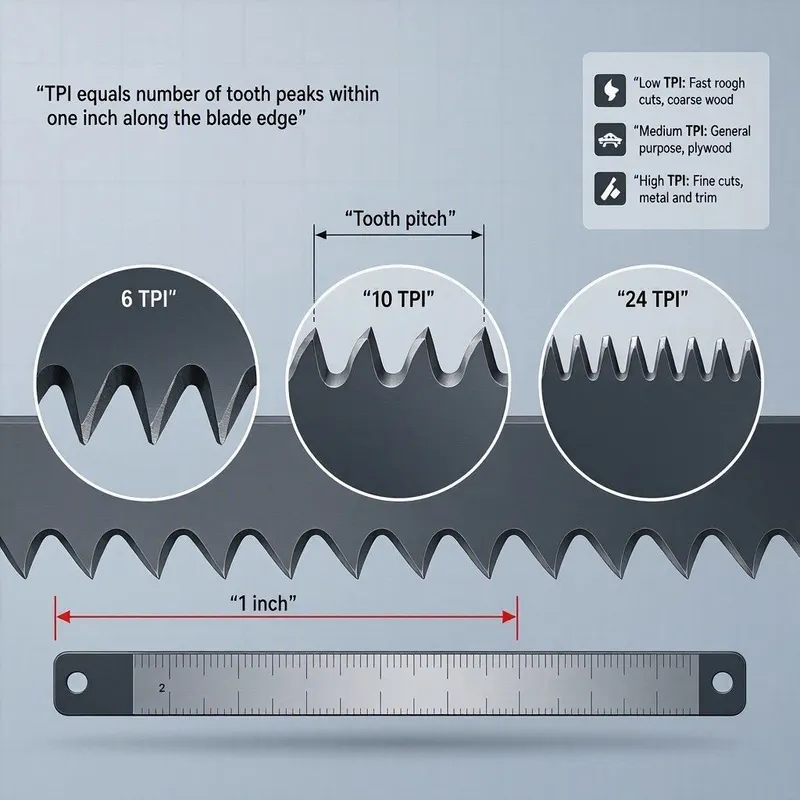
As a simple starting point, you can think about blades like this:
| TPI | General Use | Typical Application |
|---|---|---|
| 3–5 TPI | Very coarse | Fast cutting of thick wood |
| 5–8 TPI | Coarse | General wood and demolition |
| 8–12 TPI | Medium | Wood, plastic and mixed materials |
| 12–18 TPI | Fine | Thinner materials and some metal |
| 18–24+ TPI | Very fine | Thin metal and specialist applications |
These ranges are general guidance rather than fixed rules. Always check the specifications supplied by the blade manufacturer.
For a more detailed explanation, UKToolGuide’s Reciprocating Saw Blade TPI Guide will cover TPI in more depth.
Does Blade Length Matter?
Yes.
Reciprocating saw blades are available in different lengths.
Common lengths include approximately:
- 150mm
- 200mm
- 230mm
- 250mm
- 300mm
Longer blades can be useful when you need to cut through thicker material. However, longer doesn’t automatically mean better. A blade that’s much longer than necessary can flex more during cutting, which may make the saw harder to control.
For many DIY jobs, a blade around 150–230mm can provide a useful balance between reach and control. Always check the maximum blade length recommended by your particular saw.
Does Blade Thickness Matter?
Yes. Blade thickness affects durability and flexibility.
A thicker blade can be useful for demanding demolition applications because it can resist bending and withstand tougher cutting conditions.
A thinner blade can be useful when flexibility and speed are more important. Again, the best choice depends on the job.
If you’re cutting through old timber containing nails, for example, a robust demolition blade may be more appropriate than a thin blade designed for light cutting.
What Reciprocating Saw Blade Do I Need for Wood?
For ordinary wood cutting, look for a blade specifically designed for wood.
The appropriate TPI depends on the thickness of the timber and whether you want speed or a relatively cleaner cut.
For fast, rough cuts
Choose a coarser blade with fewer teeth per inch.
For finer cuts
Choose a blade with more teeth.
For demolition timber
Consider a demolition or bi-metal blade, particularly if nails or other metal fixings are present.
What Reciprocating Saw Blade Do I Need for Metal?
For metal, choose a blade specifically designed for metal cutting. Metal blades generally have finer teeth than coarse wood blades. The correct TPI depends heavily on the thickness of the metal.
As a general principle:
Thin metal → finer teeth
Thicker metal → coarser teeth
But don’t rely on this rule alone. Check the blade manufacturer’s specifications for the material and thickness you’re cutting.
What Reciprocating Saw Blade Do I Need for PVC?
Plastic and PVC can usually be cut using a suitable blade designed for plastic or a multi-material blade.
The best choice depends on the type and thickness of the plastic. For plumbing work, make sure you know what the pipe contains before cutting.
Never assume that a pipe is empty simply because it looks like an ordinary piece of plastic.
What Reciprocating Saw Blade Do I Need for Demolition?
For demolition work, look for a blade specifically designed for demolition or heavy-duty applications.
If you’re cutting old timber containing nails, choose a blade that specifically states that it is suitable for wood with embedded nails. This is one area where spending a little more on a suitable blade can be worthwhile.
Trying to dismantle a structure using a fine wood blade can quickly result in damaged or worn teeth.
What Reciprocating Saw Blade Do I Need for Branches?
For cutting branches, choose a suitable pruning or wood-cutting blade. The blade should be appropriate for the size and type of wood you’re cutting.
Don’t use an ordinary metal blade simply because it happens to fit the saw. The blade’s intended application is more important than simply getting the blade into the tool.
Can You Use Any Reciprocating Saw Blade in Any Saw?
Many reciprocating saw blades use a standard fitting and are designed to work across a range of compatible reciprocating saws.
However, never assume that every blade is suitable for every saw.
Before buying, check:
- Blade compatibility
- Maximum blade length
- Manufacturer recommendations
- Blade thickness
- Intended application
Your saw’s manual is the best place to check compatibility. You can find more here about how to use a reciprocating saw.
How Long Do Reciprocating Saw Blades Last?
There isn’t a fixed lifespan for a reciprocating saw blade.
It depends on:
- What you’re cutting
- How much you’re cutting
- Blade quality
- Cutting technique
- Material thickness
- Whether you’re cutting clean material or material containing nails
- How much pressure you apply
A blade used to cut softwood may last considerably longer than one repeatedly used to cut steel or demolition timber.
The important thing is to recognise when a blade is no longer cutting effectively.
How Do You Know When a Reciprocating Saw Blade Is Blunt?
A worn blade may show several signs.
You may notice:
- Cutting takes much longer
- You need to apply more pressure
- The blade becomes excessively hot
- The saw vibrates more than usual
- The cut becomes harder to control
- The blade produces poor results
If you’re having to force the saw through the material, stop and check the blade.
A blunt or damaged blade can make the job more difficult and may increase the risk of losing control.
Should You Buy a Blade Set?
For a DIY beginner, a small selection of blades can be more useful than buying a large specialist set.
A basic collection might include:
- A general-purpose wood blade
- A demolition blade
- A metal-cutting blade
- A multi-material blade
This gives you a useful starting point for common DIY jobs.
You can then buy specialist blades when a particular project requires them.
There’s little benefit in buying 30 different blades if you’re only going to use two or three.
How to Get the Best Results From Your Blade
Choosing the correct blade is only part of the equation.
Let the blade do the work
Don’t force the saw through the material.
Excessive pressure can make cutting less efficient and increase vibration.
Use the correct speed
If your saw has variable speed control, adjust the speed to suit the material and follow the manufacturer’s guidance.
Keep the shoe against the workpiece
The shoe helps support the saw during cutting.
Using it correctly can improve control.
Use the right blade
This is the biggest one.
If the blade isn’t designed for the material, changing your cutting technique won’t necessarily solve the problem.
Replace worn blades
A cheap replacement blade is usually better than struggling with a badly worn one.
Reciprocating Saw Blade Safety
Reciprocating saw blades are extremely sharp, even when they look relatively small compared with other saw blades.
Before changing a blade:
- Switch the saw off
- Disconnect the battery or unplug the saw
- Allow the blade to cool if it has been used
- Follow the manufacturer’s instructions
- Make sure the new blade is securely fitted
Always wear suitable eye protection when cutting and consider other PPE appropriate to the material and working environment.
Most importantly, know what’s behind the material you’re cutting.
This is particularly important when cutting walls, floors, ceilings and other concealed areas.
Hidden electrical cables, pipes and other services can create serious hazards.
Reciprocating Saw Blade Cheat Sheet
If you’re a beginner and just want a quick answer, use this as a starting point:
| What You’re Cutting | Blade Type to Look For |
| Softwood | Wood blade |
| Hardwood | Wood blade |
| Plywood | Wood blade |
| Pallets | Wood/demolition blade |
| Wood with nails | Bi-metal/demolition blade |
| General demolition | Demolition blade |
| Steel | Metal-cutting blade |
| Stainless steel | Suitable metal blade |
| Aluminium | Suitable non-ferrous metal blade |
| PVC | Plastic/multi-material blade |
| Plastic | Plastic/multi-material blade |
| Branches | Pruning/wood blade |
| Mixed materials | Multi-material blade |
Remember that this is a starting point, not a substitute for checking the blade manufacturer’s specifications.
Frequently Asked Questions
Are reciprocating saw blades universal?
Many reciprocating saw blades use a common fitting and can be used with compatible saws from different manufacturers. However, you should always check the blade and saw manufacturer’s compatibility information before buying.
Can I cut wood with a metal reciprocating saw blade?
A metal blade may physically cut some wood, but it isn’t normally the best choice. Use a blade designed for the material you’re cutting for better performance.
Can I cut metal with a wood blade?
You shouldn’t rely on a standard wood blade for cutting metal. Use a blade specifically designed for the type and thickness of metal you’re cutting.
Are longer reciprocating saw blades better?
Not necessarily. A longer blade provides more reach and can be useful for thicker material, but excessive blade length can increase flex. Choose a suitable length for the job and your saw.
What is the best TPI for a reciprocating saw?
There isn’t one best TPI. Lower TPI blades are generally used for fast, coarse cutting, while higher TPI blades are generally used for finer cutting and many metal applications.
How many reciprocating saw blades do I need?
For basic DIY, you don’t need a huge collection. A good starting selection is a wood blade, demolition blade, metal blade and multi-material blade.
Final Thoughts
Choosing a reciprocating saw blade is much easier once you understand the basics.
Start by asking three questions:
1. What am I cutting?
2. Do I need a coarse, medium or fine blade?
3. How thick is the material?
From there, choose a blade specifically designed for the material and check its manufacturer’s recommendations.
For most DIY beginners, there’s no need to buy dozens of blades. A small selection of good-quality wood, demolition, metal and multi-material blades will cover a surprising number of jobs.
And remember: the best reciprocating saw blade isn’t necessarily the most expensive one — it’s the one that’s designed for the job you’re doing.
New Saw or Upgrading Your Existing Setup
If you want to upgrade your existing reciprocating saw or want to know the latest models, then check out my Reciprocating Saw Buying Guide UK.