Best budget angle grinder UK for DIY is a useful search term if you’re looking for an affordable grinder without necessarily spending £150 or more on a professional kit.
For many home DIY jobs, a reasonably priced 115mm angle grinder from an established manufacturer can provide plenty of capability for cutting, grinding, rust removal and other general tasks.
The main choice is between corded and cordless angle grinders. A corded model can be a straightforward option if you have access to a suitable mains supply, while a cordless grinder can be more convenient if you already own batteries from the same tool platform.
In this guide, we’ll look at several budget-friendly angle grinders and compare their specifications, features and typical uses. Prices can vary between retailers and over time, so the figures below should be treated as a guide rather than fixed prices.
1. Best Budget Corded Angle Grinders
A corded angle grinder can make sense if you’re looking for a relatively inexpensive tool and don’t need cordless portability.
You don’t need to buy a battery or charger, and the grinder can continue operating without needing a battery recharge. The trade-off is that you’ll need access to a suitable mains supply and may need an extension lead for some jobs.
Makita GA4530R (115mm / 720W)
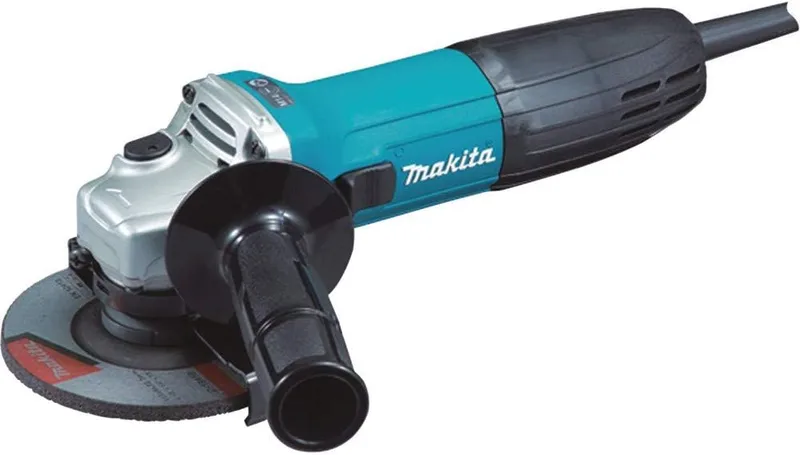
The Makita GA4530R is a compact 115mm corded angle grinder with a 720W input and a no-load speed of 11,000rpm. Makita also specifies an anti-restart function, soft start and a 22.23mm bore for this model.
- Typical UK price: Around £55–£70, depending on retailer and version
- Disc size: 115mm
- Power: 720W
- No-load speed: 11,000rpm
- Bore: 22.23mm
- Spindle: M14
- Maximum cutting depth: 30mm
- Anti-restart: Yes
- Soft start: Yes
- Weight: Approximately 1.8–2.2kg depending on specification
One useful feature for DIYers is the relatively slim motor housing, which can make the grinder easier to hold and manoeuvre. The anti-restart function is also designed to prevent an unexpected restart following an interruption to the power supply.
The GA4530R is therefore a useful option if you want a compact corded grinder without moving into a larger 125mm machine.
Check Amazon UK for price of the Makita GA4530R angle grinder
Bosch Professional GWS 7-115 (115mm / 720W)
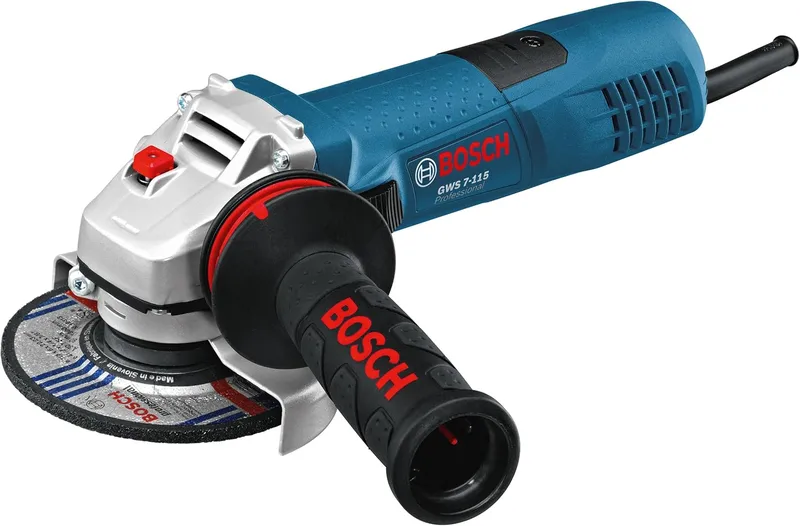
The Bosch Professional GWS 7-115 is another compact 115mm corded grinder aimed at cutting and grinding applications.
Bosch specifies a 720W rated input, 11,000rpm no-load speed, 115mm disc diameter and a weight of 1.9kg for the current UK specification. It also includes restart protection and direct motor cooling.
- Typical UK price: Around £60–£70
- Disc size: 115mm
- Power: 720W
- No-load speed: 11,000rpm
- Spindle: M14
- Weight: 1.9kg
- Restart protection: Yes
- Direct motor cooling: Yes
The compact design and relatively small grip are useful when working in tighter spaces. Bosch also states that the grinder is intended for applications including cutting metal, tiles and bricks when used with suitable accessories.
Corded Comparison
| Model | Power | Disc size | No-load speed | Weight | Notable features |
|---|---|---|---|---|---|
| Makita GA4530R | 720W | 115mm | 11,000rpm | 1.8–2.2kg | Anti-restart, soft start, slim housing |
| Bosch GWS 7-115 | 720W | 115mm | 11,000rpm | 1.9kg | Restart protection, direct motor cooling |
Specifications can vary slightly between versions and markets, so check the exact model number before buying.
Check Amazon UK for price of the Bosch Professional GWS 7-115 angle grinder
2. Budget Cordless Angle Grinders
Cordless grinders can be particularly useful for DIYers who already own compatible batteries. However, there is an important difference between the price of a bare tool and the price of a complete kit. A cordless grinder advertised at a low price may not include the battery or charger.
If you are starting a battery platform from scratch, the total cost can therefore be considerably higher than the grinder’s advertised bare-tool price.
Ryobi R18AG-0 ONE+ 18V (115mm)
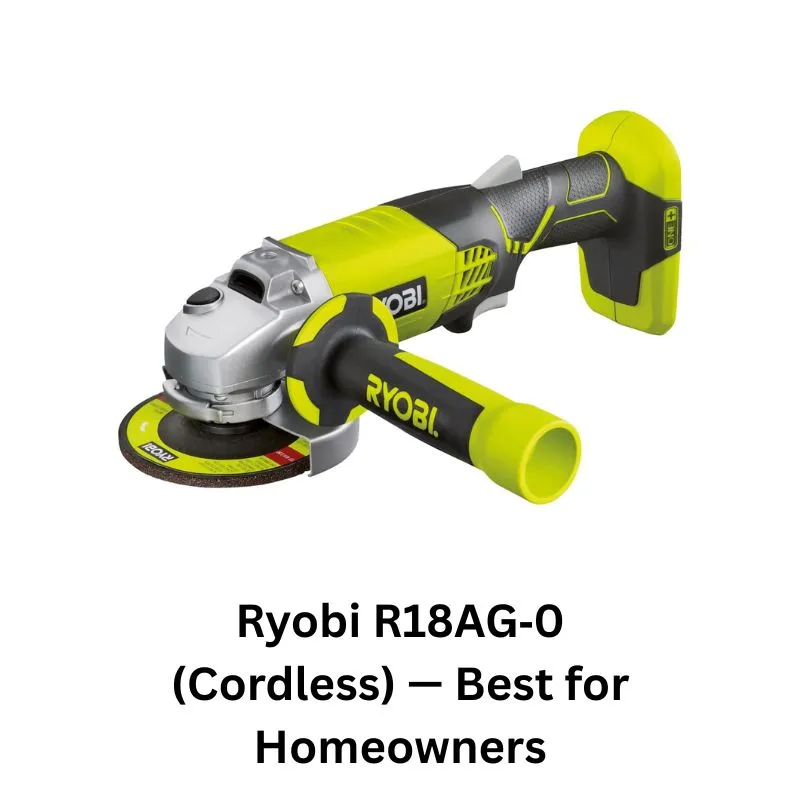
The Ryobi R18AG-0 is a 115mm cordless grinder from the ONE+ platform.
Ryobi specifies a no-load speed of 7,500rpm and a three-position auxiliary handle. The tool also has a two-stage non-lockable switch and a tool-less wheel guard.
- Disc size: 115mm
- Voltage: 18V
- No-load speed: 7,500rpm
- Battery: ONE+ 18V
- Bare tool: Battery and charger sold separately
- Handle: Three positions
- Guard: Tool-less adjustment
Ryobi’s current information also gives example cutting figures for different battery capacities. For example, it lists up to 17 cuts of 13mm steel pipe with a 2.0Ah battery, 46 with 4.0Ah and 57 with 5.0Ah. Actual runtime will vary with the material, accessory and way the grinder is used.
This makes the R18AG-0 particularly relevant if you already have other ONE+ tools and batteries.
Check Amazon UK for price of the Ryobi R18AG-0 ONE+ angle grinder
Einhell TE-AG 18/115 Li (115mm)
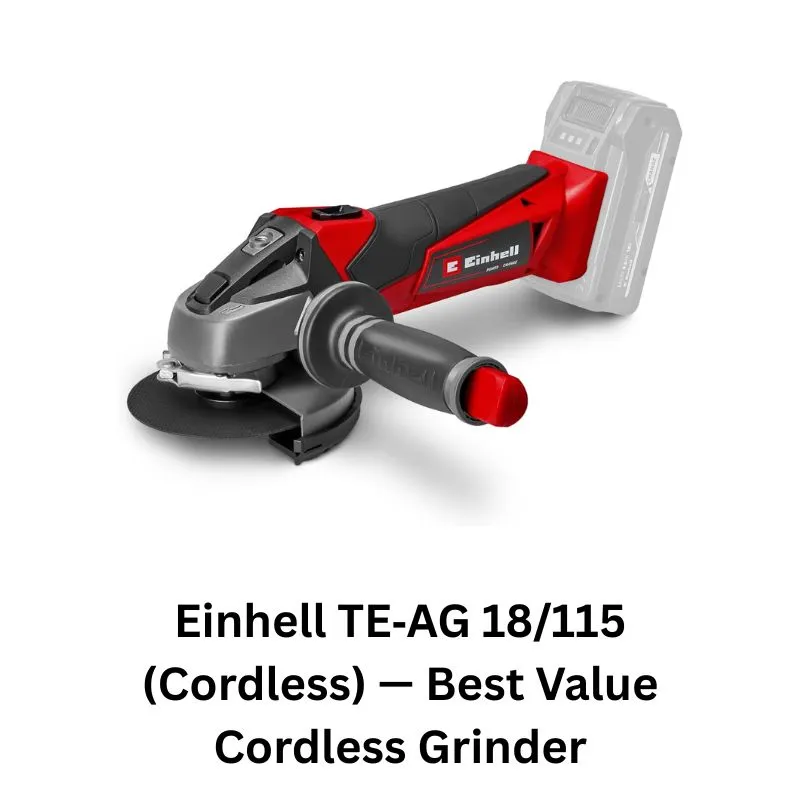
The Einhell TE-AG 18/115 Li is another 18V cordless option aimed at home, garden and workshop use.
Einhell specifies an 8,500rpm maximum idle speed, a maximum disc diameter of 115mm and a maximum cutting depth of 28mm. The Solo version weighs 1.21kg without the battery.
- Disc size: 115mm
- Voltage: 18V
- No-load speed: 8,500rpm
- Maximum cutting depth: 28mm
- Battery platform: Power X-Change
- Bare-tool weight: 1.21kg
- Overload protection: Yes
- Restart protection: Yes
- Auxiliary handle: Three positions
Einhell recommends a battery of at least 2.5Ah for optimum power and operating time on the Solo version.
As with Ryobi, the battery platform can be an important part of the buying decision. If you already own compatible Power X-Change batteries, the bare-tool route can make more sense than buying a completely new battery system.
Check Amazon UK for price of the Einhell TE-AG 18/115 Li angle grinder
Cordless Comparison
| Model | Voltage | Disc size | No-load speed | Bare-tool weight | Battery platform |
|---|---|---|---|---|---|
| Ryobi R18AG-0 | 18V | 115mm | 7,500rpm | — | ONE+ |
| Einhell TE-AG 18/115 Li | 18V | 115mm | 8,500rpm | 1.21kg | Power X-Change |
The Ryobi specification above is based on the manufacturer’s current product information; the original article’s 2.1kg figure should therefore be removed rather than presented as a universal tool weight.
3. Corded or Cordless: Which Is More Practical for DIY?
There isn’t one answer for every DIYer.
Corded
A corded grinder can make sense if:
- You have a suitable mains supply nearby
- You want to avoid buying batteries and chargers
- Most of your work is in a garage, workshop or other fixed location
- You expect to use the grinder for longer periods
The Makita and Bosch models above both use 720W motors and 115mm discs, making them compact options for general DIY cutting and grinding.
Cordless
A cordless grinder can make more sense if:
- You already own compatible batteries
- You regularly work away from mains power
- You want to avoid trailing cables
- You need to move around a garden, driveway or other outdoor area
Remember that battery and charger costs can change the overall price considerably if you don’t already own the platform.
4. What Size Angle Grinder Should a DIY Beginner Buy?
For many general DIY jobs, 115mm is a useful starting size.
A 115mm grinder is relatively compact and can handle a range of cutting and grinding applications when paired with the correct accessory.
However, 125mm grinders are also common and can provide greater cutting capacity. The actual cutting depth depends on the grinder, guard and disc, so don’t choose a grinder size based on disc diameter alone.
If you’re unsure whether you need 115mm or 125mm, think about the material you expect to cut and the maximum cutting depth you are likely to need.
For many occasional DIY jobs, a compact 115mm grinder can be sufficient. If you regularly work with thicker material, a 125mm model may provide additional capacity.
5. Three Things to Check Before Buying a Budget Angle Grinder
1. Check What Is Included
With a corded grinder, the advertised price will generally cover the tool itself.
With cordless models, check whether the package includes:
- Battery
- Charger
- Carry case or bag
- Side handle
- Guard
- Spanner or disc-changing equipment
A cheap bare tool isn’t necessarily cheaper once you add a battery and charger.
2. Check the Safety Features
Look for features such as:
- A properly fitted wheel guard
- Restart protection where provided
- Soft start where provided
- A suitable auxiliary handle
- A switch arrangement that suits how you intend to use the tool
More features don’t automatically make one grinder suitable for every DIY job, so consider the actual specification rather than simply counting features.
3. Check the Accessories
The grinder is only part of the setup.
Make sure the discs or other accessories you buy are:
- The correct diameter
- Compatible with the grinder
- Suitable for the material and task
- Rated for the grinder’s operating speed
- In good condition
Don’t assume that a disc is suitable simply because it physically fits the spindle.
6. Don’t Forget Safety Equipment
Angle grinders use high-speed rotating accessories, so safety equipment should be part of your budget.
At a minimum, consider suitable eye protection and hearing protection, along with other PPE appropriate to the material and task.
HSE guidance on abrasive wheels covers wheel characteristics, mounting, guards and protective equipment, and is a useful reference for anyone using a portable grinder.
The guard should remain correctly fitted and positioned between the operator and the wheel. HSE guidance specifically highlights the importance of guards on portable grinding machines and the risks associated with removing them to fit an oversized wheel.
Never remove or modify the guard simply to make a different-sized disc fit.
7. Avoid Choosing a Grinder on Price Alone
Buying a budget angle grinder doesn’t mean you have to choose the cheapest grinder available.
A better approach is to look at the complete package:
- Manufacturer
- Warranty
- Replacement parts and accessories
- Disc availability
- Battery platform, if cordless
- Safety features
- Disc size
- Power or voltage
- Weight and handling
- The type of DIY work you actually plan to do
A grinder that costs slightly more but fits your existing battery platform or has the features you need may make more sense than choosing purely on the lowest purchase price.
Quick Comparison: Budget Angle Grinders
| Model | Type | Disc | Power / Speed | Battery | Key point |
|---|---|---|---|---|---|
| Makita GA4530R | Corded | 115mm | 720W / 11,000rpm | No | Compact corded grinder with anti-restart |
| Bosch GWS 7-115 | Corded | 115mm | 720W / 11,000rpm | No | Compact design with restart protection |
| Ryobi R18AG-0 | Cordless | 115mm | 7,500rpm | ONE+ 18V | Useful if you already own ONE+ batteries |
| Einhell TE-AG 18/115 Li | Cordless | 115mm | 8,500rpm | Power X-Change 18V | Compact budget cordless platform option |
Specifications should be checked against the exact model and package before purchase, as manufacturers can update products and retailers may sell different versions.
Final Thoughts
The best budget angle grinder for DIY depends on how and where you intend to use it.
A compact 115mm corded grinder can be a straightforward choice if you mainly work near a mains supply. The Makita GA4530R and Bosch GWS 7-115 both use 720W motors and 115mm discs, while offering features such as restart or anti-restart protection.
If you already own an 18V battery platform, a cordless model such as the Ryobi R18AG-0 or Einhell TE-AG 18/115 Li may make more sense because you can use your existing batteries.
The important thing is not to choose a grinder simply because it has the lowest price. Look at the complete cost, the specification, the accessories you need and whether the tool is suitable for the jobs you actually plan to do.
For more information, see our guides on what an angle grinder is used for, angle grinder discs explained, and how to use an angle grinder safely.