What is an angle grinder? An angle grinder is a handheld power tool that uses a rotating disc or accessory to cut, grind, clean and prepare a range of materials. The tool itself is relatively compact, but the accessory you fit determines what type of work it can carry out.
Angle grinders are commonly used for jobs such as cutting suitable metal, grinding welds, removing rust, preparing surfaces and cutting masonry with the correct accessory. They can be useful for DIY, home maintenance, renovation projects and metalwork.
If you’re new to power tools, it can be difficult to know exactly what an angle grinder does, which discs you need and what the different sizes mean. There are also important safety considerations because the disc rotates at high speed and some accessories are designed for specific materials and applications.
In this beginner’s guide, we’ll explain what an angle grinder is, how it works, what the different discs are used for and the types of jobs you can use one for. We’ll also look at corded and cordless models and cover some of the important safety points beginners should understand before using one.
If you’re specifically looking to buy an angle grinder, you can also see our Best Angle Grinders UK (2026 Buyer’s Guide) for a more detailed look at sizes, features, battery platforms and current models.
What Does an Angle Grinder Do?
An angle grinder is a handheld power tool with a rotating spindle that drives a disc or other accessory. The accessory you fit determines what type of work the grinder can perform.
Depending on the disc or accessory, an angle grinder can be used for tasks such as cutting suitable metal, grinding welds, removing rust, cleaning surfaces and cutting certain masonry materials.
This makes an angle grinder a versatile tool, but it is important to use the correct accessory for the material and application. A cutting disc, for example, is designed for cutting and should not be used for side grinding. Similarly, a diamond cutting disc intended for masonry is not the same as a disc designed for cutting metal.
Common Angle Grinder Uses
Some of the jobs an angle grinder can be used for include:
- Cutting metal – suitable bolts, threaded rod, brackets, pipe and metal sections with the correct cutting disc
- Grinding metal – removing material, smoothing welds and shaping suitable metal surfaces
- Removing rust and coatings – using a suitable wire wheel, wire cup or abrasive accessory
- Surface preparation – cleaning and preparing metal before painting or other finishing work
- Cutting masonry – cutting suitable brick, block, concrete, paving and tiles with the correct diamond accessory
- Finishing metal – using flap discs or other suitable abrasive accessories
- Polishing – using a compatible backing plate and polishing accessory where the grinder and accessory are suitable for the job
The angle grinder itself is therefore only part of the equation. Choosing the correct disc or accessory is just as important as choosing the grinder.
What Size Angle Grinder Should a Beginner Buy?
Angle grinders are available in several sizes, with 115mm, 125mm and 230mm being common options.
| Disc size | Typical applications |
|---|---|
| 115mm | Smaller cutting and grinding jobs, general DIY and metalwork |
| 125mm | General DIY and applications requiring slightly greater cutting capacity |
| 230mm | Deeper cuts and larger, more demanding applications |
A 115mm or 125mm grinder can be a practical starting point for many DIY users, while a 230mm model is generally more suited to larger and heavier-duty work.
There isn’t one size that is right for every beginner. Consider the materials you expect to work with, the thickness of those materials, the cutting depth required and how easy the tool is for you to handle.
If you’re choosing a grinder to buy, it’s also worth comparing corded and cordless models, motor specifications, safety features and battery compatibility rather than choosing on disc size alone.
Always check the manufacturer’s specifications for the particular grinder and make sure the disc or accessory you intend to use is compatible with it.IY.
What size angle grinder should a beginner buy?
For many DIY jobs, a 115mm or 125mm angle grinder can be a practical starting point. The right size depends on the materials you expect to cut or grind and how much cutting depth you need.
| Size | Typical applications |
|---|---|
| 115mm | Smaller cutting and grinding jobs, general DIY and metalwork |
| 125mm | General DIY and jobs requiring slightly greater cutting capacity |
| 230mm | Deeper cuts and larger, more demanding applications |
A 115mm grinder is relatively compact and can be suitable for many smaller DIY jobs. A 125mm model offers a little more cutting capacity while still being suitable for a range of general-purpose applications.
A 230mm grinder is considerably larger and is generally intended for deeper cuts and more demanding work, such as certain masonry and building applications.
Rather than choosing a size simply because you’re a beginner, consider the materials you need to work with, their thickness, the cutting depth required and how comfortable you are handling the tool.
Always check the manufacturer’s specifications before buying, including the maximum disc diameter and cutting capacity.
How an Angle Grinder Works
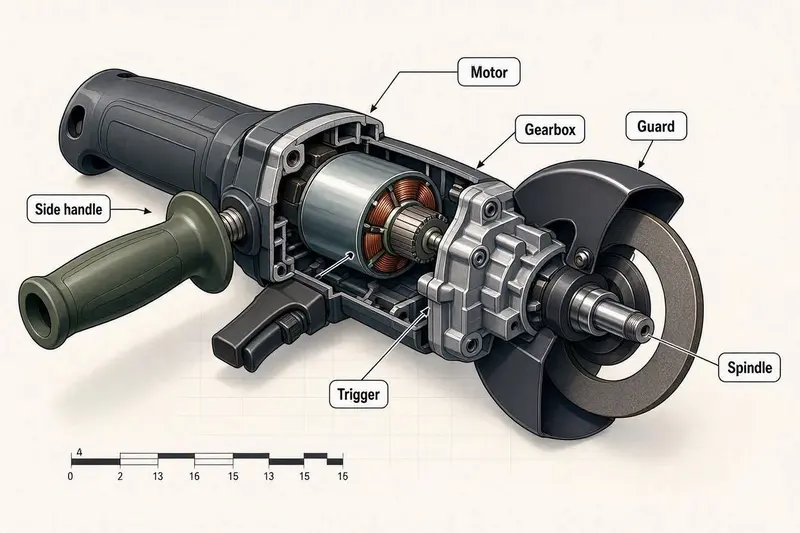
An angle grinder uses a motor to rotate a disc or accessory at high speed. The spindle is positioned at a right angle to the motor, which is where the tool gets its name.
The main components of an angle grinder include:
- Motor – provides the power needed to rotate the spindle
- Gearbox – transfers the motor’s power to the spindle
- Spindle – the rotating shaft onto which the disc or accessory is fitted
- Disc guard – helps protect the user from sparks, fragments and contact with the rotating accessory
- Switch – controls the motor; the exact design varies between models
- Side handle – provides an additional gripping position and can help with control
The exact design and features vary between angle grinders. Some models also include features such as electronic brakes, soft start, restart protection, variable speed or anti-kickback systems.
The accessory fitted to the spindle determines what type of work the grinder is designed to carry out. For example, a cutting disc can be used for suitable cutting applications, while a grinding disc is designed for removing material from a surface.
Accessories can be changed when required, but you should always switch off and disconnect the grinder before changing an accessory, and follow the manufacturer’s instructions for fitting and removing it.
This means the same basic power tool can be used for a range of different jobs, provided the grinder, guard and accessory are all suitable for the particular application.her.
Common Angle Grinder Disc Types
The disc or accessory you fit determines what an angle grinder can be used for. Different accessories are designed for different materials and applications, so it is important to check that the accessory is suitable for your particular grinder and the job you intend to carry out.
1. Cutting Discs
Cutting discs are relatively thin abrasive discs designed for cutting suitable materials, particularly metal.
They can be used for jobs such as:
- Cutting suitable bolts and threaded rod
- Cutting metal brackets
- Cutting suitable pipe and metal sections
- Cutting sheet metal
Cutting discs are designed for cutting and should not be used for side grinding. Always check the disc diameter, maximum RPM and material suitability before use.
2. Grinding Discs
Grinding discs are generally thicker than cutting discs and are designed for removing material from a surface rather than cutting through it.
Common uses include:
- Smoothing welds
- Removing excess material
- Shaping suitable metal
- Removing burrs and rough edges
A grinding disc should be used only for the applications specified by the manufacturer.
3. Flap Discs
Flap discs contain overlapping abrasive flaps and can be used for material removal, smoothing and finishing.
They are commonly used for:
- Smoothing welds
- Removing surface rust
- Preparing metal surfaces
- Smoothing rough edges
- Finishing suitable metalwork
Different grit sizes are available, with coarser grits generally removing material more quickly and finer grits producing a smoother finish.
4. Diamond Cutting Discs
Diamond cutting discs are designed for cutting hard mineral materials, depending on the particular disc.
Suitable applications can include:
- Brick and block
- Concrete
- Paving
- Tiles
- Natural or manufactured stone
Not every diamond disc is suitable for every material, so always check the manufacturer’s instructions before use. Cutting masonry can also produce significant dust, so appropriate dust control and respiratory protection may be required.
5. Wire Wheels and Wire Cups
Wire wheels and wire cups are used mainly for cleaning and preparing metal surfaces.
They can be useful for:
- Removing loose rust
- Removing some loose paint and coatings
- Cleaning metal surfaces
- Cleaning around suitable welds
- Preparing metal before painting
Wire bristles can break away during use and be thrown from the accessory at high speed, so suitable eye and face protection is particularly important.
For a more detailed explanation of the different accessories, see my guide to Angle Grinder Discs Explained.
Always check the accessory’s diameter, maximum operating speed, intended material and compatibility with your grinder before fitting it.
Corded vs Cordless Angle Grinders
Angle grinders are available in both corded and cordless versions, and each has advantages depending on where and how you plan to use the tool.
Corded Angle Grinders
Corded grinders run from the mains, so they don’t need a battery or charging between uses.
Advantages include:
- Continuous mains power while connected
- No battery charging required
- No additional battery weight
- Often a lower initial cost than a complete cordless setup
- Useful for longer periods of work near a power socket
Potential drawbacks include:
- You need access to a suitable power supply
- The cable can restrict movement
- An extension lead may be required for some jobs
Cordless Angle Grinders
Cordless grinders are powered by rechargeable batteries, commonly as part of an 18V battery platform.
Advantages include:
- No mains cable to manage
- Greater freedom of movement
- Useful for outdoor work or areas without convenient mains power
- Can be particularly convenient if you already own compatible batteries
Potential drawbacks include:
- Battery runtime is limited
- Batteries need to be charged
- Larger-capacity batteries can add weight
- Buying the battery and charger can increase the overall cost if you don’t already own them
Which Should You Choose?
If you mainly work in a garage or workshop with convenient access to mains power, a corded grinder can be a straightforward option.
If you regularly work outdoors, away from sockets or already use a compatible cordless battery system, a cordless grinder may be more convenient.
Neither type is automatically better for every DIY user. Consider where you’ll use the grinder, how long you’ll use it for, whether you already own compatible batteries and the total cost of the setup.
For more detailed buying advice, see our Best Angle Grinders UK (2026 Buyer’s Guide).
What Can You Use an Angle Grinder For?
An angle grinder can be used for a wide range of cutting, grinding, cleaning and surface-preparation jobs, provided the grinder and accessory are suitable for the material and application.
Common DIY uses include:
- Cutting metal – suitable pipe, bolts, brackets, threaded rod and metal sections with the correct cutting disc
- Cutting masonry – suitable paving, bricks, blocks and tiles with the correct diamond cutting disc
- Removing rust – cleaning rust and corrosion from suitable metal surfaces using a wire wheel, wire cup or abrasive accessory
- Cleaning welds – removing excess material and smoothing suitable welds with a grinding or flap disc
- Sharpening tools – sharpening suitable metal tools when the grinder and accessory are appropriate for the task
- Smoothing rough edges – removing burrs and rough edges from suitable metalwork
- Surface preparation – removing suitable coatings, rust or other surface material before further work
Angle grinders can therefore be useful for DIY projects, home maintenance, renovation work and metalwork.
However, an angle grinder isn’t automatically suitable for every material or application. The disc or accessory must be specifically suitable for the material and operation, and you should always follow the manufacturer’s instructions.
If you’re new to angle grinders, our guide to Angle Grinder Uses for Beginners explains these applications in more detail.
Is an Angle Grinder Safe for Beginners?
An angle grinder can be used by DIY beginners, but it is a high-speed power tool that needs to be treated with care. The rotating disc can cause serious injury if the grinder, disc or technique is unsuitable.
Before using one, make sure you understand the manufacturer’s instructions and use the correct disc or accessory for the material and operation.
Essential PPE
The appropriate PPE depends on the job and material, but may include:
- Safety glasses or suitable eye protection – helps protect against sparks and flying particles
- Face protection – a face shield can provide additional protection alongside suitable eye protection
- Hearing protection – angle grinders can produce significant noise
- Suitable respiratory protection – particularly where the work creates harmful dust
- Sturdy footwear – helps protect your feet from dropped tools and materials
- Suitable protective clothing – avoid loose clothing that could interfere with the tool
Gloves may be appropriate for some tasks, but they should not be relied upon as a substitute for correct technique and safe working practices.
Key Safety Tips
- Use the correct guard and make sure it is fitted correctly
- Use the correct disc or accessory for the grinder, material and application
- Check the disc before use and never use one that is cracked, damaged or unsuitable
- Check the disc’s maximum operating speed and make sure it is compatible with the grinder
- Hold the grinder securely with both hands where the manufacturer’s instructions require this
- Keep your body positioned safely and avoid placing yourself directly in line with the rotating disc
- Make sure the workpiece is properly supported and secure
- Keep other people away from the immediate work area
- Allow the accessory to stop completely before putting the grinder down
- Disconnect the grinder from its power source before changing an accessory
When cutting or grinding, avoid forcing the tool through the material. If the disc binds, catches or the grinder behaves unexpectedly, stop and reassess the setup.
One Important Safety Point
The disc is one of the most important safety considerations when using an angle grinder. Cutting discs, grinding discs, flap discs, wire wheels and diamond cutting discs are designed for different applications and must be used according to their manufacturer’s instructions.
Never assume that an accessory is suitable simply because it fits the spindle. Check its diameter, maximum RPM, intended material, application and compatibility with the grinder.
Angle grinders can be useful DIY tools, but they should never be treated as harmless. Good safety practices, the correct accessory, proper guarding and appropriate PPE all form part of using one responsibly.
For a more detailed guide, see How to Use an Angle Grinder Safely.
For additional guidance on abrasive wheels and angle grinder safety, see the HSE guidance on the safe use of abrasive wheels.
Which Angle Grinder Should You Buy?
The right angle grinder depends on the type of work you plan to do, the materials you need to work with, the disc size required and whether you want a corded or cordless tool.
For many DIY users, 115mm and 125mm grinders are practical sizes to consider for general cutting and grinding work. Larger 230mm grinders are designed for applications where greater cutting depth is required.
Before buying, consider:
- Disc size – make sure it provides enough cutting capacity for your projects
- Power source – decide whether corded or cordless suits your workspace
- Motor and performance – compare the manufacturer’s specifications for the work you intend to do
- Safety features – look for features such as a suitable guard, restart protection or electronic braking where appropriate
- Battery compatibility – if choosing cordless, check whether the grinder works with batteries you already own
- Ergonomics and weight – consider how comfortable the grinder is to handle
If you’re ready to compare specific models, see our Best Angle Grinders UK (2026 Buyer’s Guide) for a more detailed look at angle grinder sizes, features, power options, accessories and current models.