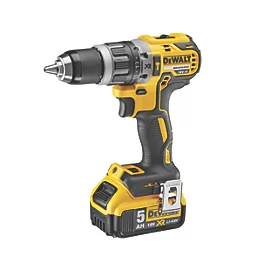
I own a DeWalt 18V combi drill and an impact driver myself. I’ve used them for ages, love them to bits, and yet for the longest time, I had absolutely no idea what the confusing string of letters stamped on the side actually meant. I did guess that the “D” stood for DeWalt.
If you are staring at a box on Amazon, Screwfix, or Toolstation and seeing codes like DCD796P2 or DCF887N, you aren’t stupid. It looks like complete gibberish.
Big retail sites love using these long manufacturer codes, but they rarely explain what they actually mean to regular DIYers. If you do not know the secret code, you could easily end up ordering a tool that does not fit your current battery charger, or worse, a “bare tool” that arrives completely empty without a battery inside.
Thankfully, DeWalt actually uses a very logical system. Once you know the formula, you can decode any DeWalt model number in under five seconds.
Part 1: The 3-Letter Tool Type Formula
Every single cordless DeWalt tool starts with a three-letter code. This prefix tells you exactly what kind of machine is inside the box.
The first two letters are always the same: D stands for DeWalt, and C stands for Cordless. The third letter is the secret key that unlocks the tool category:
- DCD = Drill. This covers standard combi drills, drill drivers, and percussion drills.
- DCF = Fastener. This covers high-torque impact drivers, impact wrenches, and screwdrivers.
- DCS = Saw. This means jigsaws, circular saws, reciprocating saws, and multi-tools.
- DCG = Grinder. Used exclusively for angle grinders and die grinders.
- DCH = Hammer. Used for heavy-duty SDS rotary hammer drills meant for structural concrete.
- DCW = Woodworking. This covers routers and random orbital sanders.
- DCB = Battery. This covers the individual lithium-ion batteries and wall chargers.
“DW” is the prefix DEWALT uses for wired (corded) tools
Part 2: The Middle Numbers (The Generation & Tier)
Right after those three letters, you will see a three-digit number (like 709, 796, or 996).
As a casual DIYer, you do not need to memorise all these digits. The general rule of thumb is that higher numbers mean a more powerful motor or a higher trade specification.
For example, the DeWalt DCD709 is a small, entry-level sub-compact drill. The DCD796 is a mid-range powerhouse. The DCD996 is a massive, heavy trade-spec beast meant for professional site workers drilling wide holes all day long.
Part 3: The Letters at the End (The “Box Contents” Trap)
This is the most critical part of the entire code. The letters at the very end of the model number tell you exactly what you are getting in the case.
If you do not check this part of the code before hitting “buy,” you might think you have scored an absolute bargain, only to find out you bought an empty shell with no power source.
- N or B = Bare Unit. (e.g., DCF887N). This means you get the tool only. There is no battery, no charger, and usually no plastic carry case. Only buy this if you already have DeWalt 18V batteries sitting in your shed!
- D1 or D2 = 2.0Ah Batteries. The number tells you how many batteries are in the box. A “D2” kit gives you two small, lightweight 2.0Ah batteries. This is excellent for light, indoor flat-pack furniture assembly.
- P1 or P2 = 5.0Ah Batteries. This is the classic trade standard. A “P2” kit gives you two heavy-duty 5.0Ah batteries and a multi-voltage rapid charger. This is the best choice for long weekend projects and garden work.
- E1 or E2 = Powerstack Batteries. This means the kit includes DeWalt’s newest, compact pouch-cell batteries, which deliver 50% more power in a much smaller casing.
GB and XJ Explained
When you see a code like DCD796P2-GB or DCF887P2-GB on a shelf at Screwfix or Toolstation, it tells you two very specific things:
- The Right Mains Plug: It guarantees that the battery charger included in the box comes fitted with a standard UK 3-pin plug (Type G) rather than a European 2-pin plug.
- UK Extended Warranty: It ensures the tool is an official UK import, meaning it qualifies for the official DeWalt UK 3-year extended warranty when you register the code online.
- Note: If you ever see -XJ at the end of a DeWalt model code instead of -GB, that is the regional code for the wider European market. DeWalt often uses -XJ for “Bare Units” (tools sold without a battery or charger) because a tool body doesn’t require a specific regional mains plug.
The 5-Second UK Buyer Checklist
Next time you are scrolling through a trade counter website, just use this quick mental rule:
- Look at the third letter to make sure you are buying the right tool category (e.g., D for Drill, S for Saw).
- Look at the very end of the code. If it ends in an N or B, make sure your wallet is ready to buy a separate battery package!