By Enda McLarnon — Experienced UK DIYer sharing practical fixes from my 1958 red brick home.
Walk into any Screwfix, B&Q, or Toolstation, and the tool wall is dominated by bulky 18V cordless drills. For years, the conventional wisdom in UK DIY has been simple: buy 18V or you are buying an underpowered toy.
That advice is outdated. Thanks to brushless motor technology and higher-density lithium-ion cells, modern 12V drill/drivers, especially platforms like Bosch Professional 12V, Milwaukee M12, and DeWalt 12V XR, pack more usable torque than full-sized 18V NiCad drills did ten years ago.
The real question is not whether a 12V drill/driver is “good?” It is whether it matches the specific materials in your house. Here is the honest, no-nonsense breakdown of what a 12V drill/driver handles effortlessly, where it hits a wall, and why it might actually be the best first tool you buy.
Still deciding between tool categories? Check our Beginner’s Guide to Drill/Drivers for the basics, or if you know you need to drill into solid brick walls, head straight to our Combi Drill Hub.
What a 12V Drill/Driver Handles Effortlessly (About 85% of Home Jobs)
If you live in a modern UK new-build with timber stud walls and plasterboard, or you spend most weekends assembling furniture and maintaining cabinetry, a 12V drill/driver is not a compromise. It is an upgrade in handling.
- Flat-Pack Furniture & Kitchen Cabinets: A compact 12V drill/driver weighs roughly 0.8kg to 1.0kg with a battery attached, which is nearly half the weight of a full-sized 18V kit. When you are holding a drill upside down inside a narrow wardrobe frame or mounting kitchen wall units, that lighter weight saves your wrist and prevents you from camming out screw heads.
- Plasterboard Fixings & Curtain Poles: Drilling pilot holes into plasterboard and timber battens for wall anchors, curtain tracks, and floating shelves takes zero effort on a 12V tool.
- Wood Screws up to 60mm–75mm: Driving standard 4.0mm x 50mm or 5.0mm x 70mm wood screws into softwood framing, shelving brackets, or door linings is well within a modern 12V drill/driver’s 30Nm to 45Nm torque range.
- Sheet Metal & Plastics: High-speed second gear (typically 1,300 to 1,500 RPM) spins High-Speed Steel (HSS) bits fast enough for clean holes in aluminum trim, PVC window frames, and thin steel brackets.
Where a 12V Drill/Driver Hits Its Limit
Every tool has a ceiling. Buying a 12V drill/driver and expecting it to behave like a heavy site tool will only overheat the motor and flatten your battery in ten minutes.
- Drilling into Brick, Stone, or Concrete: Standard 12V drill/drivers lack a mechanical hammer action entirely. Even if you buy a 12V combi model with a hammer setting, the smaller gearbox struggles against dense 1950s UK red brick, engineering brick, or concrete lintels. For masonry, step up to an 18V combi drill or an SDS drill.
- Large Spade Bits & Hole Saws: Boring a 25mm spade bit through thick joists or cutting 68mm holes for downlights creates heavy rotational drag. A 12V motor will trip its electronic overload protection quickly under sustained heavy resistance.
- Heavy Garden Framing & Decking: Driving dozens of 100mm structural landscaping screws or thick coach bolts into treated timber will drain a compact 2.0Ah 12V battery fast.
12V vs. 18V Drill/Drivers: Side-by-Side Comparison
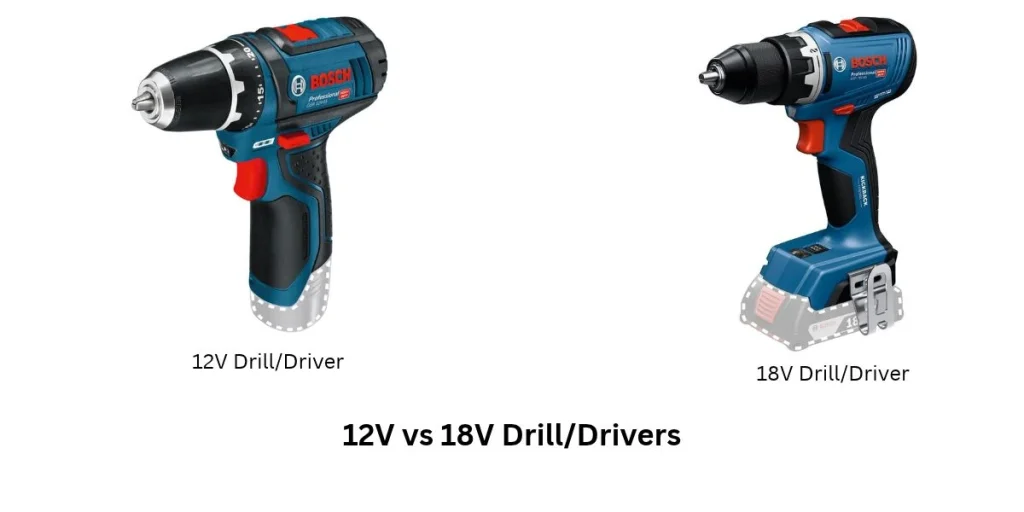
| Feature | 12V Drill/Driver | 18V Drill/Driver |
| Typical Weight (with battery) | 0.85kg – 1.1kg | 1.5kg – 2.0kg |
| Typical Torque Rating | 30Nm – 45Nm | 50Nm – 70Nm+ |
| Chuck Capacity | Usually 10mm keyless | Usually 13mm keyless |
| Best Use Case | Indoor DIY, flat-pack, tight cupboards, overhead work | Heavy timber work, larger drill bits, garden projects |
| Shared Battery Ecosystem | Compact inspection lights, multi-tools, small drivers | Circular saws, jigsaws, lawnmowers, strimmers |
The “Chuck Size” Catch Most Buyers Miss
One practical detail separates 12V from 18V tools: most 12V drill/drivers come with a 10mm keyless chuck, whereas 18V models almost always feature a 13mm chuck.
For everyday screwdriving (using 1/4-inch hex bits) and standard 2mm to 8mm wood or metal drill bits, a 10mm chuck is completely fine. However, if you regularly use larger blacksmith drill bits or heavy hole saw arbors with 12mm shanks, they physically will not fit inside a 10mm chuck.
The Verdict: Should You Buy a 12V Drill/Driver?
- Buy a 12V Drill/Driver if: You want an agile, lightweight, grab-and-go tool for indoor home maintenance, flat-pack furniture, and woodwork, or you already own an 18V combi drill for heavy jobs and want a nimble second driver so you aren’t constantly swapping between drill bits and screwdriver bits.
- Buy an 18V Drill/Driver if: This will be your only power tool and you plan to expand into 18V garden tools, circular saws, or heavier outdoor timber projects using the same battery platform.
Ready to compare actual kits? See our top budget and mid-tier picks in Best Cordless Drill/Drivers Under £50 UK and Best Cordless Drill/Drivers Under £100 UK, or stock up on the right bits in Best Drill Bit Sets for UK DIY.
About the Author: Enda McLarnon
I’m an experienced UK DIYer tackling renovation life inside a 1958 red brick home.
I built this blog to help beginners conquer home maintenance anxiety and save a fortune on expensive trade calls.