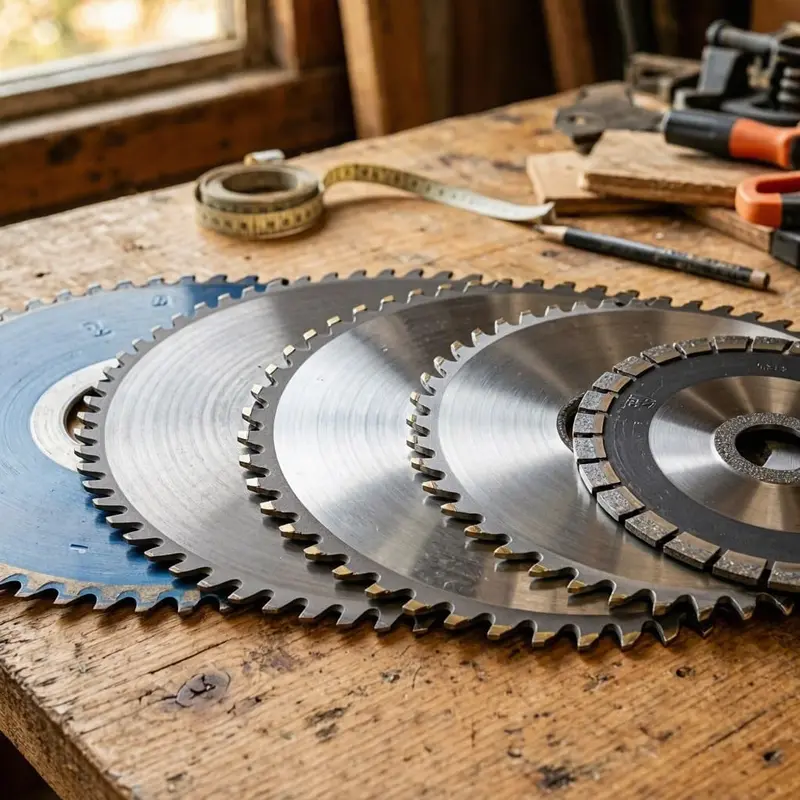
If you’re looking for the best circular saw blades for DIY UK, choosing the right blade can make a big difference to how easily and cleanly your saw cuts.
For DIY beginners, you need to know that circular saw blades come in different sizes, tooth counts and designs. Some are made for fast cuts through construction timber, while others are designed to produce a cleaner finish on plywood, MDF or other sheet materials.
The good news is that you don’t need to understand every technical specification to choose a suitable blade. The most important things to consider are blade size, tooth count, the material you’re cutting and the type of finish you want.
In this guide, I will explain the different types of circular saw blades in straightforward terms. I will also explain tooth counts, blade sizes and the best blades for common UK DIY materials, helping you choose the right blade for your circular saw and your project.
Whether you’re replacing a worn-out blade or looking for a cleaner, more accurate cut, choosing the right blade can make your circular saw easier and more effective to use.

If you’re new to circular saws, my circular saw buying guide explains the main features to consider before choosing a saw.
Understanding Circular Saw Blades
Before choosing a circular saw blade, it helps to understand what the numbers and specifications actually mean. The most important things you’ll come across are blade diameter, bore size and tooth count. These determine whether a blade will fit your saw and how it is likely to perform.
Blade diameter
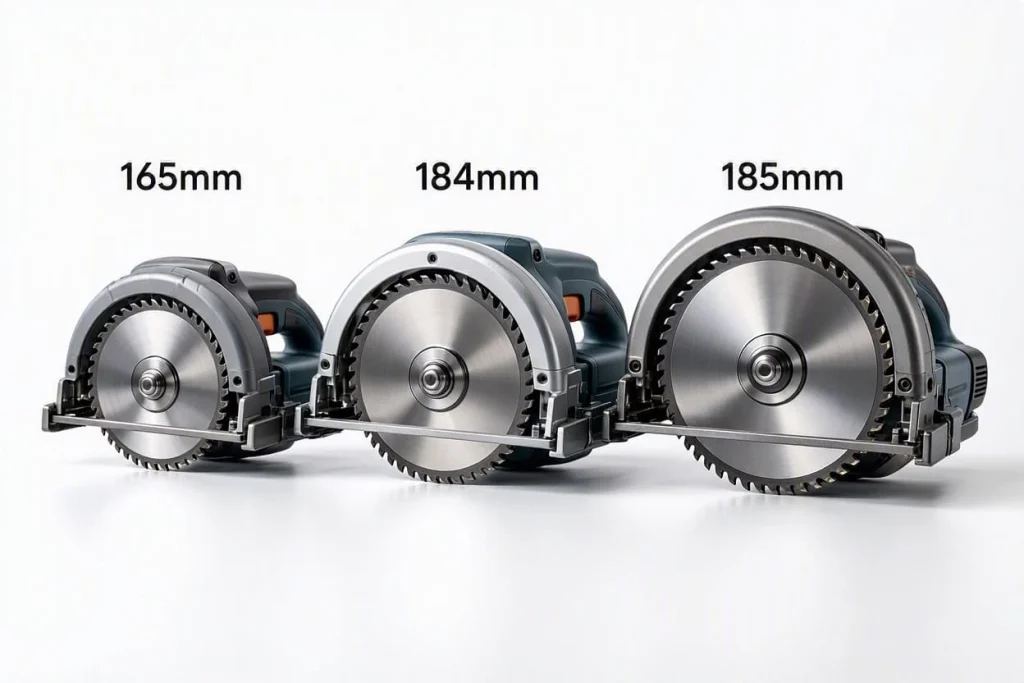
The blade diameter needs to match the size your circular saw is designed to use. Common sizes for DIY circular saws include:
- 165mm — common on cordless circular saws
- 184mm — found on some larger cordless models
- 185mm — common on corded DIY circular saws
You should always check your saw’s manual or manufacturer’s specifications before buying a replacement blade. Don’t assume that a blade will fit simply because it looks similar to the original.
Bore size
The bore is the hole in the centre of the blade that fits onto the saw’s spindle. Different circular saws use different bore sizes, so this is another specification you need to check before buying.
For example, some 165mm circular saws use a 20mm bore, while other manufacturer’s saws may use a different size.
Tooth count
The number of teeth on a blade has a major effect on how it cuts. As a general rule:
- Fewer teeth — faster, more aggressive cuts
- More teeth — slower cuts but generally a cleaner finish
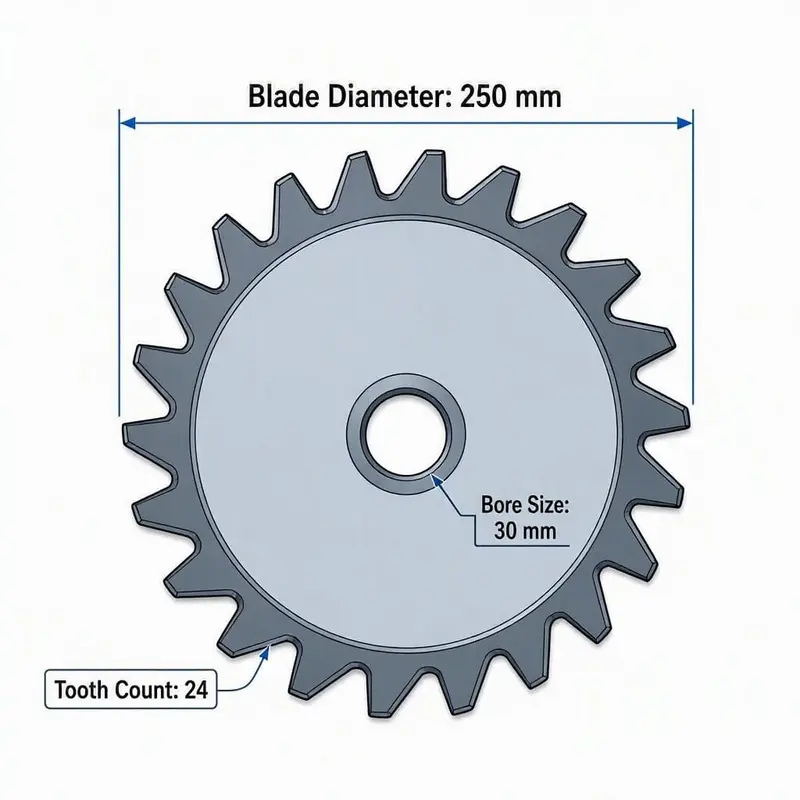
This is why a blade designed for quickly cutting construction timber may look very different from one designed for cutting plywood or producing a cleaner finish. I will explain tooth count in much more detail in the next sections because it is one of the most important things for beginners to understand.
Don’t just buy the blade with the most teeth
It can be tempting to assume that more teeth automatically means a better blade. That’s not necessarily the case.
If you’re cutting construction timber and want to make quick cuts, a high-tooth-count finishing blade may actually make the job slower. Equally, if you’re cutting an expensive sheet material and want a clean edge, a coarse blade may produce a rougher finish than you’d like.
The best circular saw blade is the one that matches the material and type of cut you’re making.
This is the key principle I will use throughout this guide. If you’re unsure which blade size your saw needs, see my guide to what size circular saw you need for DIY.
Circular Saw Blade Tooth Count Explained
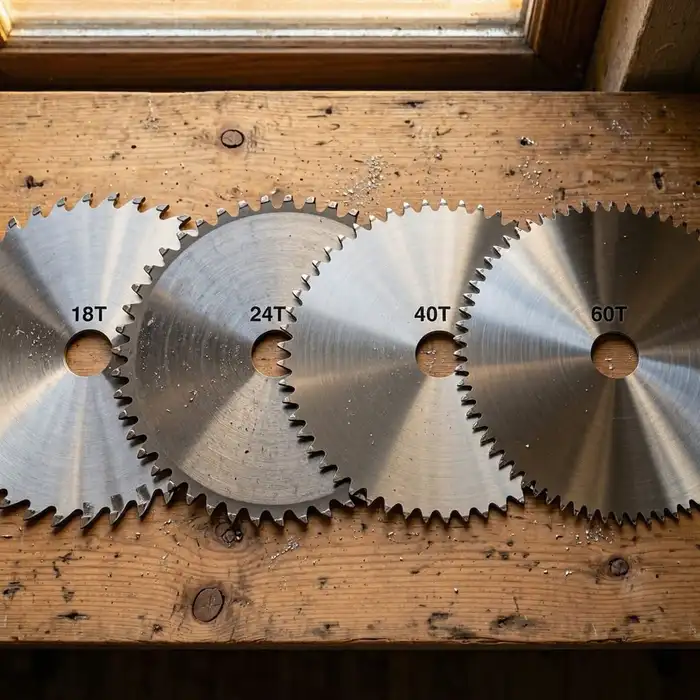
One of the most important things to understand when choosing a circular saw blade is tooth count. You’ll often see blades described by numbers such as 18T, 24T, 40T or 60T. The T stands for teeth, so a 24T blade has 24 teeth around its cutting edge.
Low-tooth-count blades
Blades with around 18–24 teeth are commonly designed for fast cutting. They’re useful for jobs such as:
- Cutting construction timber
- Quickly cutting softwood
- General building and renovation work
- Jobs where speed is more important than a perfectly clean edge
The downside is that a coarse blade can leave a rougher finish, particularly when cutting sheet materials.
Medium-tooth-count blades
Blades around 30–40 teeth can offer a useful compromise between cutting speed and finish. They’re often a good choice for general DIY because they can handle a variety of timber and board materials without being as aggressive as a coarse construction blade.
For a DIY user who doesn’t want to keep changing blades for every small job, a good-quality medium-tooth-count blade can be a useful general-purpose option.
High-tooth-count blades
Blades with 50–60 or more teeth are generally designed for cleaner, more controlled cuts. They’re particularly useful when the appearance of the cut matters, such as:
- Plywood
- MDF
- Laminated boards
- Furniture projects
- Fine woodworking
- Cross-cutting timber where a cleaner edge is required
The trade-off is that they normally cut more slowly than a coarse blade.
Which tooth count should a beginner choose?
There’s no single tooth count that is best for every DIY project.
A useful starting point is:
| Tooth count | General use | Typical result |
|---|---|---|
| 18–24T | Fast timber cutting | Fast, rougher cut |
| 30–40T | General DIY | Good balance |
| 50–60T+ | Fine cuts and sheet materials | Cleaner finish |
The important thing is to match the blade to the material and the type of cut you want to make. In the next section, I will compare 24T, 40T and 60T blades directly so you can see when each one makes the most sense.
24T vs 40T vs 60T Circular Saw Blades
If you’re new to circular saws, 24T, 40T and 60T are three useful tooth counts to understand. They each have a different purpose, and choosing the right one can make a noticeable difference to both cutting speed and the quality of the finished cut.
24T blades — fast cutting
A 24-tooth blade is generally suited to fast, relatively aggressive cutting. It’s a good option for:
- Construction timber
- Softwood
- General building work
- Cutting timber where the finish isn’t critical
The main advantage is speed. With fewer teeth engaging with the material, the saw can remove material quickly. The trade-off is a rougher edge compared with a higher-tooth-count blade.
40T blades — the general-purpose option
A 40-tooth blade is often a useful middle ground for DIY. It provides a reasonable balance between cutting speed and finish, making it suitable for jobs such as:
- General timber cutting
- Plywood
- OSB
- MDF
- Shelving and DIY projects
If you’re buying your first replacement blade and want something versatile, a good-quality 40T general-purpose blade can be a sensible choice.
60T blades — cleaner cuts
A 60-tooth blade is designed more towards achieving a cleaner finish. It can be useful for:
- Plywood
- MDF
- Laminated boards
- Furniture projects
- Visible finished edges
- Finer woodworking
The increased number of teeth generally means the blade removes less material with each tooth, helping produce a smoother cut.
However, it isn’t automatically the best choice for every job. A 60T blade can cut more slowly and may not be the ideal option when you’re simply cutting lots of construction timber.
Quick comparison
| Blade | Best for | Cutting speed | Finish |
|---|---|---|---|
| 24T | Construction timber | Fast | Rougher |
| 40T | General DIY | Medium | Good |
| 60T | Fine cuts and sheet materials | Slower | Cleaner |
So which should a DIY beginner buy?
If you regularly work on different types of DIY projects, 40T is a good general-purpose starting point. If you’re mainly cutting construction timber and want speed, consider 24T.
If you’re making furniture, cutting sheet materials or want a cleaner visible edge, 60T can be the better choice.
You don’t necessarily need to buy three different blades straight away. Start with the blade that matches the work you do most often, then add another type when your projects require it.
If you’re still choosing the saw itself, my guide to the best circular saw for DIY in the UK compares several suitable options for beginners.
Best Circular Saw Blades for Cutting Timber
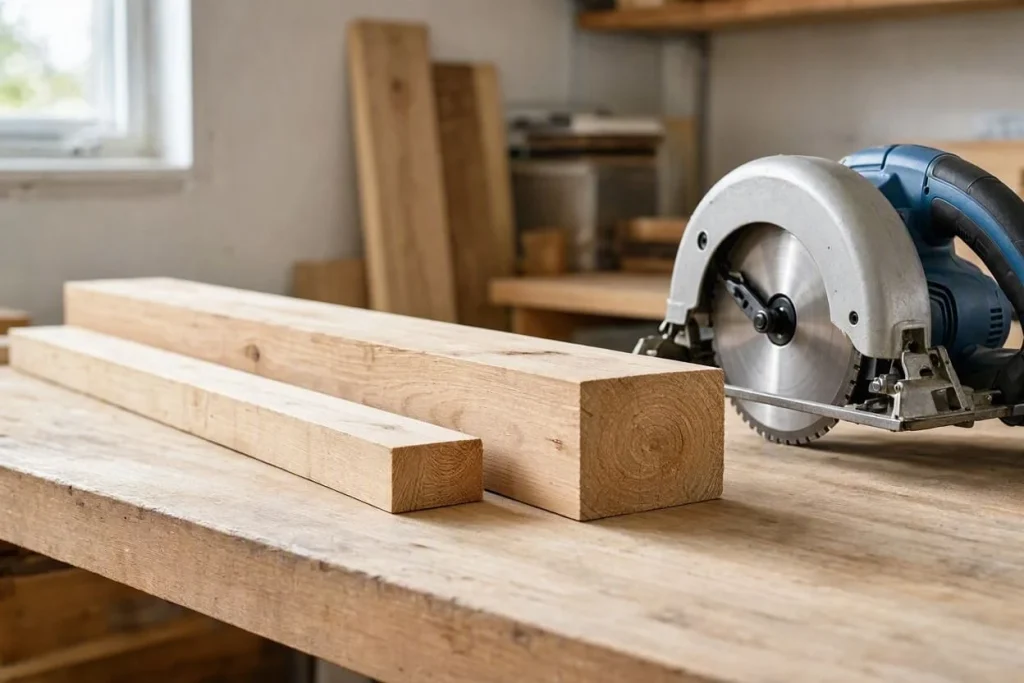
For most DIY projects, timber is one of the materials you’ll cut most often with a circular saw. The best blade depends on whether you’re making quick rough cuts or want a cleaner finished edge.
For construction timber
If you’re cutting standard construction timber such as 2×1 or 4×2, a lower-tooth-count blade is usually a good choice. A 18T or 24T blade can make quick cuts through softwood and construction timber, making it useful for:
- Studwork
- Basic framing
- Garden projects
- Decking
- Fence construction
- General building work
The finish may be relatively rough, but that often doesn’t matter for structural or hidden timber.
For cleaner timber cuts
If the cut will be visible, a blade with around 40 teeth can provide a cleaner finish while still cutting at a reasonable speed. This can be useful for:
- Shelving
- Furniture projects
- Visible timber
- General woodworking
- DIY projects where the cut edge will be seen
For particularly clean cuts, you can move towards a 50T or 60T blade, although this usually means accepting a slower cutting speed.
Choose the blade according to the job
| Timber job | Suggested blade | Main priority |
|---|---|---|
| Construction timber | 18–24T | Fast cutting |
| General DIY timber | 30–40T | Balance of speed and finish |
| Shelving | 40–60T | Cleaner edge |
| Furniture | 50–60T+ | Clean finish |
| Rough garden work | 18–24T | Speed |
It’s also worth remembering that tooth count isn’t the only factor. The quality of the blade, tooth design, kerf and the condition of the blade can all affect the finished cut.
For most beginners, the simplest approach is to have a coarser blade for fast construction work and a finer blade for cleaner cuts rather than trying to find one blade that does everything.
Best Circular Saw Blades for Plywood and Sheet Materials
Plywood and other sheet materials can produce a much cleaner result when you use the right circular saw blade. For DIY projects, materials such as plywood, OSB, MDF and chipboard are common, but they don’t all require exactly the same blade.
Plywood
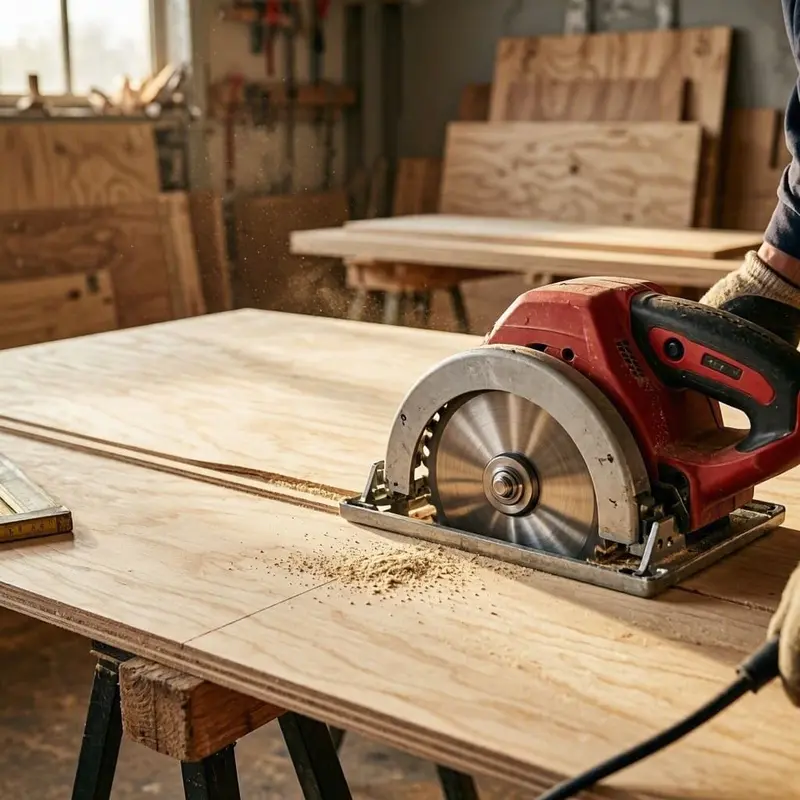
For plywood, a 40T to 60T blade is often a good starting point. A 40T blade provides a useful balance between cutting speed and finish, while a 60T blade can produce a cleaner edge when appearance is more important.
This can be particularly useful for:
- Shelving
- Cabinets
- Furniture projects
- Worktops and panels
- General woodworking
When cutting plywood, supporting the sheet properly is also important. A poorly supported sheet can move or vibrate during cutting, which can affect the quality of the cut.
OSB
OSB is generally more forgiving than plywood because the finished edge is often less important. A 24T to 40T blade can work well for general DIY and construction projects.
If you’re cutting large amounts of OSB quickly, a coarser blade can save time. If you want a cleaner edge, moving towards a 40T blade can make sense.
MDF
MDF can benefit from a blade with a higher tooth count, particularly when you’re looking for a clean edge.
A 40T to 60T blade can be a good choice for typical DIY work.
MDF also produces a significant amount of fine dust when cut, so make sure you use suitable dust control and appropriate personal protective equipment.
Chipboard and laminated boards
For chipboard, melamine-faced board and similar materials, a 40T to 60T blade can help produce a cleaner cut. This is particularly useful when the surface will remain visible.
With laminated boards, the correct blade and careful cutting technique can help reduce chipping or breakout along the cut edge.
Quick comparison
| Material | Suggested tooth count | Priority |
|---|---|---|
| Plywood | 40–60T | Clean cut |
| OSB | 24–40T | Speed and versatility |
| MDF | 40–60T | Cleaner finish |
| Chipboard | 40–60T | Cleaner edge |
| Laminated board | 40–60T+ | Reduce chipping |
These are useful starting points rather than strict rules. Blade manufacturers may recommend different tooth counts or blade designs for particular materials.
The important thing is to choose a blade that’s compatible with your circular saw and specifically suitable for the material you’re cutting.
Best Circular Saw Blades for MDF and Chipboard
MDF and chipboard are common materials for DIY furniture, shelving and home improvement projects, but they can be harder on blades than ordinary softwood. The right blade can help produce a cleaner edge and reduce the amount of chipping around the cut.
MDF
For MDF, a 40T to 60T blade is generally a good starting point for DIY. If you’re making visible furniture components or shelving where the edge needs to look neat, a higher-tooth-count blade can be worthwhile.
MDF can also produce a lot of fine dust, so good dust extraction and suitable respiratory protection are important when cutting it.
Chipboard
For standard chipboard, a 40T blade can provide a useful balance between cutting speed and finish.
If you’re cutting melamine-faced chipboard, a higher-tooth-count blade can help produce a cleaner edge and reduce chipping of the decorative surface.
What about a general-purpose blade?
If you only occasionally cut MDF or chipboard, you don’t necessarily need a specialist blade. A good-quality 40T general-purpose blade can be a practical option for many DIY projects.
However, if you’re regularly making furniture or cutting expensive sheet materials, investing in a suitable finer blade can make a noticeable difference to the finished result.
A useful tip for beginners
Don’t assume that adding more teeth will always solve cutting problems. Blade condition, cutting technique and supporting the material properly are also important.
A sharp, suitable blade used with a steady feed rate will normally produce a better result than simply fitting the highest-tooth-count blade you can find.
Best Circular Saw Blades for Fine, Clean Cuts
If you’re making furniture, putting down laminate flooring, shelving or other DIY projects where the cut edge will be visible, cut quality becomes more important than cutting speed.
A blade with more teeth can often produce a smoother finish, but there are several other factors that matter too.
Choose a higher tooth count
For cleaner cuts, a 40T to 60T blade is a useful starting point.
For example:
- 40T — good balance between speed and finish
- 50T — cleaner cuts for more detailed work
- 60T+ — useful when a particularly clean finish is important
You don’t always need the highest tooth count available. For many DIY projects, a good-quality 40T or 60T blade will be more than adequate.
Match the blade to the material
A fine blade can be particularly useful for:
- Plywood
- MDF
- Laminated boards
- Furniture panels
- Shelving
- Decorative timber
For solid construction timber, however, using a very fine blade can make the cut unnecessarily slow.
Support the material properly
Even the best circular saw blade can produce a poor result if the material isn’t properly supported. When cutting sheet materials, make sure the workpiece is secure and adequately supported so it doesn’t move or sag during the cut.
This is particularly important towards the end of a cut, when unsupported material can break away and cause splintering.
Let the saw do the work
Another common beginner mistake is pushing the saw too quickly. Use a steady, controlled feed rate and allow the blade to cut at its own pace.
If you force the saw through the material, you can increase the chances of:
- Rough cuts
- Chipping
- Burning
- Reduced blade life
- The saw wandering away from the cutting line
For the cleanest possible result
For particularly visible cuts, you can also consider using a suitable guide rail or straightedge to keep the saw moving accurately.
A sharp, appropriate blade combined with good material support, a steady feed rate and accurate guidance will usually produce a much better result than simply choosing a blade with the highest number of teeth.
Best Circular Saw Blades for Fast Cuts
When you’re cutting a lot of construction timber, speed can be more important than achieving a perfectly smooth finish. This is where a coarse-tooth circular saw blade can be particularly useful.
Choose a lower tooth count
For fast cutting, 18T to 24T blades are a good starting point. With fewer teeth engaging with the material, these blades can remove material quickly and are well suited to jobs such as:
- Cutting construction timber
- Studwork
- Framing
- Decking
- Fence construction
- Garden projects
- General building work
The trade-off is that the cut edge will usually be rougher than one produced by a 40T or 60T blade.
Why not use a 60T blade for everything?
A high-tooth-count blade can certainly cut timber, but it isn’t always the most practical choice for construction work. If you’re making dozens of cuts through softwood, a 60T blade can be slower and may generate more heat because more teeth are engaging with the material.
A 24T construction blade is often a better choice when you’re prioritising productivity over appearance.
Fast doesn’t mean forcing the saw
It’s important not to confuse a fast-cutting blade with pushing the saw as quickly as possible. Let the blade maintain its cutting speed and use a steady, controlled feed rate.
If the saw begins to struggle, slow down rather than forcing it through the material.
A useful two-blade setup
For a DIY user who regularly works on different projects, having two blades can be more useful than trying to find one blade that does everything.
24T blade:
Use for fast cuts through construction timber and rougher work.
40T or 60T blade:
Use when you want a cleaner finish on timber, plywood, MDF and other sheet materials.
This simple setup gives you flexibility without needing a large collection of specialist blades.
Multi-Material Circular Saw Blades
If you want one blade that can handle a variety of DIY materials, you will come across multi-material circular saw blades. These are designed to cut more than just ordinary timber and can be useful for DIYers who don’t want to keep changing blades for different jobs. The Evolution brand use a lot of these.
What can a multi-material blade cut?
Depending on the specific blade, a multi-material blade may be suitable for materials such as:
- Softwood
- Hardwood
- Plywood
- MDF
- Chipboard
- Laminated boards
- Plastics
- Some non-ferrous metals
Always check the manufacturer’s specifications before cutting a particular material. Not every multi-material blade is designed for every material.
When is a multi-material blade useful?
A multi-material blade can be particularly convenient if your DIY projects involve a mixture of materials.
For example, you might use the same saw for:
- Cutting timber for a garden project
- Cutting plywood for shelving
- Trimming laminated boards
- Cutting plastic components
Instead of changing blades between every job, a suitable multi-material blade can give you greater flexibility.
Are multi-material blades as good as specialist blades?
Not necessarily. A specialist timber blade may cut construction timber faster, while a dedicated fine-tooth blade may produce a cleaner finish on plywood or furniture boards.
Think of a multi-material blade as a versatile compromise rather than automatically the best blade for every material.
What should beginners look for?
If versatility is more important to you than achieving the absolute fastest or cleanest cut, a good-quality multi-material blade can be a useful addition to your toolkit.
However, check three things before buying:
- Blade diameter — it must match your circular saw.
- Bore size — it must fit the saw’s spindle.
- Approved materials — make sure the blade is actually designed for what you intend to cut.
For many DIY users, a general-purpose 40T blade plus a coarse 18–24T blade may still be the more practical combination if most of their work involves timber and sheet materials.
How to Choose the Right Circular Saw Blade for Your Project
Choosing a circular saw blade becomes much easier once you know what you’re cutting and what kind of finish you want. You don’t need to memorise every blade specification. Start with these five questions.
1. What material are you cutting?
Think about the material first.
- Construction timber → 18–24T
- General timber and DIY → 30–40T
- Plywood and MDF → 40–60T
- Laminated boards → 40–60T+
- Mixed materials → suitable multi-material blade
These are useful starting points rather than fixed rules. Always follow the blade manufacturer’s recommendations.
2. How clean does the cut need to be?
If the cut will be hidden or doesn’t need to look perfect, a coarse blade is often the better choice. For visible edges, furniture or shelving, choose a finer blade with more teeth.
Fast cut = fewer teeth
Cleaner cut = more teeth
3. How often will you make the cuts?
If you’re cutting dozens of pieces of construction timber, speed and durability are likely to matter more than achieving a perfect finish. If you’re making one piece of furniture, spending a little more time to achieve a cleaner cut may be worthwhile.
4. Does the blade fit your circular saw?
Before buying, check:
- Blade diameter
- Bore size
- Maximum RPM rating
- Manufacturer’s recommended materials
For example, a 165mm circular saw will normally require a blade designed for that diameter. Don’t fit a blade simply because the bore appears to match.
5. Do you actually need a new blade?
If your current blade is producing poor cuts, don’t automatically assume that you need a different tooth count. A blade that is dull, damaged or contaminated with material buildup can perform poorly even if it’s the right type.
Inspect the blade and replace it if the teeth are damaged or excessively worn.
A simple beginner’s approach
If you’re just starting out and mainly doing normal DIY, you don’t need a drawer full of blades.
A sensible starting setup could be:
- 24T — fast cuts through construction timber
- 40T — general-purpose DIY
- 60T — cleaner cuts on sheet materials and furniture projects
That gives you a useful range without making blade selection unnecessarily complicated.
The best circular saw blade isn’t necessarily the most expensive or the one with the most teeth. It’s the one that matches the material, the job and the finish you need.
Quick Circular Saw Blade Comparison
By this point, the differences between blade types should be becoming clearer. Here’s a quick comparison you can use when deciding which blade is most suitable for a particular DIY job.
| Blade type | Typical tooth count | Best suited to | Cutting speed | Finish |
|---|---|---|---|---|
| Coarse construction blade | 18–24T | Construction timber, framing, garden work | Fast | Rougher |
| General-purpose blade | 30–40T | Everyday DIY and mixed timber | Medium | Good |
| Fine-tooth blade | 50–60T+ | Plywood, MDF, furniture and visible cuts | Slower | Cleaner |
| Multi-material blade | Varies | Mixed materials | Varies | Varies |
Which blade should you choose?
For most DIY beginners, there’s no need to overcomplicate things.
Choose a 24T blade if you mainly want to cut construction timber quickly.
Choose a 40T blade if you want a versatile option for general DIY.
Choose a 60T blade if you’re more concerned with achieving a clean finish on sheet materials or furniture projects.
Choose a multi-material blade if you regularly work with several different materials and value convenience.
Remember that these are general guidelines. The exact performance of a blade depends on its design, tooth geometry, material and the recommendations made by the manufacturer.
Before buying any blade, always check that the diameter, bore size and maximum RPM are compatible with your circular saw.
For more information on using work equipment safely, see the HSE guidance on using work equipment safely.
Best Circular Saw Blades for DIY UK: Our Recommendations
For most UK DIY beginners, I wouldn’t recommend buying a large collection of circular saw blades straight away. Instead, start with one good general-purpose blade and add a more specialised blade when your projects require it.
Best all-round option: 40T
A good-quality 40-tooth blade is probably the most useful starting point for general DIY.
It can be suitable for:
- General timber
- Plywood
- OSB
- MDF
- Chipboard
- Shelving
- Furniture projects
It offers a useful balance between cutting speed and finish.
Best for fast timber cutting: 24T
If you’re mainly working with construction timber, a 24T blade makes more sense.
It’s particularly useful for:
- 2×1 and 4×2 timber
- Studwork
- Framing
- Decking
- Fencing
- Garden projects
You’ll generally get a faster cut, although the edge won’t be as clean as one produced by a finer blade.
Best for clean cuts: 60T
For furniture, shelving and visible sheet-material cuts, a 60T blade can be a worthwhile addition.
It’s particularly useful when you’re more concerned about the appearance of the finished edge than cutting speed.
Best setup for a regular DIY user
If you expect to use your circular saw regularly, I’d recommend building a simple three-blade setup:
| Blade | Main purpose | Why have it? |
|---|---|---|
| 24T | Fast timber cutting | Quick construction and garden work |
| 40T | General DIY | Best all-rounder |
| 60T | Clean cuts | Furniture and sheet materials |
This gives you much more flexibility than trying to make one blade do everything.
Don’t forget compatibility
Before buying any of these blades, check the specifications for your particular circular saw.
The blade diameter, bore size and maximum RPM all need to be compatible with the saw.
For example, a 165mm circular saw may use a 20mm bore, but you should always confirm the exact requirements for your model rather than relying on assumptions.
The most important thing is to choose the blade for the work you’re doing, rather than simply buying the blade with the highest tooth count or the most expensive specification.
If you’re deciding between a corded and cordless model, my corded vs cordless circular saw guide explains the advantages and disadvantages of each.
Frequently Asked Questions
What tooth count is best for a circular saw?
For general DIY, a 30T to 40T blade is a good starting point because it offers a useful balance between cutting speed and finish. A 24T blade is better for fast timber cutting, while a 50T or 60T blade can produce a cleaner finish.
Is a 24T blade better than a 40T blade?
Neither is automatically better. A 24T blade is generally better for fast cuts through construction timber, while a 40T blade is more versatile for general DIY and can provide a cleaner finish.
Is a 60T blade better for plywood?
A 60T blade can be a good choice for plywood when you want a cleaner finished edge. However, the quality and design of the blade also matter, so tooth count shouldn’t be the only factor you consider.
Can I use one circular saw blade for everything?
You can use a good general-purpose blade for many DIY jobs, but one blade won’t necessarily be ideal for every material and type of cut.
A 40T blade can be a useful all-round option, while having a coarser 24T blade and finer 60T blade available gives you more flexibility.
How long does a circular saw blade last?
There isn’t a fixed lifespan for a circular saw blade.
Blade life depends on the material being cut, how often you use it, the blade quality and whether the teeth become damaged or worn.
If the saw starts producing noticeably rougher cuts, requires more force or begins burning the material, inspect the blade and consider replacing it.
Can I sharpen a circular saw blade?
Some circular saw blades can be professionally sharpened, particularly higher-quality blades designed for repeated use.
For many DIY users, however, replacing a relatively inexpensive blade may be more practical than having it sharpened.
Does more teeth mean a better circular saw blade?
No.
More teeth generally help produce a cleaner cut, but fewer teeth can cut faster through construction timber.
The best blade depends on the material and the type of cut you’re making.
What size circular saw blade do I need?
The blade diameter must match the specification of your circular saw.
Common DIY sizes include 165mm, 184mm and 185mm, but you should always check your particular saw’s manual or manufacturer’s specifications before buying a replacement.
For more information on choosing the right saw size, see our guide to [what size circular saw you need for DIY].
What is the best circular saw blade for beginners?
For most DIY beginners, a good-quality 40T general-purpose blade is a sensible starting point.
If you regularly cut construction timber, adding a 24T blade can be useful. If you move into furniture making or cleaner sheet-material cuts, a 60T blade can be a worthwhile addition.
Should I buy a cheap circular saw blade?
Not necessarily.
You don’t always need the most expensive blade, but choosing a reputable, properly specified blade is generally more sensible than simply buying the cheapest option available.
Look at the blade’s compatibility, intended materials, tooth design and manufacturer specifications, rather than judging it on price alone.
Final Verdict
For most UK DIY beginners, the best approach is not to look for one circular saw blade that does everything.
Instead, choose a blade based on the material you’re cutting and the type of finish you want.
A 24T blade is a good choice for fast cuts through construction timber and general building work. A 40T blade offers a useful balance of speed and finish and is probably the best all-round starting point for many DIY users. A 60T or finer blade is better suited to cleaner cuts in plywood, MDF, laminated boards and furniture projects.
If you use your circular saw regularly, having two or three different blades available gives you much more flexibility.
Before buying any blade, always check that the diameter, bore size and maximum RPM are suitable for your particular circular saw, and make sure the blade is designed for the material you intend to cut.
The main thing to remember is simple:
Choose the blade for the job, not simply the blade with the most teeth.
A good-quality blade that’s correctly matched to your material will make your circular saw easier to use, produce better results and can also help the blade and saw last longer.