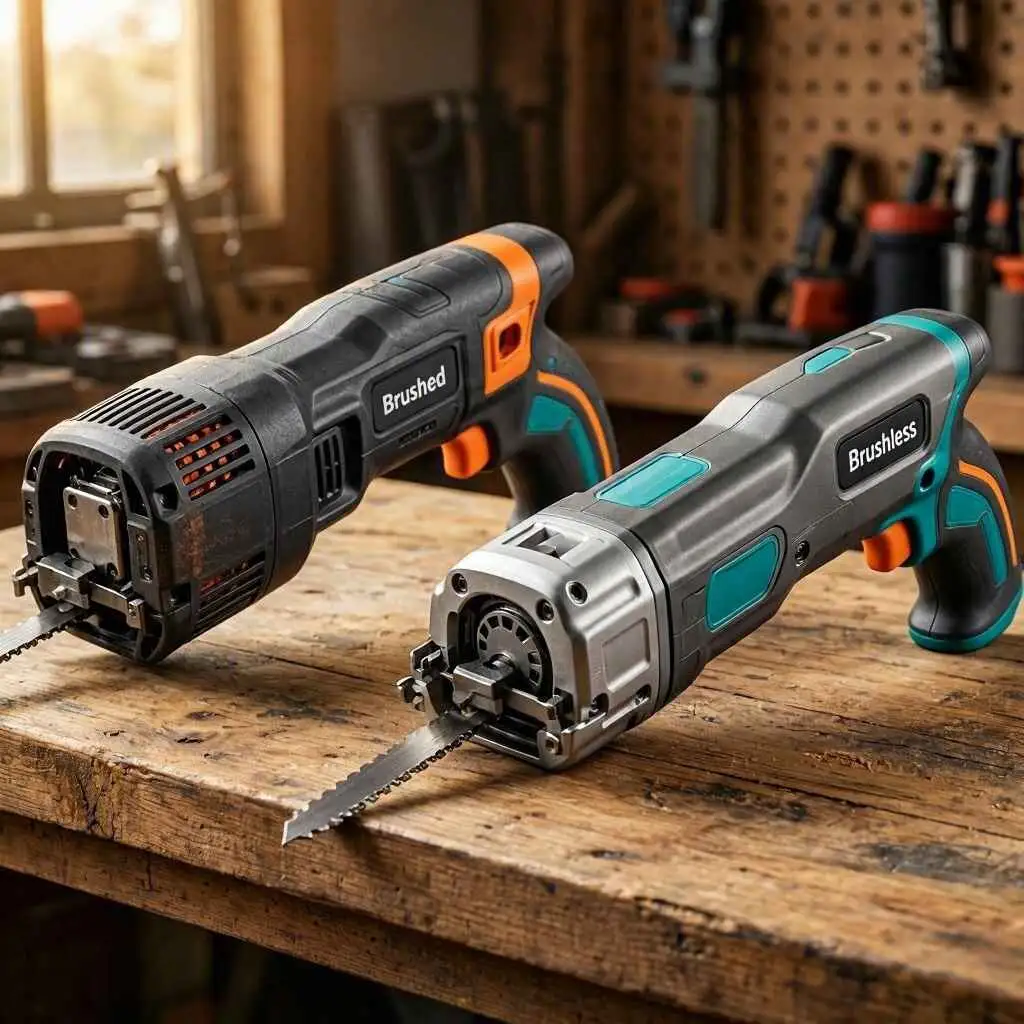
If you’re looking for a cordless reciprocating saw, you’ll quickly come across two types of motor:
Brushed and brushless.
At first glance, the difference might not seem particularly important. After all, both types of saw can cut wood, metal, plastic and other materials when fitted with the correct blade.
So why do brushless reciprocating saws usually cost more? And is a brushless model actually worth paying extra for if you’re a DIY beginner?
The short answer is:
For regular DIY, renovation or heavy use, I’d choose a brushless reciprocating saw. For occasional light DIY, a good brushed model can still be perfectly adequate.
The difference isn’t simply about maximum power. Brushless motors can offer advantages in efficiency, heat management, durability and battery use. Let’s look at what that means in real-world DIY.
Quick Answer: Brushless or Brushed?
If you’re buying a reciprocating saw for occasional DIY jobs, you don’t necessarily need to spend extra on brushless. However, if you’re building a cordless tool collection and expect to use the saw regularly, brushless is generally the better long-term choice.
| Feature | Brushed | Brushless |
|---|---|---|
| Purchase price | Usually lower | Usually higher |
| Efficiency | Good | Generally better |
| Battery use | Generally higher | Generally lower |
| Motor maintenance | Brushes eventually wear | No carbon brushes |
| Heat generation | Generally higher | Generally lower |
| Motor durability | Good | Generally better |
| Heavy use | Good | Excellent |
| Occasional DIY | Excellent | Excellent |
| Long-term ownership | Good | Excellent |
| Best for | Budget DIY | Regular/heavy DIY |
These are general differences rather than guarantees. The performance of an individual saw also depends on its motor, electronics, gearbox, battery, blade and overall design.
What Is a Brushed Motor?
A brushed motor is a traditional type of electric motor that has been used in power tools for many years. It uses carbon brushes to transfer electrical current to the rotating part of the motor.
The brushes physically contact the motor’s commutator as it spins. That contact allows the motor to operate, but it also creates friction. Over time, the brushes wear down.
This doesn’t mean brushed motors are poor quality. Far from it. A good brushed reciprocating saw can provide years of useful service when looked after properly.
The technology is simply older and generally less efficient than modern brushless motor technology.
What Is a Brushless Motor?
A brushless motor removes the physical brushes from the motor. Instead, electronic controls manage the electrical current needed to make the motor operate.
There is therefore no carbon brush physically rubbing against a commutator. This reduces one source of friction and eliminates the brushes as a wear component. Modern cordless tool manufacturers have increasingly adopted brushless motors.
For example, current UK reciprocating-saw ranges include brushless models from manufacturers such as DeWalt, including 12V and 18V models.
What’s the Difference Between Brushed and Brushless?
The easiest way to think about it is:
Brushed motor
Electricity → brushes → motor
Brushless motor
Electricity → electronic controller → motor
The brushless design removes the physical contact between brushes and commutator. That can reduce friction and heat and improve efficiency.
For a cordless power tool, efficiency is particularly useful because the tool is relying on a battery rather than mains electricity.
Does Brushless Mean More Powerful?
Not necessarily.
This is one of the most important things to understand. A brushless motor doesn’t automatically make a reciprocating saw more powerful than every brushed model. Tool performance depends on much more than the motor type.
For example:
- Motor design
- Battery
- Electronics
- Gearbox
- Stroke length
- Stroke speed
- Blade
- Tool design
all affect cutting performance.
So don’t assume:
Brushless = automatically more powerful.
It’s better to think of brushless technology as providing the potential for greater efficiency and performance from the overall tool system.
Does Brushless Give You More Battery Runtime?
It can. One of the major advantages of brushless motors is improved efficiency. Manufacturers commonly highlight this benefit. For example, DeWalt states that its brushless reciprocating saw motor provides improved runtime and durability.
However, don’t expect a specific percentage increase in runtime simply because a tool is brushless.
Actual runtime depends on:
- Battery capacity
- Material
- Blade
- Cutting pressure
- Cutting speed
- Motor design
- Tool electronics
- Temperature
- Condition of the battery
A 5Ah battery will generally provide considerably more stored energy than a 2Ah battery in the same voltage system, regardless of whether the motor is brushed or brushless.
Why Is Efficiency Important?
This becomes particularly important with cordless tools. A cordless reciprocating saw gets all of its energy from the battery. Anything that improves the efficiency of converting that electrical energy into useful cutting work can be beneficial.
Better efficiency can potentially mean:
- More work from a battery
- Less wasted energy
- Less heat
- Better sustained performance
That’s one reason brushless technology has become increasingly common in cordless power tools.
Does a Brushless Motor Run Cooler?
Generally, yes. Because there is no physical brush-to-commutator contact, a brushless motor can reduce some of the friction and associated heat generated within the motor. However, the entire tool still generates heat.
If you’re cutting thick timber for a long time, the motor, gearbox and electronics can all become warm. So don’t interpret “brushless runs cooler” as meaning:
“A brushless saw can never overheat.”
It still needs to be used within the manufacturer’s guidelines.
Which Motor Lasts Longer?
A brushless motor generally has an advantage because it doesn’t have carbon brushes that gradually wear out. With a brushed motor, the brushes are a consumable component and eventually, they may need replacing.
A brushless motor doesn’t have that particular wear component. This can be particularly valuable if you’re using the reciprocating saw frequently. However, the motor isn’t the only part of a reciprocating saw that can wear.
Other components include:
- Gears
- Bearings
- Blade clamp
- Switches
- Electronics
- Battery
So brushless doesn’t mean indestructible.
Do Brushed Motors Need Maintenance?
Eventually, the brushes may need attention.
The exact lifespan depends on:
- How often you use the saw
- How hard you use it
- How much load you put on the motor
- The quality of the tool
- Operating conditions
For an occasional DIY user, this may never become a significant issue. You might use the saw a few times a year and never need to replace the brushes.
For someone using the saw regularly, however, brush wear becomes more relevant.
Is a Brushless Reciprocating Saw Worth the Extra Money?
This is probably the question you’re really asking.
My answer is:
For occasional DIY:
Not necessarily.
For regular DIY:
Probably.
For renovation and heavy use:
Yes, I’d strongly consider brushless.
If you’re spending more on a tool that you’ll use every week, the advantages can become much more worthwhile.
If you’re buying a reciprocating saw to cut up one old shed and then store it in the garage for two years, spending considerably more on brushless may not make financial sense.
I owned a Dewalt drill for around 15 years around the house. It had a brushed motor and the brushes didn’t wear out. I used it about once every few weeks for small jobs. In my opinion it really depends on the amount of use, your tool will actually get.
Brushless vs Brushed for Beginners
If you’re completely new to power tools, don’t feel that you must buy brushless. A decent brushed reciprocating saw can still be a useful DIY tool.
The important things are:
- Correct blade
- Appropriate power
- Good ergonomics
- Safety features
- Suitable battery
- Reliable manufacturer
- Good warranty
Brushless is an upgrade rather than a requirement.
Brushless vs Brushed for Demolition
If demolition is one of your main reasons for buying a reciprocating saw, I’d lean strongly towards brushless.
Demolition can be demanding. You might be cutting:
- Thick timber
- Timber containing nails
- Metal
- Pipe
- Old flooring
- Mixed materials
A saw working hard for extended periods benefits from good motor efficiency and heat management.
This is one situation where I’d be happier spending extra on a good brushless model.
Brushless vs Brushed for Cutting Wood
Both can cut wood effectively. For occasional timber cutting, a brushed model can be perfectly adequate.
If you’re frequently cutting:
- Thick timber
- Hardwood
- Construction timber
- Timber containing nails
- Large quantities of wood
I’d choose brushless.
But don’t forget the blade.
A good wood or demolition blade can make a bigger difference than many beginners realise.
Brushless vs Brushed for Cutting Metal
Again, both can cut metal when equipped with the correct blade and used within the tool’s specifications.
However, metal cutting can place significant demands on a reciprocating saw.
If you’re regularly cutting:
- Steel pipe
- Metal sections
- Bolts
- Metal fixtures
I’d favour brushless.
For one or two occasional jobs, brushed may be sufficient.
Brushless vs Brushed for Garden Pruning
This is an interesting case. If you’re using a reciprocating saw with a pruning blade for occasional garden work, you may not need brushless. A compact brushed saw could be perfectly adequate.
But if you’re using the saw frequently or already have a brushless battery platform, a brushless model can still make sense.
For regular tree work, however, consider whether a dedicated pruning saw or chainsaw is the more appropriate tool.
Does Brushless Make a Saw Lighter?
Not necessarily. You might assume removing brushes makes a tool automatically lighter. That’s not always the case.
The overall weight depends on:
- Motor
- Gearbox
- Housing
- Electronics
- Battery
- Blade
- Design
Some brushless models are very compact. Others are full-size heavy-duty machines.
For example, DeWalt’s current range includes compact brushless reciprocating saws specifically designed for improved access and handling.
So compare the actual weight of the complete tool, including the battery you intend to use.
Does Brushless Mean Quieter?
Not necessarily in a way that should influence your buying decision. Brushless motors can reduce some mechanical noise because they don’t have brushes physically contacting the commutator.
However, a reciprocating saw creates plenty of other noise.
You’ve got:
- Blade movement
- Gearbox noise
- Material vibration
- Cutting noise
So don’t buy a brushless reciprocating saw expecting it to be a quiet power tool.
Always use appropriate hearing protection when required.
Can You Replace the Brushes in a Brushed Saw?
Some brushed tools have replaceable brushes. If the brushes wear out, they may be replaced depending on the tool’s design and the manufacturer’s service instructions.
This can be an advantage in terms of repairability. A brushless motor doesn’t have brushes to replace.
However, brushless tools contain electronic components that are more sophisticated than those in a traditional brushed motor.
If the electronics fail, repair can be more involved.
Are Brushless Tools More Reliable?
Generally, brushless technology can provide excellent durability because there are fewer mechanical wear components within the motor.
But you shouldn’t assume:
Brushless = never breaks.
A reciprocating saw is a demanding power tool. The gearbox, bearings, electronics and blade mechanism can all experience wear. The quality of the entire tool matters.
I’d rather buy a well-designed brushed saw from a reputable manufacturer than a poorly designed brushless saw from an unknown brand.
Brushless vs Brushed Reciprocating Saw Comparison
| Feature | Brushed | Brushless |
|---|---|---|
| Motor technology | Traditional | Modern electronic |
| Carbon brushes | Yes | No |
| Friction in motor | Higher | Lower |
| Efficiency | Good | Generally better |
| Runtime potential | Good | Generally better |
| Heat | Generally higher | Generally lower |
| Motor wear | Brushes wear | No brush wear |
| Maintenance | Potential brush replacement | Less motor maintenance |
| Price | Usually lower | Usually higher |
| Heavy use | Good | Better suited |
| Occasional DIY | Very good | Very good |
| Long-term choice | Good | Excellent |
Is Brushless Worth It for a £100 Reciprocating Saw?
Don’t use the price alone to decide.
Suppose you have two saws:
Model A: £100 brushed
Model B: £150 brushless
The £50 difference might be worthwhile if you’re going to use the saw regularly. But if you’re only going to use it for a couple of weekends, the cheaper saw might be the better buy.
Think about cost per use, rather than simply purchase price.
What If I Already Own a Battery System?
This can change the decision considerably. Suppose you already own several 18V batteries.
You may be able to buy a brushless reciprocating saw as a bare tool.
That means you don’t need to buy:
- Battery
- Charger
For example, DeWalt’s 18V XR brushless reciprocating saws are part of a large compatible battery system, with the DCS382 listed as compatible with the wider 18V XR range.
This is one of the biggest advantages of committing to a cordless battery platform. You can read more if you want to understand battery runtimes.
Brushless vs Brushed: What About 12V?
Brushless isn’t limited to 18V tools. You’ll find 12V brushless reciprocating saws too.
For example, DeWalt currently lists a 12V XR brushless sub-compact reciprocating saw alongside its 18V models.
This means you can combine:
Small voltage + brushless motor
to create a compact tool that’s designed around portability and efficiency.
So don’t assume:
12V = brushed
or:
18V = brushless.
Both 12v vs 18V technologies can be found across different cordless platforms.
Brushless vs Brushed and Battery Size
Don’t forget that battery size can have a major impact on how the saw feels.
For example, an 18V brushless reciprocating saw with a large 5Ah battery may be considerably heavier than the same saw fitted with a compact battery.
A larger battery can give you more stored energy, but it also adds weight.
For overhead or awkward cutting, you may prefer a smaller battery.
For heavy demolition, the larger battery may be worthwhile.
What Other Features Should You Look For?
Don’t let the word brushless distract you from the rest of the tool.
I’d also look for:
Variable-speed trigger
Useful for controlling cutting speed.
Tool-free blade change
Makes changing blades quick and convenient.
Adjustable or pivoting shoe
Helps keep the saw stable against the workpiece.
Good vibration control
Particularly important for longer jobs.
LED work light
Useful when cutting in darker areas.
Comfortable handle
Important when you’re using the tool for extended periods.
Good balance
A well-balanced saw can feel easier to control.
Suitable stroke length
A longer stroke can help remove material more quickly, depending on the application.
Does Stroke Length Matter More Than Brushless?
It can. Imagine comparing:
Brushless Saw A
with
Brushed Saw B
You shouldn’t automatically choose Saw A.
If Saw B has a better blade, more suitable stroke characteristics and a better overall design for your job, it could perform very well.
Stroke length and stroke speed are important reciprocating-saw specifications, but real-world cutting performance depends on how well the complete tool maintains performance under load.
This is why my UKToolGuide buying guides always look at more than one specification.
What About Orbital Action?
Some reciprocating saws offer orbital action. Instead of the blade simply moving backwards and forwards, the blade follows a more elliptical movement. This can make cutting wood more aggressive and potentially faster.
However, orbital action isn’t necessarily desirable for every material. It can be particularly useful for wood but may not be appropriate for every metal-cutting application.
Again, don’t buy a saw purely because it has one impressive specification. Think about your actual work.
Brushed vs Brushless: Which Is Better for a DIY Beginner?
If you’re a beginner and have a limited budget, I’d put your priorities in this order:
1. Buy a suitable saw
Make sure it’s appropriate for the jobs you want to do.
2. Buy good blades
The blade has a huge effect on performance.
3. Choose a sensible battery platform
Especially if you’re going cordless.
4. Consider brushless
Once the basics are covered. In other words:
Don’t buy a poor tool simply because it’s brushless. You can read more here about the best reciprocating saw for DIY.
When Should You Choose a Brushed Reciprocating Saw?
A brushed model makes sense if:
- You’re on a tight budget.
- You only use the saw occasionally.
- You’re doing light DIY.
- You don’t expect heavy use.
- You find a good deal from a reputable manufacturer.
- The saw meets your cutting requirements.
For many beginners, that may be all they need.
When Should You Choose a Brushless Reciprocating Saw?
I’d choose brushless if:
- You use the saw regularly.
- You’re renovating a property.
- You do demolition.
- You cut thick timber.
- You cut metal regularly.
- You want better battery efficiency.
- You’re building a cordless tool collection.
- You expect to keep the saw for many years.
You can read more here about choosing a reciprocating saw.
Is a Brushless Reciprocating Saw Better for Renovation?
Yes, I’d generally choose one.
Renovation work can involve unpredictable cutting. One minute you’re cutting timber.
The next you’re dealing with:
- Nails
- Screws
- Pipe
- Metal
- Plastic
- Old fittings
A good brushless reciprocating saw gives you a capable tool for this kind of demanding work.
Is a Brushless Saw Necessary?
No. This is probably the most important conclusion of the article. You do not need a brushless reciprocating saw to complete DIY projects.
A brushed model can still be perfectly capable. Brushless is about getting additional benefits from the motor design.
For a beginner doing occasional DIY, those benefits may not justify the additional cost.
What About Corded Reciprocating Saws?
The brushless vs brushed question is particularly relevant to cordless tools.
Corded reciprocating saws are powered directly from the mains rather than a battery, so battery efficiency isn’t a consideration.
When comparing corded models, other factors become more important.
For a DIY beginner, cordless models can be particularly convenient because you don’t have to manage a power cable.
Common Buying Mistakes
Buying brushless just because it sounds better
Brushless is useful, but it isn’t magic.
Ignoring the battery system
The battery platform can be one of the most important long-term decisions.
Spending too much on a tool you rarely use
Sometimes a good brushed saw is the sensible choice.
Buying cheap blades
Poor blades can make a good saw perform badly.
Ignoring ergonomics
A comfortable, well-balanced saw can make a big difference.
Assuming brushless means maintenance-free
The motor has fewer wear components, but the entire tool still requires sensible care.
Brushless vs Brushed: Which Should You Buy?
Here’s the simple decision.
Buy brushed if:
You occasionally need a reciprocating saw for light DIY and want to keep the initial cost down.
Buy brushless if:
You’re going to use the saw regularly, especially for renovation, demolition or demanding cutting.
If you’re unsure:
I’d choose brushless if the extra cost is reasonable and it fits the battery system you want to build around.
That gives you more room to grow into the tool.
My Recommendation for UK DIY Beginners
If you’re building your first cordless tool collection, I would generally choose brushless for a reciprocating saw. That’s particularly true if you’re already committed to an 18V battery platform.
The combination of:
18V + brushless + good-quality blades
makes a very capable general-purpose DIY reciprocating saw.
However, I wouldn’t tell a beginner to spend hundreds of pounds just to get brushless.
If a reputable brushed model does everything you need for £80–£100 while a comparable brushless model costs substantially more, the cheaper option may be perfectly sensible.
The key question isn’t:
“Is brushless better?”
It generally is.
The better question is:
“Is brushless worth the extra money for the way I will use my reciprocating saw?”
For occasional DIY, maybe not.
For regular DIY and renovation, probably yes.
Frequently Asked Questions
What is the difference between brushed and brushless reciprocating saws?
A brushed motor uses physical carbon brushes to transfer electrical current to the motor. A brushless motor uses electronic controls instead and doesn’t have those carbon brushes.
Is a brushless reciprocating saw more powerful?
Not automatically. Overall cutting performance depends on the motor, electronics, battery, gearbox, stroke characteristics and blade.
Does brushless give better battery life?
A brushless motor can be more efficient and may provide better runtime from the same battery, although actual runtime depends on the tool, battery and workload.
Do brushed reciprocating saws need replacement brushes?
Eventually, the carbon brushes in a brushed motor can wear and may need replacing, depending on the tool’s design and usage.
Are brushless reciprocating saws worth the extra money?
For regular DIY, renovation and heavy use, they can be. For occasional light DIY, a good brushed model may provide better value.
Is brushless better for demolition?
I’d generally choose brushless for regular demolition because it is well suited to demanding cordless use.
Can you get a 12V brushless reciprocating saw?
Yes. Brushless motors are available in both compact 12V and larger cordless systems. DeWalt, for example, currently lists a 12V XR brushless reciprocating saw.
Can you get an 18V brushed reciprocating saw?
Yes. 18V doesn’t automatically mean brushless. Both motor types are available.
Is brushless maintenance-free?
The brushless motor doesn’t have carbon brushes to replace, but the rest of the tool still needs sensible care and can develop wear or faults.
Should a beginner buy brushless?
If your budget allows and you’re planning to use the saw regularly, I’d choose brushless. If you only need the tool occasionally, a good brushed model can be perfectly adequate.
Final Thoughts
The difference between a brushed and brushless reciprocating saw isn’t as complicated as it first appears.
A brushed motor is an older, proven design that can still provide excellent performance for DIY.
A brushless motor removes the carbon brushes and uses electronic control instead, offering advantages that can include better efficiency, reduced motor wear and improved suitability for demanding cordless use.
For the occasional DIYer, a brushed reciprocating saw can be a perfectly sensible purchase.
But if you’re building a serious cordless tool collection or expect to use your reciprocating saw regularly, I’d spend the extra on brushless.
It’s not because brushed tools are bad.
It’s because you’re buying a tool you’ll hopefully use for many years, and the benefits of brushless become more valuable the harder and more frequently you use the saw.
New Saw or Upgrading Your Existing Setup
If you want to upgrade your existing reciprocating saw or want to know the latest models, then check out my Reciprocating Saw Buying Guide UK.