By Enda McLarnon — Experienced UK DIYer sharing practical fixes from my 1958 red brick home.
Disclosure: As an Amazon Associate, I earn from qualifying purchases made through links on this page. If you buy a tool through my links, it costs you nothing extra, but the small commission helps me keep this site running.
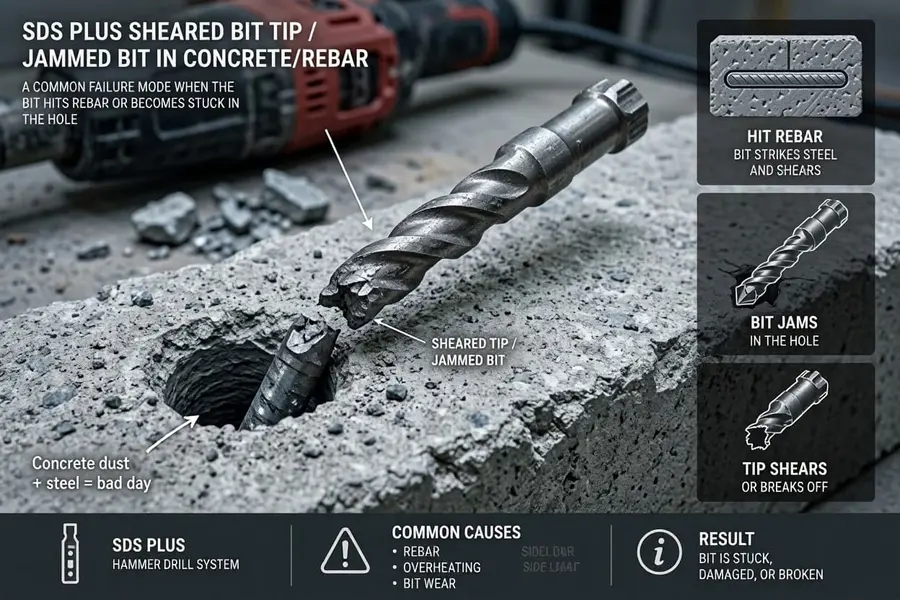
If you have ever spent a frustrating half-hour trying to drill anchor holes into high density UK engineering brick, reinforced concrete lintels, or aggressive aggregate, you know the sound. Suddenly you hear, a sudden clack, a kickback through the SDS drill, and a shank spinning freely with the tungsten tip sheared clean off in the wall.
Browse the 2-star and 3-star reviews on major trade retail sites for budget SDS drill bit sets, and you will see the exact same complaint repeated hundreds of times: “Snapping on the third hole,” “Tip disintegrated,” or “Jammed solid in rebar.”
Bit failure is rarely caused by a weak SDS drill motor or user error. It comes down to basic metallurgy, flute geometry, and the critical difference between standard 2-cutter masonry bits and heavy-duty 4-cutter full-carbide head bits.
This guide breaks down why standard SDS-Plus bits snap, how to clear debris efficiently, and the exact 4-cutter bits British tradespeople rely on for hassle-free drilling.
The Root Cause: Why 2-Cutter SDS Bits Fail
Standard budget SDS-Plus bits (including many unbranded multi-packs) use a traditional 2-cutter design. A flat tungsten carbide tip is brazed into a slot at the head of a steel shaft.
While 2-cutter bits work reasonably well in soft brick, breeze block, and low-density stone, they fail catastrophically in hardened concrete for three distinct physical reasons:
1. The Rebar Jam (Asymmetric Loading)
When a 2-cutter bit hits embedded steel rebar or ultra-hard flint aggregate, only one side of the flat carbide wing makes contact first. The drill continues rotating at high speed while the SDS hammer mechanism applies heavy kinetic impact.
This creates massive torsional shock. Because a 2-cutter bit lacks side support, the head twists violently, snapping the braze weld or shearing the steel tip at its thinnest point in the neck.
2. Flute Choking & Dust Compaction
In deep holes 100mm+, rapid dust accumulation generates immense heat. Standard dual-flute bits often lack optimised dust evacuation spirals.
When concrete dust backs up inside the hole, it compacts around the shaft. The bit heats up, softening the brazing alloy holding the carbide tip in place until the tip breaks loose.
3. Wandering & Out-of-Round Holes
Because 2-cutter bits pivot on a single central point, they naturally wander when hitting hard river pebbles embedded in UK concrete mix. This produces an oval hole rather than a precise round hole, rendering drop-in anchors or masonry screws unreliable.
The Solution: Solid Carbide 4-Cutter Bits
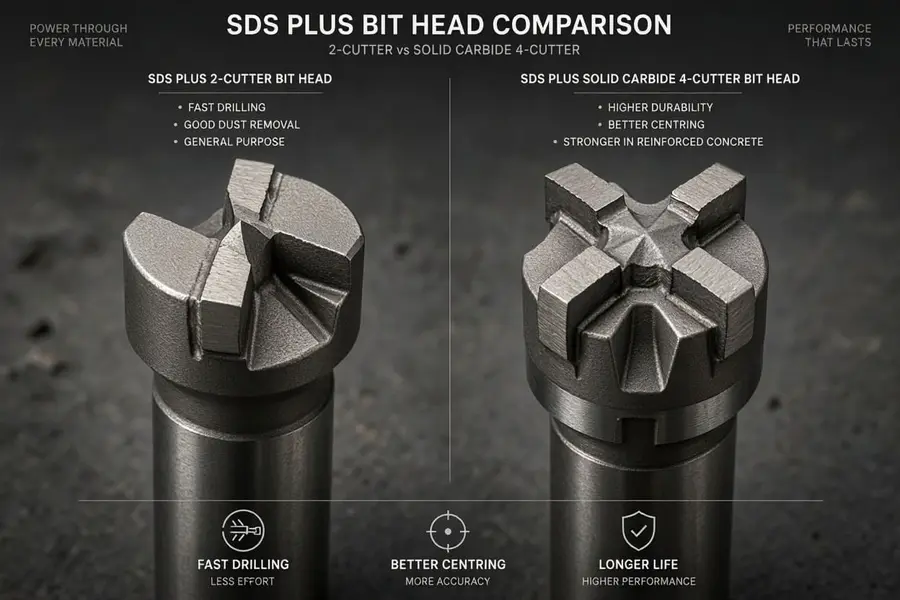
To eliminate bit snapping and bore clean, perfectly circular holes through reinforced concrete, trade professionals use 4-cutter (cross-head) SDS-Plus bits.
- 2 Cutter Head – Prone to catching rebar – Carbide – (Flat Wing Profile)
- 4 Cutter Head – Glides through obstacles – Carbide Cross – (4 cutting edges split the load)
Why 4-Cutter Geometry Prevents Snapping:
- Continuous 360-Degree Contact: A 4-cutter head features four distinct cutting edges arranged in a cross (+) or (X) shape. When hitting rebar, the load is distributed evenly across four contact points rather than slamming into a single flat wing.
- Rebar Gliding: Instead of catching and twisting, a solid 4-cutter head carves through rebar or deflects smoothly past hard aggregate without seizing the drill chuck.
- Quad-Flute Extraction: Professional 4-cutter bits feature four-spiral flute geometries designed to pump high-density dust out of the hole rapidly, keeping operating temperatures significantly lower.
The 3 Best 4-Cutter SDS-Plus Bits Used by UK Trades
When updating your tool kit, look for bits featuring a solid single-piece carbide head (not just four tiny teeth spot-welded onto a steel shaft).
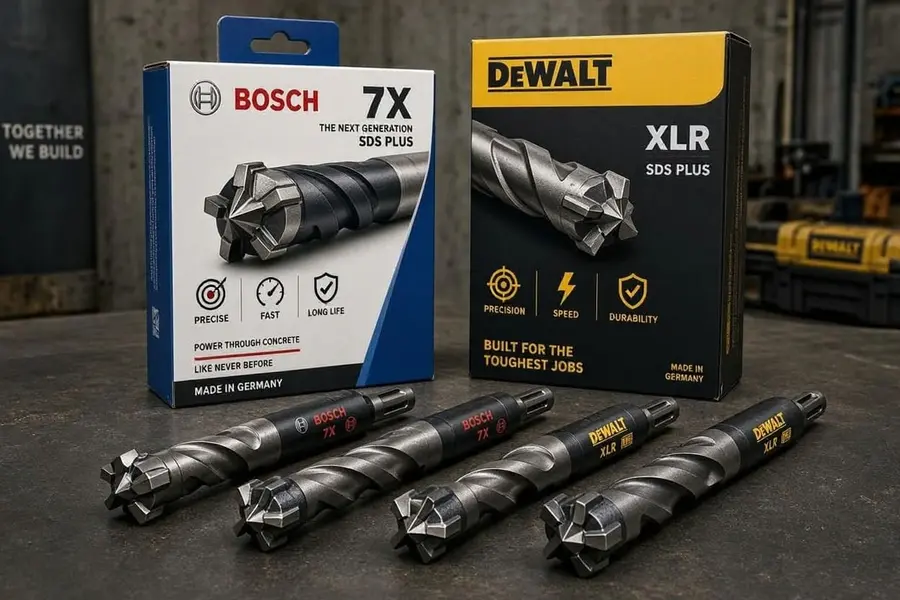
1. Bosch Expert SDS-Plus-7X (The Heavy-Duty King)
- Design: Solid full-carbide 4-cutter head using Bosch’s Indestructible Target Technology.
- Best For: Heavy reinforced concrete, lintels, and pre-stressed concrete floor beams.
- Trade Verdict: Outlasts standard 2-cutter bits up to 5 times when hitting steel rebar.
2. DeWalt XLR Full Carbide Head SDS-Plus Bits
- Design: Single solid piece of high-density carbide brazed to an optimized quad-flute steel body.
- Best For: Fast, clean fixing holes for heavy anchors, resin studs, and structural frame fixings.
- Trade Verdict: Exceptional dust removal speeds up installation when running dozens of holes in sequence.
3. Milwaukee MX4 4-Cutter SDS-Plus Bits
- Design: Target tip geometry with breaker points to pulverize aggregate before the main cutters pass through.
- Best For: On-site commercial installation work where drill jam kickback poses a safety hazard on ladders.
- Trade Verdict: Consistently drilled perfectly round holes, ensuring true expansion anchor grip every time.
Quick Reference: Matching Bit Tech to the Material
| Material / Application | Ideal Bit Type | Head Profile | Risk Level with 2-Cutter Bits |
| Soft Red Brick / Thermal Block | Standard SDS-Plus | 2-Cutter | 🟢 Low (2-cutter works fine) |
| Engineering Brick / Hard Sandstone | Premium SDS-Plus | 2-Cutter or 4-Cutter | 🟡 Medium (Speed drop, heat accumulation) |
| Poured Concrete / Lintels / Rebar | Solid Carbide SDS-Plus | 4-Cutter | 🔴 High (Frequent snapping, severe jam risk) |
| Victorian Hardened Mortar & Granite Aggregate | Solid Carbide SDS-Plus | 4-Cutter | 🔴 High (Oval holes, ruined fixings) |
Recommended Retailers & Where to Buy
When buying individual SDS-Plus sizes (such as standard 6mm, 8mm, and 10mm fixing bits) or trade multi-packs, stick to specialist UK trade merchants for genuine carbide stock:
- When drilling into reinforced concrete lintels, switching from a 2-cutter bit to a full solid-carbide head like the [Bosch EXPERT 7X 4-cutter SDS-Plus bit on Amazon] prevents the tip from binding or shearing off on rebar.
- If you prefer sourcing DeWalt, you can pick up individual sizes of the DeWalt XLR 4-cutter bit at Amazon UK
- For site work where bits are treated as consumables, grab multi-piece SDS-Plus bit sets at Amazon UK to keep your cost per hole down.
- When running cable or pipework through thick cavity walls, source specialized [long-reach 4-cutter SDS bits on eBay] to get the required 400mm+ working depth without paying premium trade counter list prices.”
About the Author: Enda McLarnon
I’m an experienced UK DIYer tackling renovation life inside a 1958 red brick home.
I built this blog to help beginners conquer home maintenance anxiety and save a fortune on expensive trade calls.