By Enda McLarnon — Experienced UK DIYer sharing practical fixes from my 1958 red brick home.
If you live in a typical UK home, you have probably experienced this exact frustration. You need to hang a heavy curtain rail above a window or bolt shelving brackets to an outside wall.
You put a brand-new masonry bit into your 18V combi drill, switch to hammer mode, lean your body weight into it, and the bit just sits there screaming, glowing red-hot, and barely scratching the surface.
When you hit hard 1950s red brick, dense engineering brick, or a reinforced concrete lintel, a standard combi drill simply reaches its mechanical limit. That is where an SDS drill takes over.
In this complete UK DIY guide, I break down how an SDS drill actually works, when you need one instead of a combi drill, and point you to our practical guides on bit fitments, chisel modes, and troubleshooting stubborn UK masonry.
1. What Is an SDS Drill (and Why Does It Hit So Much Harder)?
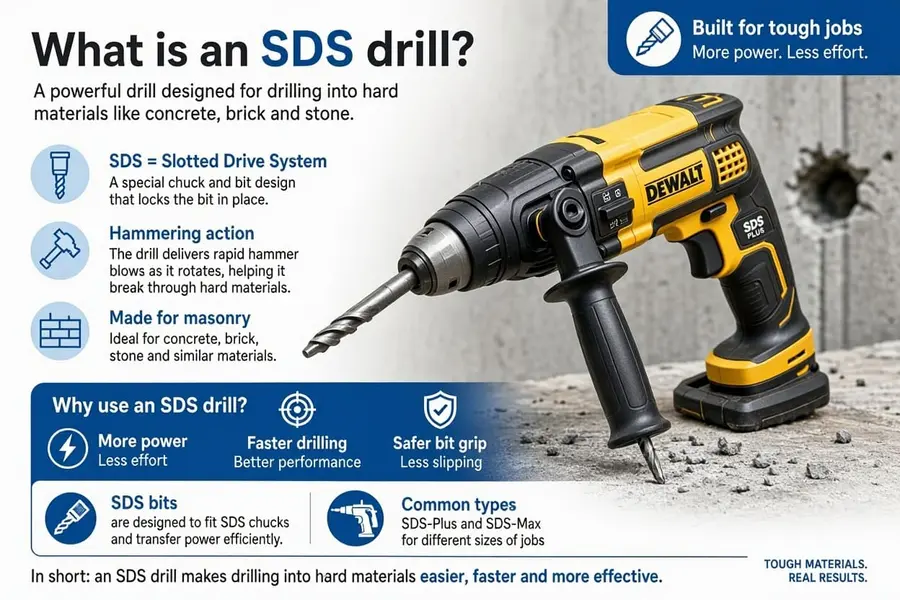
SDS stands for Slotted Drive System (originally developed by Bosch as Steck, Dreh, Sitz — Insert, Twist, Stay). Unlike a standard combi drill that tightens onto a smooth drill bit using three metal jaws, an SDS drill uses a specialised slotted chuck that locks onto grooves in the drill bit shank.
More importantly, the internal mechanism is completely different:
- How a Combi Drill Hammers: A combi drill uses two serrated metal discs (a mechanical ratchet) that rub against each other as the chuck spins. It produces thousands of tiny, rapid vibrations—which works fine for soft mortar or lightweight thermalite blocks, but relies entirely on how hard you push against the wall.
- How an SDS Drill Hammers: An SDS drill uses an electro-pneumatic piston (a miniature air hammer). As the motor turns, a piston compresses air to fire a heavy striker directly against the back of the drill bit, which slides back and forth slightly inside the slotted chuck.
Because the piston delivers genuine percussive impact energy (measured in Joules), the drill bit pulverises brick and concrete effortlessly—meaning you do not need to lean your body weight into the drill.
2. Combi Drill vs. SDS Drill: When Should You Switch?
You do not need to throw away your combi drill for wood, metal, plastic, plasterboard, and light masonry plugs in soft brick. A combi drill is lighter, more accurate, and far easier to control.
However, stepping up to an SDS Plus drill transforms tough UK masonry jobs from a 20-minute struggle into a 10-second breeze:
- Switch to an SDS Drill for: Concrete lintels above windows, hard clay/engineering bricks, stone walls, deep anchor bolts (M8–M16), core drilling through external walls for extractor fans, and removing old bathroom or kitchen tiles.
- Stick With Your Combi Drill for: Driving screws, drilling timber or steel, plasterboard fixings, and light 5mm–6mm wall plugs in softer brickwork.
Deep-Dive Comparisons & Masonry Troubleshooting:
- Weighing up whether to buy one? Read our full head-to-head: Combi Drill vs SDS Drill: When Do You Actually Need an SDS for Brick? (Insert URL)
- Stuck mid-job right now? Find out what’s blocking your bit in Why Won’t My Drill Go Into a Brick Wall? (Lintels, Engineering Brick & Bits) (Insert URL)
3. Understanding the 3 Modes on an SDS Plus Drill
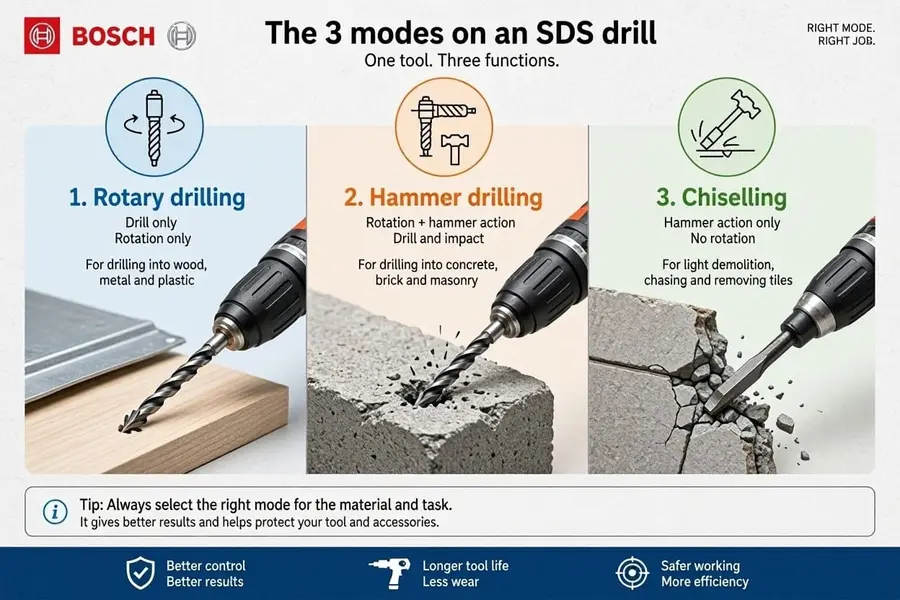
Almost every modern DIY-friendly SDS Plus drill features a large rotary dial on the side of the gearbox with three distinct symbols:
- Rotary Only (Drill Symbol): Turns off the hammering piston completely. Used with a chuck adapter for drilling wood or metal, or for mixing plaster/tile adhesive with a paddle.
- Rotary Hammer (Drill + Hammer Symbol): The main setting for masonry. Combines rotation with pneumatic hammering to bore cleanly through brick, block, and concrete.
- Chisel / Rotation-Stop (Hammer Symbol Only): Locks the chuck so it stops spinning while the piston continues hammering. Fitted with a flat or pointed chisel bit, this turns your drill into a light demolition tool for lifting floor tiles, chasing cables into plaster, or chipping away old mortar.
Using Chisel Mode Safely:
- Want to strip a bathroom wall or lift old kitchen tiles? Read our practical guide: How to Use Chisel Mode on an SDS Drill (Removing Tiles & Light Demolition) (Insert URL)
4. SDS Plus vs. SDS Max (and Bit Care Rules)
When shopping for drill bits or looking at tool specs, you will see two main size standards—and getting them mixed up is a common beginner mistake:
- SDS Plus (10mm Shank): The universal standard for UK DIY and general trade work. Easily handles masonry bits from 4mm up to 26mm, plus light chiselling.
- SDS Max (18mm Shank): A heavy-duty commercial standard designed for massive demolition breakers and structural concrete boring (30mm+ holes). Overkill for standard home maintenance.
One Golden Maintenance Rule: Grease Your Bits
Because an SDS drill bit slides back and forth inside the chuck dozens of times per second, running dry metal-on-metal creates friction and heat that wears out the internal rubber seals and locking balls. Always apply a small dab of SDS chuck grease to the slotted shank before inserting a bit.
Bit Fitment & Maintenance Guides:
- Confused by shank sizes and chuck adapters? Check out: SDS Plus vs SDS Max: Which Fitment Do You Need for Home DIY? (Insert URL)
- Protect your tool’s chuck from premature wear: Why You Must Grease SDS Drill Bits (And How to Do It Properly) (Insert URL)
5. Corded vs. Cordless SDS Drills for UK DIYers
Before looking at specific models, decide how you plan to use the tool around your home:
- Corded 240V SDS Drills: Usually offer higher impact energy (2.5J to 3.2J+) for under £80–£120. Because most heavy masonry drilling happens infrequently—such as fitting a garden tap, hanging a TV bracket, or lifting patio slabs—a corded model never suffers from flat batteries and delivers relentless power.
- Cordless 18V Brushless SDS Drills: Ideal if you already own 18V batteries (Makita LXT, DeWalt XR, Bosch Professional, Ryobi ONE+) and want complete freedom up a ladder, in the loft, or down at the bottom of the garden without trailing extension leads.
Ready to Compare the Best SDS Drills for UK Homes?
Now that you know how pneumatic hammering works and what features matter for British brickwork, head over to our curated product showroom to compare our top corded and cordless picks:
👉 4 Best SDS Plus Drills for UK DIYers (Corded & Cordless Picks) (Insert your affiliate page URL)
About the Author: Enda McLarnon
I’m an experienced UK DIYer tackling renovation life inside a 1958 red brick home.
I built this blog to help beginners conquer home maintenance anxiety and save a fortune on expensive trade calls.