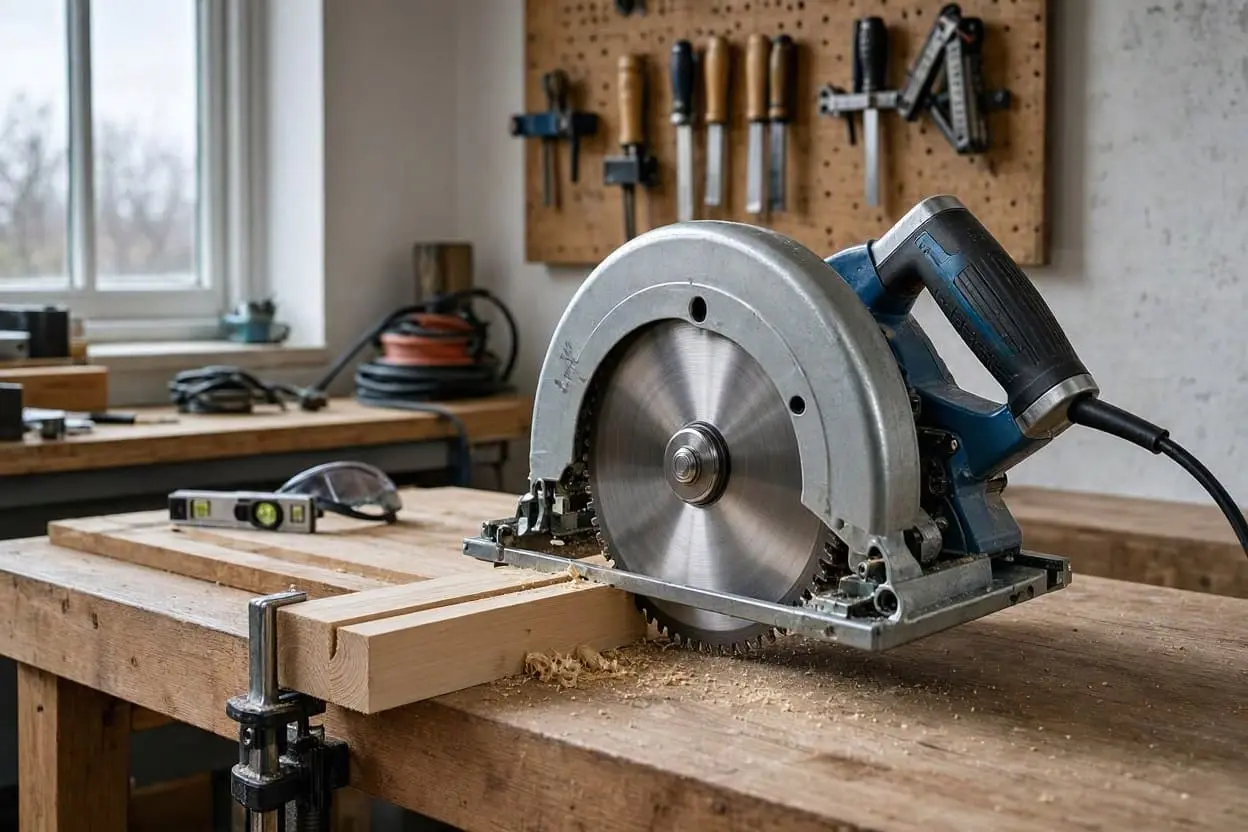
Finding the best budget circular saw UK DIY users can rely on doesn’t have to mean spending a fortune. There are affordable models available that can handle everyday jobs such as cutting timber, plywood and sheet materials.
A circular saw is a practical power tool for making long, straight cuts when building shelves, making simple furniture or cutting timber to size. However, cheaper models can differ in cutting capacity, ease of use, build quality and the features they include. Choosing the right one means looking beyond the initial price.
In this guide, I’ll look at budget-friendly circular saws available in the UK and compare what they offer for the money. I’ll explain the main features to consider, highlight the advantages and limitations of each option, and help you decide which saw is best suited to your DIY projects.
The aim is to help you find a circular saw that offers good value for money without paying for features you may never need.
Affiliate Disclosure: UKToolGuide may earn a commission if you buy a product through links in this article, at no extra cost to you. This helps support the website and allows us to continue providing practical DIY tool guides and advice.
You may also want to read my article on the best circular saw for DIY.
How to Choose the Best Budget Circular Saw UK
When choosing a budget circular saw, it’s worth looking beyond the price tag. The right saw should have enough cutting capacity and power for your projects, be comfortable to handle and include the features you’ll actually use.
Here are the main things to consider before buying.
Power and Motor Performance
For a corded circular saw, the motor’s power rating is measured in watts (W). Many DIY models fall within the 1,200W to 1,500W range, which can be suitable for everyday jobs involving timber, plywood and other sheet materials.
However, wattage alone doesn’t tell you how well a saw will perform. Blade quality, motor design, cutting depth and the material you’re cutting all make a difference.
If you mainly cut standard timber and plywood, you may not need a more powerful model. If you regularly work with thicker timber or hardwood, check the manufacturer’s specifications to make sure the saw is suitable for the job.
Blade Size and Cutting Depth
Circular saw blades are measured by their diameter, commonly 165mm or 184mm to 185mm on full-size DIY saws.
A larger blade can generally cut deeper, but the actual cutting depth depends on the saw’s design and the angle at which you’re cutting. Always check the manufacturer’s stated maximum cutting depth rather than relying on blade size alone.
For many everyday DIY projects, a 165mm circular saw has enough capacity for common timber sizes and sheet materials. A larger saw may be useful if you regularly need to cut thicker stock.
Remember that the blade must also be compatible with your saw, including its specified diameter, bore size and other manufacturer requirements.
Choosing the right blade can make a real difference to the quality of your cuts. See our guide to choosing the right circular saw blade for more advice on matching a blade to your material and DIY project.
Corded vs Cordless Circular Saws
Both corded and cordless circular saws can be good choices for DIY. The better option depends on where you work, how often you use the saw and your budget.
Corded circular saws
Advantages
- Usually cheaper to buy than a comparable cordless saw and battery kit.
- Provide a continuous power supply while connected to the mains.
- Suitable for longer sessions where access to a power socket is available.
Disadvantages
- The cable can restrict movement and needs to be kept clear of the cutting area.
- Less convenient when working outdoors or away from a suitable power supply.
Cordless circular saws
Advantages
- Offer greater freedom of movement around the workshop, garden or building site.
- Convenient when working away from a mains socket.
- May be a good-value option if you already own compatible batteries and a charger.
Disadvantages
- The initial cost can be higher, particularly if batteries and a charger are not included.
- Battery capacity and charging time affect how long you can work between charges.
- Performance varies between models and battery systems.
For a first circular saw on a tight budget, a corded model is often worth considering. If you already own batteries from a compatible tool range, a cordless saw may make more financial sense.
Additional Features to Consider
Budget circular saws can include useful features, although you shouldn’t pay extra for equipment you don’t need.
- Dust extraction: Some saws have a port for connecting a suitable dust extractor. This can help manage sawdust, although it won’t eliminate it completely.
- Laser guide: A laser projects a line onto the workpiece on some models. It can be helpful, but it isn’t essential; the saw’s built-in cut-line markings and a suitable guide can also help you make accurate cuts.
- Soft-grip handles: These may improve comfort and control, particularly during longer jobs.
- Cutting-depth adjustment: Makes it possible to set the blade depth to suit the material and the manufacturer’s instructions.
- Parallel guide: Helps you make repeated straight cuts at a consistent distance from an edge, although a separate straightedge or guide rail may be more suitable for some jobs.
When working to a restricted budget, prioritise a suitable cutting depth, reliable performance, good handling and essential safety features. Treat extras such as lasers as bonuses rather than reasons to choose one saw over another.
My Top Picks
When comparing the best budget circular saw UK options, consider more than the purchase price. Cutting depth, blade size, ease of adjustment and the materials you plan to cut all affect how useful a saw will be for your DIY projects.
To choose the best budget circular saw UK DIY projects require, compare the maximum cutting depth, blade size and ease of adjustment as well as the price.
Budget Circular Saw Comparison Table
| Circular saw | Motor power | Blade size | Max. cut at 90° | Main advantage |
|---|---|---|---|---|
| Evolution R185CCS | 1,600W | 185mm | 64mm | Versatile multi-material blade |
| HYCHIKA 185mm | 1,300W | 185mm | 65mm | Excellent value, based on my experience |
| Titan TTB874CSW | 1,200W | 165mm | 55mm | Low purchase price |
| Bosch PKS 55 | 1,200W | 160mm | 55mm | Established brand and straightforward adjustments |
Specifications are based on manufacturer or retailer listings. Always check the exact model and its current specifications before buying.
Which Budget Circular Saw Should You Choose?
- Best for versatility: Evolution R185CCS, particularly if you want a saw with a multi-material blade.
- Best based on my budget-saw experience: HYCHIKA 185mm, which I’ve found excellent value after fitting a better-quality blade.
- Best low-cost alternative: Titan TTB874CSW, worth considering if keeping the initial cost down is your priority.
- Best established-brand alternative: Bosch PKS 55, although its higher price makes it less suitable for a strict budget.
Prices and availability can change, so compare current UK retailer listings before making your decision.
1. Evolution R185CCS 185mm Circular Saw – Best Value for Money
My Thoughts
I’ve used the Evolution R185CCS on a number of DIY jobs. The saw belonged to my friend David, and we used it for cutting fencing and decking boards, as well as cutting studs and noggins when handling the timber.
What makes this model particularly useful is its multi-material blade, which is designed to cut wood and certain other materials, including wood containing embedded nails, when used in accordance with the manufacturer’s instructions. That versatility can be helpful when working with reclaimed timber or tackling outdoor projects where you may not know exactly what is embedded in the wood.
The R185CCS is a corded saw with a 1,600W motor and a 185mm blade. Its cutting capacity makes it suitable for a range of common DIY timber jobs, although you should always check the material thickness and support the workpiece properly before cutting.
Key Features
- Motor: 1,600W
- Blade diameter: 185mm
- Maximum cutting depth at 90°: 64mm
- Maximum cutting depth at 45°: 40mm
- Blade: Multi-material blade supplied with the saw
Who Is It Suitable For?
The Evolution R185CCS is worth considering if you want a versatile corded saw for jobs such as:
- Cutting fencing and decking boards
- Trimming timber to length
- Cutting suitable studs and noggins
- Working with timber that may contain embedded nails, using the correct blade and safe cutting practices
Is It Worth Buying?
The Evolution’s main advantage is its combination of cutting capacity and multi-material versatility. If you regularly work with fencing, decking or reclaimed timber, those features can be useful. If you mainly cut clean timber and plywood, a simpler saw may be sufficient.
Check Amazon UK for availability and price
2. Hychika Circular Saw – under £50
My Thoughts
I own the Hychika circular saw and think it offers excellent value for money. One change I made was to fit a better-quality blade, which is worth bearing in mind when considering my experience with the saw.
I’ve found the adjustments easy to use, and the saw is well aligned. It’s also light and comfortable to hold, which makes it a practical choice for everyday DIY work.
For someone who wants a straightforward circular saw without spending a large amount of money, those are useful qualities. Cutting performance depends on the blade fitted and the material being worked on, so I would recommend choosing a suitable, good-quality blade rather than judging the saw solely by the blade supplied.
Key Features
- Motor: 1,300W
- Blade diameter: 185mm
- No-load speed: 4,500rpm
- Maximum cutting depth at 90°: 65mm
- Maximum cutting depth at 45°: 45mm
- Dust extraction: Connection for a suitable vacuum or dust extractor
- Supplied blade: 24-tooth blade
- Other features: Adjustable cutting depth and angle, safety switch and parallel guide
Who Is It Suitable For?
Based on my experience, the Hychika is worth considering for DIY users who need a budget-friendly saw for jobs such as:
- Cutting timber to size
- Making straight cuts in suitable sheet materials
- General home and garden projects
- Occasional workshop jobs
Is It Worth Buying?
I think the Hychika offers excellent value, particularly if you want a basic circular saw and are prepared to invest in a suitable blade. My experience has been positive, especially regarding its adjustments, alignment and handling.
Before buying, check the exact model, supplied accessories, cutting capacity and current UK price. These details can vary between listings, and a budget saw is only a good deal if it meets the requirements of your intended projects.
Check Amazon UK for availability and price
3. Titan TTB874CSW 165mm Circular Saw – Best Low-Cost Option
My Thoughts
If you’re looking for a full-size circular saw without spending too much, the Titan TTB874CSW is worth considering. It’s a corded model designed for straightforward DIY cutting, making it an option for anyone who needs a saw for occasional jobs around the home or workshop.
The 1,200W motor and 165mm blade make it suitable for many everyday timber-cutting tasks. Its smaller blade also means it has less maximum cutting capacity than the 185mm Evolution and Hychika saws featured in this guide, so it’s important to check the cutting depth before buying.
One advantage of choosing a corded budget saw is that you don’t need to buy batteries or a charger. You simply need a suitable mains supply and enough room to work safely with the cable kept clear of the blade.
Key Features
- Motor: 1,200W
- Blade diameter: 165mm
- Maximum cutting depth at 90°: Approximately 55mm
- Power supply: 240V mains
- Warranty: Check the current retailer and manufacturer’s terms
Who Is It Suitable For?
The Titan TTB874CSW may suit DIY users who need an affordable saw for jobs such as:
- Cutting timber to length
- Making straight cuts in suitable sheet materials
- Preparing timber for shelving and simple furniture projects
- Tackling occasional home and garden DIY jobs
Is It Worth Buying?
The Titan is worth considering if keeping the initial cost down is your main priority. It offers a straightforward alternative to more expensive circular saws, although its cutting capacity is more limited than that of a typical 185mm model.
Before buying, check the current price, included blade, cutting-depth specification and guarantee. As with any budget saw, the best choice depends on whether its capabilities match the materials and sizes you plan to cut.
Check the current price of the Titan TTB874CSW at Screwfix
4. Bosch PKS 55 Circular Saw – Established Brand Option
My Thoughts
The Bosch PKS 55 is a corded circular saw aimed at DIY users who want a straightforward tool from an established manufacturer. It has a 1,200W motor and a 160mm blade, making it suitable for many everyday cutting jobs involving timber and wood-based sheet materials.
Its cutting depth is similar to that of other 165mm-class saws, so it can handle common DIY materials provided they fall within the saw’s specified capacity. It also has adjustable cutting depth and angle, a spindle lock for blade changes and a parallel guide to help with straight cuts.
Key Features
- Motor: 1,200W
- Blade diameter: 160mm
- Maximum cutting depth at 90°: 55mm
- Maximum cutting depth at 45°: 38mm
- No-load speed: 5,040–6,160rpm
- Power supply: 240V mains
Who Is It Suitable For?
The Bosch PKS 55 may suit DIY users working on projects such as:
- Cutting timber to length
- Making shelving and simple furniture
- Cutting suitable plywood and other wood-based sheet materials
- Making straight cuts with the supplied parallel guide
Is It Worth Buying?
The Bosch PKS 55 has useful adjustment features and a practical cutting capacity for general DIY. However, its current price puts it above the cheapest saws in this guide.
If you specifically want a Bosch saw, it may be worth considering. If your main priority is spending as little as possible, compare it carefully with the Evolution, Hychika and Titan before deciding.
Check the current price and included accessories before buying, as these can vary by retailer and model variant.
Tips for Safe and Accurate Circular Saw Use
A budget circular saw can be a useful addition to your DIY toolkit, but safe setup and good cutting technique are just as important as choosing the right model. Always read the manufacturer’s instructions before using a new saw.
Safety First
Follow these precautions whenever you’re using a circular saw:
- Wear suitable protective equipment: Use safety glasses or suitable eye protection, hearing protection and appropriate respiratory protection when cutting materials that generate hazardous dust. MDF, for example, can produce large amounts of fine dust.
- Secure the workpiece: Support the material properly and clamp it where appropriate so it cannot shift during cutting. Make sure the blade will not contact the workbench, supports or anything beneath the material.
- Keep the work area clear: Remove trip hazards and keep the power cable, where fitted, away from the cutting path.
- Check the saw before use: Inspect the blade, guards and power supply. Make sure the blade is suitable for the material and correctly fitted.
- Keep your hands clear: Hold the saw using its designated handles and keep your hands away from the blade’s path. Never reach underneath the workpiece while cutting.
- Wait for the blade to stop: Keep the saw under control after completing the cut. Do not put it down until the blade has stopped rotating.
Always follow the manufacturer’s instructions and use suitable safety precautions when operating a circular saw. The HSE’s woodworking safety guidance provides further information on working safely with woodworking equipment.
Tips for Accurate Cuts
- Measure carefully: Check your measurements before cutting, particularly when preparing several pieces of timber.
- Mark a clear cut line: Use a pencil and a suitable measuring tool. For long, straight cuts, a compatible guide rail or securely clamped straightedge can help.
- Set the cutting depth correctly: Follow the saw manufacturer’s instructions and make sure the blade has sufficient capacity for the material.
- Let the saw reach full speed: Start the saw as instructed and allow the blade to reach operating speed before entering the material.
- Guide the saw steadily: Keep the baseplate flat against the workpiece and follow the cut line without forcing the saw. Forcing the blade can lead to poor cuts and increase the risk of binding or kickback.
- Keep the guards working properly: Never disable or hold back the blade guard. If it does not operate correctly, stop and have the saw checked before using it again.
- Finish safely: Maintain control throughout the cut and keep the saw in position until the blade has stopped. Avoid twisting the saw or trying to pull a rotating blade back through a cut.
Good preparation makes cutting easier and can improve the finished result. If you’re new to circular saws, practise on suitable scrap timber and follow the instructions supplied with your particular model.
Final Thoughts: Choosing a Budget Circular Saw
You don’t have to spend a fortune to find a circular saw for everyday DIY. The key is to choose a model with enough cutting capacity for your projects, comfortable handling and the features you genuinely need.
Choosing the best budget circular saw UK DIY users can afford comes down to matching the saw’s cutting capacity, features and price to the jobs you need to do.
The Evolution R185CCS is worth considering if you want the versatility of a multi-material blade. The Hychika 185mm is a budget option that I’ve found excellent value, particularly after fitting a better-quality blade. The Titan TTB874CSW offers a lower-cost, full-size alternative, while the Bosch PKS 55 is worth comparing if you prefer an established brand and are willing to spend more.
Before buying, compare current UK prices, cutting depths, included blades and warranty terms. Remember that the cheapest saw isn’t necessarily the best value if it doesn’t suit the materials you need to cut.
Choose carefully, work safely and you’ll be better placed to find a circular saw that fits both your DIY plans and your budget.