
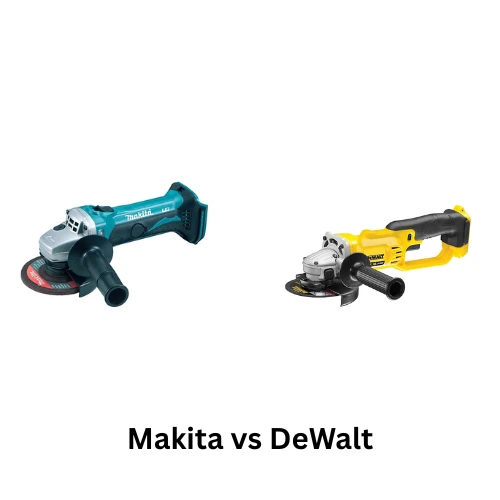
It’s one of the most important choice a UK tradesman faces when investing in their power tools: Makita blue or DeWalt yellow? This isn’t just about picking a colour; it’s about locking yourself into an entire 18V cordless ecosystem.
This is a decision that dictates your budget, performance potential, and versatility for the next decade. Getting it wrong means being stuck with a system that falls short on the job site, while getting it right means smoother workflow and higher productivity.
It really isn’t a simple popularity contest. This guide provides a definitive, data-driven comparison of these two industry giants across the most critical professional metrics:
- Raw power
- Battery innovation
- Ergonomics
- Tool range depth.
We cut through the marketing noise to show you which system offers the best long-term value and on-site performance. To provide a fair and relevant comparison, we’re focusing on the heart of the tradesman’s kit, the mid-to-high-range 18V Brushless Combi Drill.
Specifically, we’re pitting equivalent models, such as the widely popular Makita DHP484 against the rugged DeWalt DCD796, to see which brand truly deserves a permanent spot in your toolbox.
Core Specification Showdown: Head-to-Head Drill Specs
When comparing any two professional tools, the core specifications are your best starting line. While marketing teams focus on flashy features, a tradesman needs to know the hard numbers for torque, blows per minute (BPM), and physical dimensions.
For our benchmark, we’re analysing the key metrics of two equivalent, highly popular 18V brushless combi drills:
The Makita DHP484 and the DeWalt DCD796.
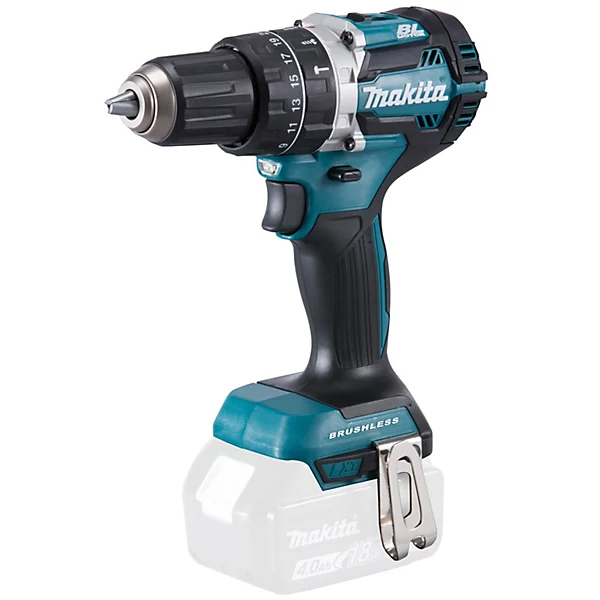 Makita DHP484 Cordless Drill | 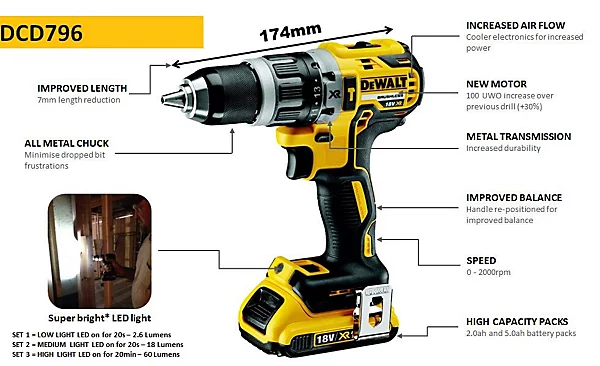 Dewalt DCD796 Cordless Drill |
|---|
The figures below reveal crucial differences in how each tool will perform under pressure on a typical UK job site.
Metric | Makita (DHP484/Equivalent) | DeWalt (DCD796/Equivalent) | Key takeaway |
|---|---|---|---|
Max Torque (Hard) | ~54 Nm | ~70 Nm | DeWalt wins on raw pulling power for heavy load. |
Max RPM (High Gear) | ~2,000 rpm | ~2,000 rpm | Top drilling speed is equivalent for both systems |
Max BPM (Hammer) | ~30,000 bpm | ~34,000 bpm | DeWalt has a slight advantage for faster masonry penetration. |
Weight (Body Only) | ~1.3 kg | ~1.1 kg | Makita is slightly heavier, DeWalt is noticeably lighter. |
Length (Head) | ~182 mm | ~173 mm | DeWalt is more compact—critical for working in cabinets or voids. |
Interpreting the Numbers
The key difference here lies in the balance between power and portability. The DeWalt DCD796 family is engineered for slightly more raw aggression, delivering a significantly higher maximum torque of 70 Nm.
This power jump makes a difference when driving large coach bolts or using sizable hole saws into dense materials, where the tool needs more rotational force to prevent stalling.
However, the Makita DHP484 balances this torque deficit with a focus on size and comfort. Although slightly heavier than the DCD796, it offers a proven, robust motor.
The most telling specification is the length of the head (the shortest distance from the chuck to the rear of the motor): DeWalt’s design is almost 10mm shorter, making it the clear winner for installers and fitters who frequently work in tight, enclosed spaces where every millimetre counts.In short, if your primary tasks involve constant heavy-duty drilling, the DeWalt’s higher torque and BPM offer a slight edge. If your priority is reduced fatigue and easier access in confined areas, the physical dimensions of the DeWalt unit are more advantageous.
The Ecosystem Decides: Battery and Tool Range
While the raw specs of a single drill are important, the true long-term decision for any professional is the battery ecosystem. This is Makita’s LXT versus DeWalt’s XR.
Committing to a platform means committing to its strengths, limitations, and future tool releases. This is where long-term value and on-site efficiency are ultimately decided.
A. Battery Technology and Management
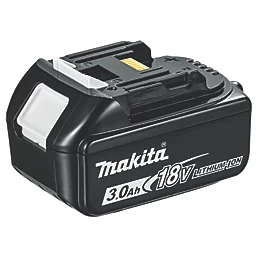
Comparison | Makita LXT | DeWalt XR | Key Difference |
|---|---|---|---|
Cooling/charging | Uses a chip in the battery that communicates thermal and charge status to the charger, minimizing heat. | Relies heavily on vented chargers and sometimes finned battery packs for heat dissipation. | Makita’s management system is often cited as more proactive in extending battery life. |
Run Time | Excellent, consistent run time across the range. | Excellent, often delivering high peak power for heavy draws. | Both are leaders, but DeWalt is often engineered for high-wattage draws (e.g., large grinders) while Makita balances run time and longevity. |
Security and Housing | Highly durable housing with a focus on internal cell protection. | Often features rugged, over-moulded rubber bumpers for superior impact resistance on site. | DeWalt batteries tend to handle drops and harsh physical site environments slightly better. |
Both Makita and DeWalt use modern 18V lithium-ion technology, but their approach to run time, cooling, and charging differs significantly.
The consensus among tradesmen is that the Makita LXT system often excels in battery longevity over years of use due to its sophisticated, fan-assisted cooling chargers and proactive battery management system (BMS).
However, the DeWalt XR system provides incredible peak power output, essential for their larger, heavy-duty site equipment like high-torque impact wrenches or 54V FlexVolt conversion tools.
B. Depth of Tool Range (The LXT vs. XR Catalogue)
Once you commit to a battery platform, you gain access to its catalogue. This factor alone may swing the decision based on your trade specialty.
- Makita’s Strength:Sheer Volume and Niche Tools. The LXT platform boasts one of the largest 18V tool selections globally. Makita excels in specialist and finishing tools, offering items like specific vacuums, planers, coffee makers, and a vast range of smaller landscaping equipment. If your work involves a lot of second-fix carpentry, decorating, or if you need a specific, high-end finishing tool, Makita likely has a battery-powered solution.
- DeWalt’s Strength: Heavy Site Tools and Innovation. The XR platform, particularly with the optional FlexVolt system (which uses 54V/18V convertible batteries), is renowned for its heavy-duty site equipment. Tools like powerful circular saws, SDS-Max hammers, and heavy-duty cut-off saws often draw huge power. DeWalt targets the general builder and structural carpenter who need extreme power delivery for challenging, high-demand tasks.
The choice here comes down to your work profile: Do you need the widest possible range of specialist LXT tools (Makita), or do you need the highest possible power and ruggedness for the toughest jobs (DeWalt)?
Job Site Factors: Ergonomics, Durability, and Warranty
Beyond the numbers for torque and RPM, the final decision often comes down to the intangible elements For example, how the tool feels in your hand after eight hours, how well it handles being dropped, and what protection the manufacturer offers if the worst happens.
These job site factors can drastically affect fatigue and long-term cost of ownership.
Ergonomics and User Comfort
Ergonomics isn’t a luxury; it’s a necessity for preventing strain injuries and minimizing fatigue.
- Makita’s Philosophy (LXT): Makita generally favors a slimmer, contoured body design with a distinctly soft rubber overmoulding. Tradesmen often find that the LXT grip sits more comfortably in smaller hands and reduces hand fatigue during continuous, repetitive tasks like drywall screwing or light assembly. The trigger pull is also consistently noted as being smooth and progressive.
- DeWalt’s Philosophy (XR): DeWalt’s design leans towards a chunkier, more robust handle with a textured, slightly harder rubber grip. This design excels when you need a firm, non-slip grip under sweaty or gloved conditions. The weight distribution often feels heavier at the base, giving a solid, planted feel during high-torque applications.
Verdict on Comfort: Makita often wins on pure comfort and soft-touch feel, while DeWalt wins on security and heavy-duty grip under difficult conditions.
Durability and Ruggedness
Job sites are messy and tools are dropped. Durability relates both to the internal components (like dust sealing) and the external housing.
- Dust Sealing: Both brands feature brushless motors that inherently reduce maintenance, but Makita is often praised for its superior Extreme Protection Technology (XPT) on select models, designed to actively resist dust and moisture infiltration, which is vital for tool longevity in dusty environments like concrete cutting or grinding.
- Physical Resilience: DeWalt tools, particularly the batteries and casings, are generally perceived as having a slight edge in pure ruggedness and impact absorption. The thick, high-density yellow plastic and strategic rubber bumpers seem engineered to better withstand accidental drops from heights.
Warranty and Support (UK Focused)
Protection after purchase is critical. Both brands offer similar baseline coverage but differ in the registration requirements:
- Makita Warranty: Offers a standard 3-year limited warranty on tools (body only) and a 2-year warranty on batteries. You must register the tool online within 30 days of purchase to activate the full 3 years.
- DeWalt Warranty: Also offers a 3-year limited warranty on tools and a standard 1-year warranty on batteries. Like Makita, registration is mandatory and must be completed online, typically within 28 days.
The Key Takeaway: DeWalt offers superior physical impact protection and brute-force power, while Makita counters with an edge in dust/moisture resistance (XPT) and a longer standard warranty on its high-cost batteries.
The Final Verdict: Choosing Your Champion
Choosing between the Makita and DeWalt 18V ecosystems isn’t about finding a single “better” drill; it’s about selecting the platform that best supports your trade, your work style, and your future tool investments.
Based on the analysis of raw power, ecosystem depth, and job site factors, here are our scenario-based recommendations for UK tradesmen:
Winner for General Builders & Heavy-Duty Use: DeWalt XR
For the tradesman who routinely tackles heavy-duty framing, large-diameter drilling, and site work involving masonry or concrete, DeWalt is the clear choice.
Why: Its higher Max Torque (~70 Nm) and Max BPM (~34,000) provide the necessary brute force to push through tough materials without bogging down.
Furthermore, DeWalt’s integration with the FlexVolt 54V system allows for seamless transition to high-draw tools like table saws and angle grinders, offering unmatched power versatility on a single battery platform.
The rugged, impact-resistant housing also handles the punishment of a typical building site better.
Winner for Installers, Finishers, & Specialists: Makita LXT
For second-fix carpenters, kitchen fitters, electricians, and plumbers whose work demands versatility, finesse, and access to a wide array of specialist tools, Makita takes the lead.
Why: While slightly lower on peak power, Makita’s massive LXT tool range includes niche solutions (specific finishing sanders, compact vacuums, quiet drivers) that the competition often misses.
The slightly greater focus on dust/moisture resistance (XPT) and a longer 2-year battery warranty translate to better long-term reliability for costly battery packs.
Crucially, the more compact head length of DeWalt (DCD796) gives it a physical advantage in tight installation spaces.
Winner for Budget and Long-Term Value
Assessing “value” is tough as prices fluctuate, but generally:
- Entry Kits: Makita often offers a slightly more aggressive entry point for its standard combi drill kits, making it a good choice for apprentices or those building a kit slowly.
- Long-Term Battery Cost: Makita’s 2-year battery warranty offers a greater hedge against the single most expensive replacement component in the entire cordless system.
Making the right purchase is just the first step. To ensure your new tool system, whether blue or yellow, lasts for years, don’t miss our definitive guide on safety and maintenance:
The Essential Guide to Power Tool Safety, Care, and Long-Term Maintenance