
Why Finding a Stud Is Important?
If you are putting up a heavy flat screen TV, installing new cabinets, or anchoring a bookshelf, you need to be sure that you are attaching it to a structural framing (the stud).
Drilling into plasterboard does not support significant weight. More importantly, drilling can risk striking water pipes or electrical wiring. That can be a pretty big and costly mistake.
Stud finders are simple tools designed to locate these structural elements and hazards beneath the surface.
The choice comes down to two one of two types: Magnetic (simple and reliable) and Electronic (advanced and feature-rich). We will explain both of these below.
The Magnetic Stud Finder: Simple Reliability

Magnetic stud finders are the original, low-tech solution. They don’t use batteries, require no calibration, and are incredibly reliable for their specific function.
2.1 How They Work
A magnetic stud finder contains a small, powerful magnet that detects the presence of ferrous metal. That is usually nails or screws used to attach the drywall (plasterboard) to the wooden stud behind it.
When the magnet finds a fastener, it simply sticks to the wall.
2.2 Pros and Cons
Pros
- Highly Reliable: Simple physics, so there are virtually no false positives.
- No Batteries: Always ready to go, regardless of storage time.
- Affordable: Often costs less than £10
Cons
- Slow: Requires careful, slow scanning to locate single fasteners.
- Only Finds Metal: Cannot detect PEX pipes, plastic wiring conduit, or the edge of the wood stud itself.
- Doesn’t Mark the Centre: It finds the fastener, which is rarely the perfect centre of the stud.
Tip: Keep a magnetic finder in your tool bag as a reliable backup. Use it to confirm the location found by an electronic unit
The Electronic Stud Finder: Speed and Features
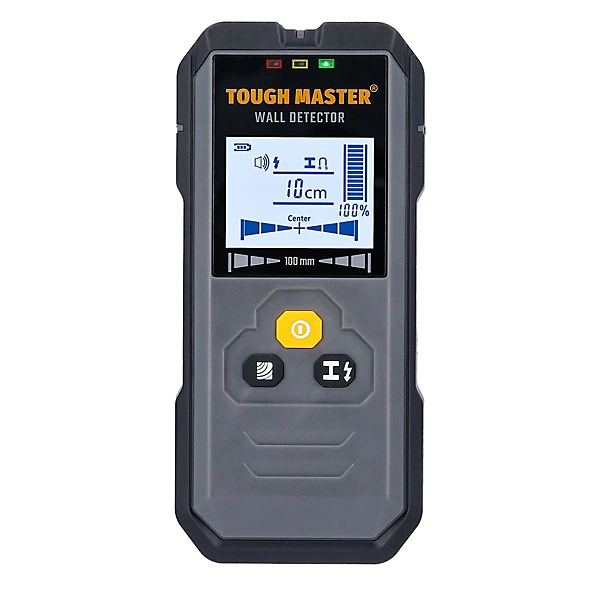
Electronic stud finders are the modern standard. They use capacitance to scan the wall. They are much faster and offer essential features like wire and pipe detection.
3.1 How They Work
Electronic finders, also called capacitance finders, measure the wall’s dielectric constant (a measure of how well a material resists the flow of electricity).
- The device emits a weak electrical field into the wall.
- Drywall/Plasterboard has a consistent dielectric constant.
- When the device passes over a dense object (like a solid wood stud), the constant changes, and the finder’s sensor registers this shift.
- The change is displayed via a light or sound, indicating the edge of the stud.
3.2 Key Types of Electronic Finders
Type | Detection Method | Max Depth |
|---|---|---|
Edge Finder (Most Common) | Detects the change in density at the edges of the stud. | Up to 19mm, (3/4-inch) depth. |
Centre Finding | Uses multiple sensors to map both edges and calculate the precise centre. | Up to 38mm, (1.5-inch) depth. |
Deep Scan | Advanced modes that can detect objects through thicker materials or multiple layers of plasterboard. | Up to50mm, (2-inch) depth. |
3.3 The Crucial Calibration Step
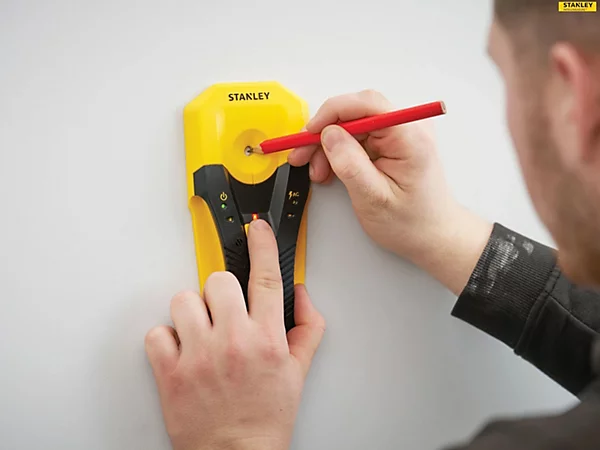
Electronic stud finders must be calibrated before each use.
- Place the finder flat against the wall.
- Press and hold the power/scan button.
- The device measures the baseline density of that exact spot (the empty wall).
- If you calibrate directly over a stud, the tool will incorrectly assume the stud is the ’empty wall’ and won’t detect it when you scan! Always calibrate over an area of the wall that you best know is clear.
Essential Safety Feature: AC Wire Detection
This feature alone justifies the cost of an electronic model. AC (Alternating Current) detection uses sensors to pick up the electromagnetic field surrounding active electrical wires.
- Benefit: The tool will illuminate a warning light AC WARN or similar) even if the wire isn’t directly next to a stud.
- Warning: This detection works best for live (active) wires. If the circuit is off, the electromagnetic field is gone, and the detector will likely not find it. Always turn off power if you are cutting into the wall, even after scanning.
Which Finder is Right for Your Project?
Scenario | Recommended Type | Reason |
|---|---|---|
Hanging Pictures (Light Weight) | Magnetic | Quick, easy confirmation of a fastener for light loads. |
Installing Cabinets or TVs (Heavy Loads) | Electronic (Center-Finding) | Absolute precision needed to find the exact center of the stud for maximum anchoring strength. |
Scanning Before Cutting/Drilling | Electronic (with AC detection) | The built-in wire warning is essential for safety, even if you don’t hit a stud. |
Old House with Lath and Plaster | Magnetic | Lath and plaster walls often confuse electronic finders due to inconsistent density. A strong magnet can reliably find the old metal fasteners. |
Summary
Choosing the right stud finder is one of the easiest ways to move from novice to confident DIYer. While a magnetic finder is a reliable low-cost tool, the electronic stud finder’s speed, precision, and vital AC wire detection make it the mandatory choice for any serious renovation work.
For a full list of essential skills, tools, and guides to ensure your project goes smoothly from start to finish, head back to our main resource: the DIY Home Renovation Essentials guide.