
Welcome, DIYers! When it comes to starting any type of a project that involves cutting, a circular saw is a powerful and really useful tool.
But if you’ve started looking, you’ll quickly notice they come in a range of sizes. What’s the difference, and more importantly, which one is right for your projects?

This guide will explain circular saw sizes in the UK, covering both the powerful standard models and the handy mini saws. We’ll explain common blade diameters, what they mean for your projects, and which tool to choose based on your needs.Let’s get cutting!
The Quick Answer: Key Differences at a Glance
| Mini Circular Saw | Standard Circular Saw |
|---|---|---|
Common Blade Sizes | 85mm-115mm (3-3/8″ – 4.5″) | 65mm – 235mm (6-1/2″ – 9-1/4″) |
Max Cut Depth | Shallow (approx. 20mm to 40mm) | Deep (approx. 50mm to 80mm+) |
Weight & Handling | Lightweight & compact | Heavier & more powerful |
Ideal For… | Laminate flooring, plywood, small planks, trimming | Cutting thick timber, sheet materials, decking |
Best For Beginners? | Often easier to handle & safer for small jobs | More powerful but can be intimidating for novices |
What Circular Saw Sizes Actually Mean (And Why it Matters)

Comparison of my standard circular saw and my mini circular saw.
The size of a circular saw is actually defined by the diameter of its blade. This is the single most important factor that determines two things:
- Maximum Cutting Depth: The larger the blade, the deeper the cut you can make. This is the main reason to choose a larger saw.
- Tool Weight & Power: Larger blades require bigger, more powerful motors and housings, making the saw heavier.
Let’s explore the common sizes you’ll find in UK DIY shops.
Mini Circular Saws: The Small But Mighty Option
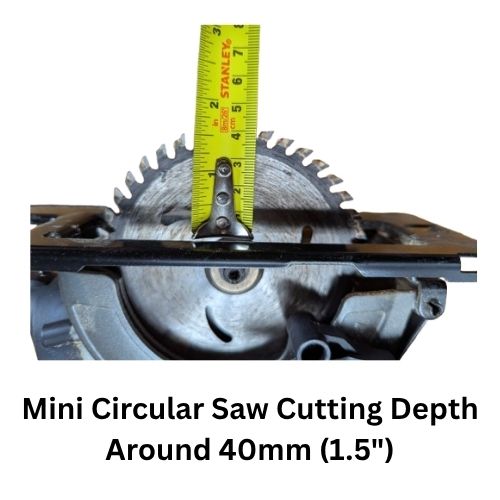
Image of me measuring the actual cutting depth of my mini circular saw
Mini circular saws have surged in popularity in the UK. This is especially true for beginners and those with who are working on smaller, lighter projects.
Mini circular saws have surged in popularity in the UK. This is especially true for beginners and those with who are working on smaller, lighter projects.
Common Blade Sizes:
- 85mm (3-3/8″)
- 115mm (4-1/2″)
Maximum Cutting Depth:
- Typically from 20mm to 40mm (approx. 3/4″ to 1-1/2″).
What They’re Best For:
- Cutting laminate flooring, vinyl, cutting sheet materials, like plywood, trimming doors or MDF up to 18mm.
- Trimming thin timber planks.
- Quick, straight cuts where a large saw would be too cumbersome.
Why a Mini Saw Might Be Right for You:
- Lightweight & Easy to Handle: Great for working overhead or in tight spaces.
- More Beginner-Friendly: Still very powerful, but less intimidating than a full-size saw.
- Excellent for Thin Materials: Provides clean, precise cuts without the risk of splintering or overpowering the material.
- Cordless Options: Many models are cordless, offering great portability.
Standard Circular Saws: The Traditional Workhorse
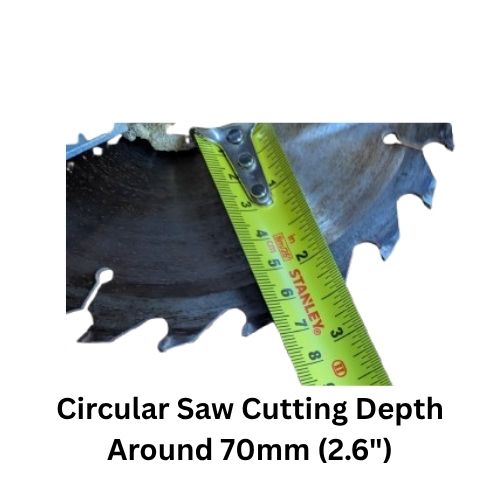
Image of me measuring the actual cutting depth of my standard circular saw
These are the saws you are probably more familiar with. They are designed for power, speed, and cutting through thicker materials.
Common Blade Sizes:
- 165mm (6-1/2″) – A popular choice for general DIY. A good balance of size and cutting depth.
- 184mm (7-1/4″) – The most common size in the UK and worldwide. A real workhorse.
- 190mm (7-1/2″)
- 235mm (9-1/4″) – A heavy-duty saw for professionals or serious DIYers cutting very thick timber.
Maximum Cutting Depth:
- Typically from 50mm to 80mm+ (approx. 2″ to 3″+).
What They’re Best For:
- Cutting thick structural timber (e.g., 2x4s, 4x2s).
- Cutting sheets of plywood or MDF up to 25mm thick.
- Decking and other outdoor construction projects.
- Making long, deep, straight cuts quickly and efficiently.
Why a Standard Saw Might Be Right for You:
- Raw Power: Handles tough, thick materials with ease.
- Versatility: With the right blade, it can cut wood, plastic, and even metal.
- Deep Cuts: Essential if you’re working with anything over 40mm thick.
- Precision: Can be used with a rip fence or a straight edge guide for very accurate cuts.
Cut Depth: The Most Important Number to Look For
While the blade size gives you a good idea, the actual maximum cutting depth is the specification to focus on.
When a saw is set to a 90° angle (used for a straight cut), the maximum cut depth is less than the blade’s full radius. This is because the saw’s body and baseplate prevent the blade from going all the way down.
Example: A standard circular saw with a 184mm (7-1/4″) blade might have a maximum cut depth of around 65mm (2-1/2″). This is a perfect depth for cutting through standard 2-inch thick timber with some room to spare.
Always check the product specifications for the exact cutting depth at both 90° and 45° (for bevel cuts).
Which Size Should You Choose?
Choose a Mini Circular Saw if:
- Your projects are mainly small to medium-sized (e.g., cutting laminate, trimming small pieces of wood).
- You prefer a lightweight, easy-to-handle tool.
- Your budget is a key consideration.
- You’re a beginner looking for a less intimidating way to start.
Choose a Standard Size Circular Saw if:
- You’re cutting thicker timber (over 40mm).
- You’re working on bigger projects like building decking or sheds.
- You need power and speed for long, continuous cuts.
- You’re comfortable with a larger, heavier tool.
For many DIYers, having both is the ultimate solution, but if you’re starting out, a standard 165mm or 184mm saw is a fantastic all-rounder for most home projects.
We hope this guide has helped you understand the different sizes and which saw will be the perfect addition to your DIY tool kit.
What’s your next cutting project? Let us know in the comments below!