
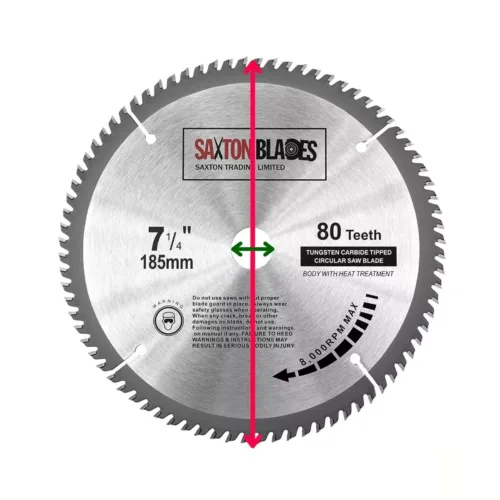
Choosing a circular saw blade in the UK is a bit of a minefield. You have to juggle metric diameters, different bore holes, and “kerf” widths.
In my 50 years in the workshop, I’ve seen many beginners buy a blade that looks right, only to find it won’t fit the spindle or it’s too thick for their cordless saw to turn.This guide will show you exactly how to read a blade’s markings and find the perfect match for your specific saw.
Step 1: Read the “Secret Code” on your Blade
Before you go to the shop to get a new blade, look at your current blade. There are three numbers you need.
Always check the blade itself before buying. The three most important numbers are etched right there on the steel.
The “Big Three” Measurements Explained
When you’re looking for a blade, you’ll see a string of numbers like 184mm x 16mm x 24T. Here is how to read them:
- Diameter (e.g., 165mm, 184mm, 190mm): This is the total width of the blade. You cannot upsize here. If your saw takes a 165mm blade, a 190mm blade simply won’t fit under the guard.
- Bore Size (e.g., 16mm, 20mm, 30mm): This is the hole in the middle. In the UK, 20mm and 30mm are most common for cordless and corded saws.
- Tooth Count (The ‘T’): This isn’t about size, it’s about finish. 24T is for “ripping” (fast, rough cuts); 40T+ is for “cross-cutting” (neat, clean finishes on skirting or furniture).
Enda’s Tip: In my experience, picking the right diameter and bore size ensures the blade will fit your saw. Always best to bring an old blade with you just to be sure. After that, it’s just the tooth count as explained above.
Step 2. Find Your Saw Category
There are three main categories of circular saw:
- The mini circular saw, also known as a compact saw in the UK
- The standard circular saw, probably the most common with the trades.
- Heavy duty circular saws mainly used by construction trades.
Group A: Mini & Compact Saws
- Best for: Trimming laminate, plywood, and thin sheets.
Saw Model | Blade Diameter | Bore Size |
|---|---|---|
Worx Handycut | 85mm | 10mm |
Bosch UniversalCirc 12 | 85mm | 15mm |
Worx WX427 | 120m | 9.5m |
Dremel Saw-Max | 75mm | 11mm |
Note: Notice the smaller blade size and these sizes vary by brand.
Group B: Standard Cordless Saws (The 18V Favorites)
These are the saws used for 90% of home DIY, such as decking, stud walls, and kitchen fitting. You can also buy these as a UK mains option. In the UK, the 20mm bore is the “Gold Standard” for this category.
- Best for: 2×4 timber, decking, and general DIY.
Saw Model | Blade Diameter | Bore Size | Enda’s Pro Tip |
|---|---|---|---|
Makita DSS611 / DSS610 | 165mm | 20mm | The UK’s most common cordless size |
DeWalt DCS391 | 165mm | 20mm | Always use “Thin Kerf” to save your battery. |
Ryobi One+ (R18CS) | 165mm | 16mm* | Watch out: Ryobi often uses 16mm, not 20mm! |
Milwaukee M18 CCS55 | 165mm | 15.87mm (5/8″) | Uses the American standard “Diamond” bore. |
DeWalt DCS570 / DCS575 | 184mm | 16mm | A larger “High-Torque” cordless size. |
Note: The blade sizes also vary by brand, but 165mm is really popular in the UK.
Group C: Corded & Heavy-Duty Saws (The Site Standards)
If you have a saw with a “tail” (a plug), you likely have a much larger motor. These saws require larger diameters to cut through thicker timber in a single pass. In the UK, 190mm is the standard size for a professional-grade handheld corded saw.
Saw Model | Blade Diameter | Bore Size | Enda’s Pro Tip |
|---|---|---|---|
Makita HS7601J / HS7100 | 190mm | 30mm | One of the UK’s top-selling corded saws. |
Bosch GKS 190 | 190mm | 30mm | Great power, but requires a 30mm bore blade. |
DeWalt DWE575 / DWE576 | 190mm | 30mm | Rugged site saw; very common on UK builds |
Evolution R185CCS (Multi-Material) | 185mm | 20mm | Warning: Evolution uses a unique 20mm bore! |
Large Table Saws (Various) | 250mm – 315mm | 30mm | Always check the “Maximum RPM” of these blades. |
If you own one of these popular UK saws, these are the standard sizes of blades you’ll likely need:
Saw Type | Popular Models | Standard Blade Size |
|---|---|---|
Compact Cordless | Makita DSS611 / DeWalt DCS391 | 165mm x 20mm |
Standard Corded | Makita HS7601J / Bosch GKS 190 | 190mm x 30mm |
Large Site Saws | DeWalt DWE575 | 184mm x 16mm |
Enda’s Warning: Always check your specific manual! Some older Bosch saws use a 16mm bore, while newer ones use 30mm. Don’t guess, always measure.
Step 3: What if the “Bore” is Wrong?
If you find a blade you love but the center hole (bore) is too big for your saw, you can use a Reduction Ring.

The Rule: You can use a ring to make a 30mm hole fit a 20mm spindle.
- The Danger: Never use a blade where the hole is smaller than your spindle. Never “file it out” to make it fit.
Cutting Depth Explained
One other very important consideration is to understand the cutting depth of any circular saw blade. We explain that in more detail below.
The cutting depth will change slightly depending on the bore size of the blade. The larger the bore size, the smaller depth it will cut. Manufacturers use different size bores on their blades.
The sizes we have used below are averages. It is also worth knowing that larger sized blades have large sized bores.
Blade Diameter | Typical Max Cutting Depth | Will it cut a 47mm (2″) joist? | Enda’s Note |
|---|---|---|---|
85mm (Mini) | ~25mm | No | Great for flooring and 12mm plywood only. |
115mm (Mini) | ~38mm | No | Perfect for 18mm-25mm sheet materials. |
165mm (Standard) | ~54mm | Yes | The “Sweet Spot” for UK stud work and decking. |
190mm (Corded) | ~66mm | Yes | Easily handles 2-inch timber with room to spare. |
Enda’s Final Tip: Thin Kerf vs Standard
If you are using a cordless saw, always look for the words “Thin Kerf” on the pack. These blades are slightly thinner. Because they remove less wood, the motor doesn’t have to work as hard, and your battery will last much longer.
Hopefully you are better informed about circular saw blade sizes. They range in sizes from 115-355 mm with bore sizes ranging from 16-30mm. The circular saw that you own determines the appropriate blade size. You can always fit a smaller blade to a larger saw, but not the other way around.
How to Choose the Right Blade
- Check your saw’s manual or existing blade for size specs
- Match diameter and bore exactly
- Choose tooth count based on material:
- Low TPI (10–24): Fast cuts in wood
- High TPI (40+): Smooth cuts in laminate, MDF, or plastic
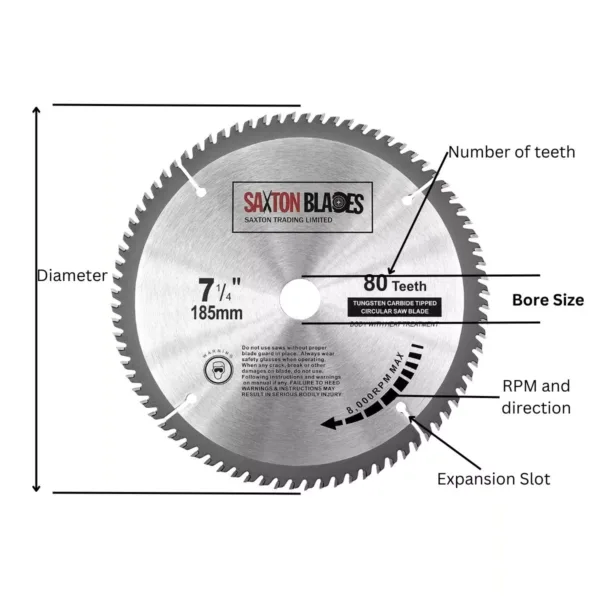
Just below you can see an image of a circular saw blade showing the most important buying considerations. Those include the blade diameter (size), the bore size, the number of teeth and the direction in which the blade should be fitted.

Here are a few important things to consider and we have listed those below:
- What material are you cutting? – For most people this will be wood. However different types of blades are available that allow you to cut metal, plastic, non-ferrous and composite materials
- The depth of cut – This is the next really important selection criteria. The depth a blade can cut depends on the size of the blade. Blades are measured by their diameter. To calculate the cutting depth subtract the bore size from the blade size and divide by 2.
- The bore size – This is the hole size in the centre of the blade. It can be made smaller using reduction rings
- Number of teeth – the more teeth the finer the cut will be
- Blade thickness – measured in millimetres and the thinner the blade the finer the cut.
- Tooth design – This varies depending on the material you want to cut. The gullet is the space between the teeth and the larger this gap the faster the cut will be. Likewise the blade and teeth tip material will also depend on the material being cut
- Expansion Slot – This allows the blade to expand as it starts to heat up
Blade size affects everything from cut depth to finish quality. Whether you’re trimming laminate or ripping timber, choosing the right blade ensures clean results and safe operation. Always check your saw’s specs before buying—and don’t forget to match the bore.
About the Author
Want more cutting tips and blade comparisons? Check out:
This guide was awesome and super helpful.Many thanks ?.
Thanks Leah glad it was helpful